
Ginkaku-ji

for Shelagh Keeley
It was a sunny winter day in Kyoto. I was approaching my third temple since breakfast, the Silver Pavilion, about which I knew nothing besides its Japanese name: Ginkaku-ji. For reference, I took a picture of the large map at the entrance and walked through the gate, turned right, then headed down a long corridor of hedges rising above stone walls. Turning left at the end, I came to a wicket where I handed a 500-yen coin to a clerk behind glass. With an affecting smile that made me smile back, he handed me a strip of paper through the aperture and said something unintelligible.
The paper was covered in black calligraphy with two big stamps in red. Large for an admission ticket, I thought. When I proceeded through the second gate to enter the garden, there was no one to take it. I looked at it again and remembered a similar paper I’d been given earlier at the Golden Pavilion where it also hadn’t been taken. Calling it a souvenir, I slipped it into my pocket next to the first one.
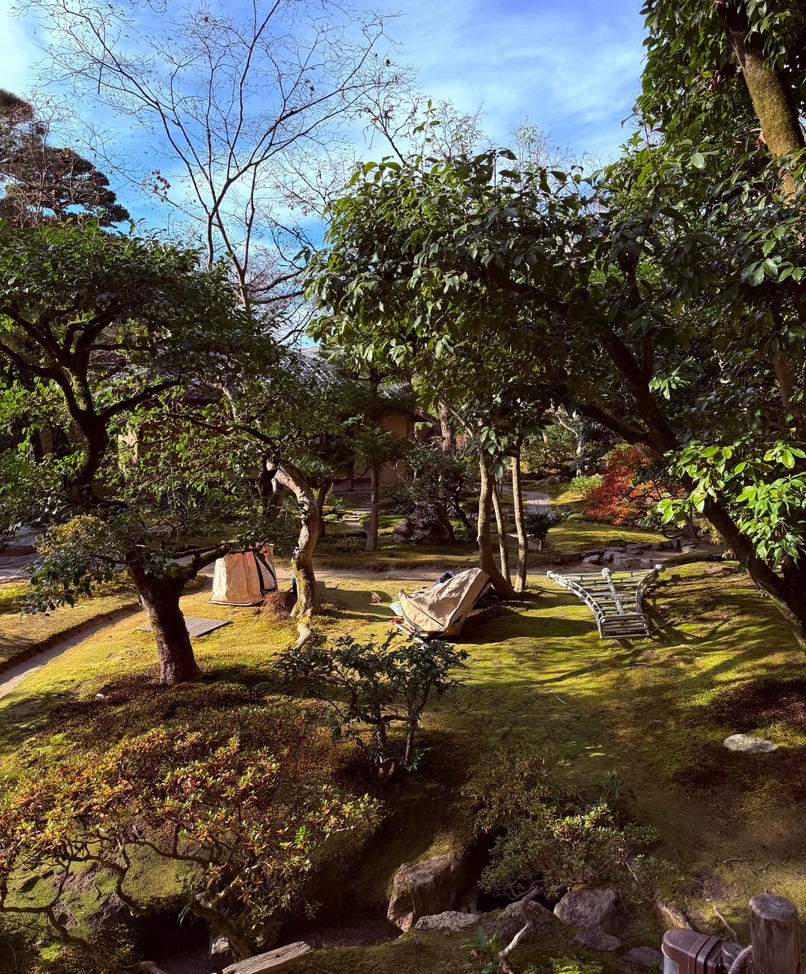
I was aware of a substantial wooden building ahead of me, and another beside it, but was too distracted by the landscaping to look at them. Shrubs and tall trees stood behind streams of gravel raked in stripes that reminded me of corduroy. Carefully placed rocks seemed to float downstream: islands in a river of pulverised stone. A smooth band of fine gravel hugged each rock like a sandy shore.
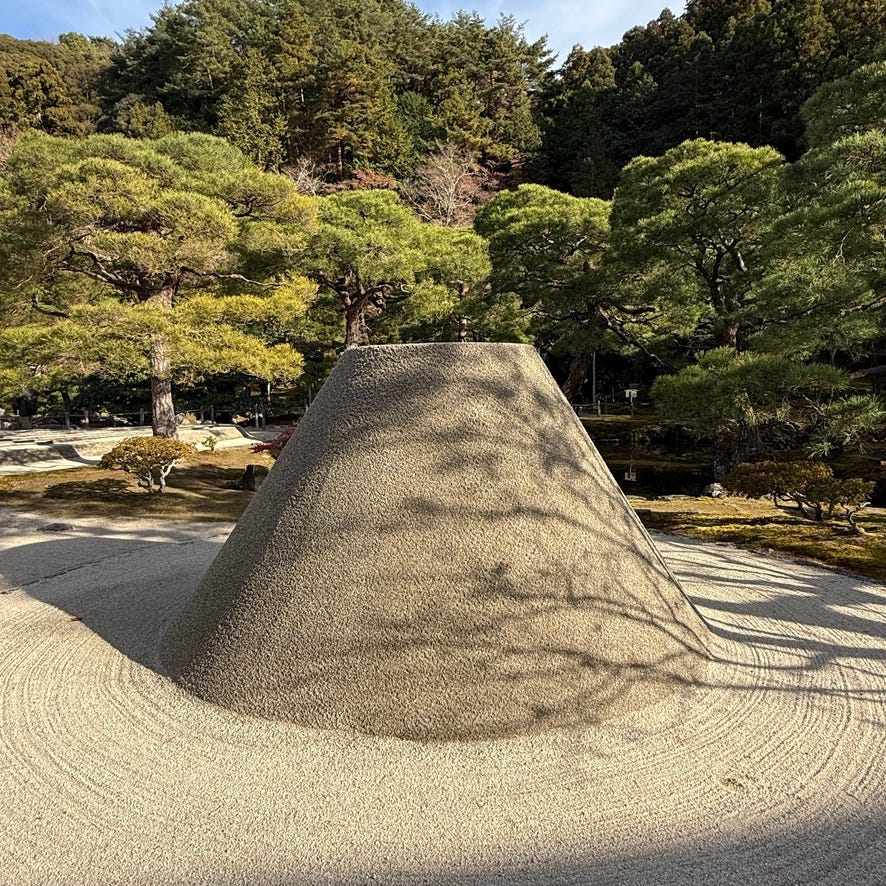
I passed through a third gate and was immediately confronted by a cone of bright sand, piled to about my height. It had a flat top instead of a peak and sat on a wide sandy bed, as if on softly rippling water. What an odd thing, I thought. A wooden sign at my feet read Kogetsudai. According to my phone, that means “moon-viewing platform,” which confused me. I looked again at the surprising shape which, I would later learn, has been rebuilt every month for about four centuries. You wouldn’t see this in a Western garden where piles of sand are hidden backstage. Naively, I wondered how one would climb the mound to view the moon and walked around it searching for steps (there weren’t any). The resemblance to Mount Fuji never crossed my mind, which made me feel foolish when I read about it later. I stared at the mound for a while—thinking of earthworks by Michael Heizer and Robert Smithson. Had they been here? The steep verticality made me wonder how one would make so perfect a shape out of sand. Then, I noticed the cramp in my face—I had been smiling since the clerk took my coin. Nice mood, I thought.
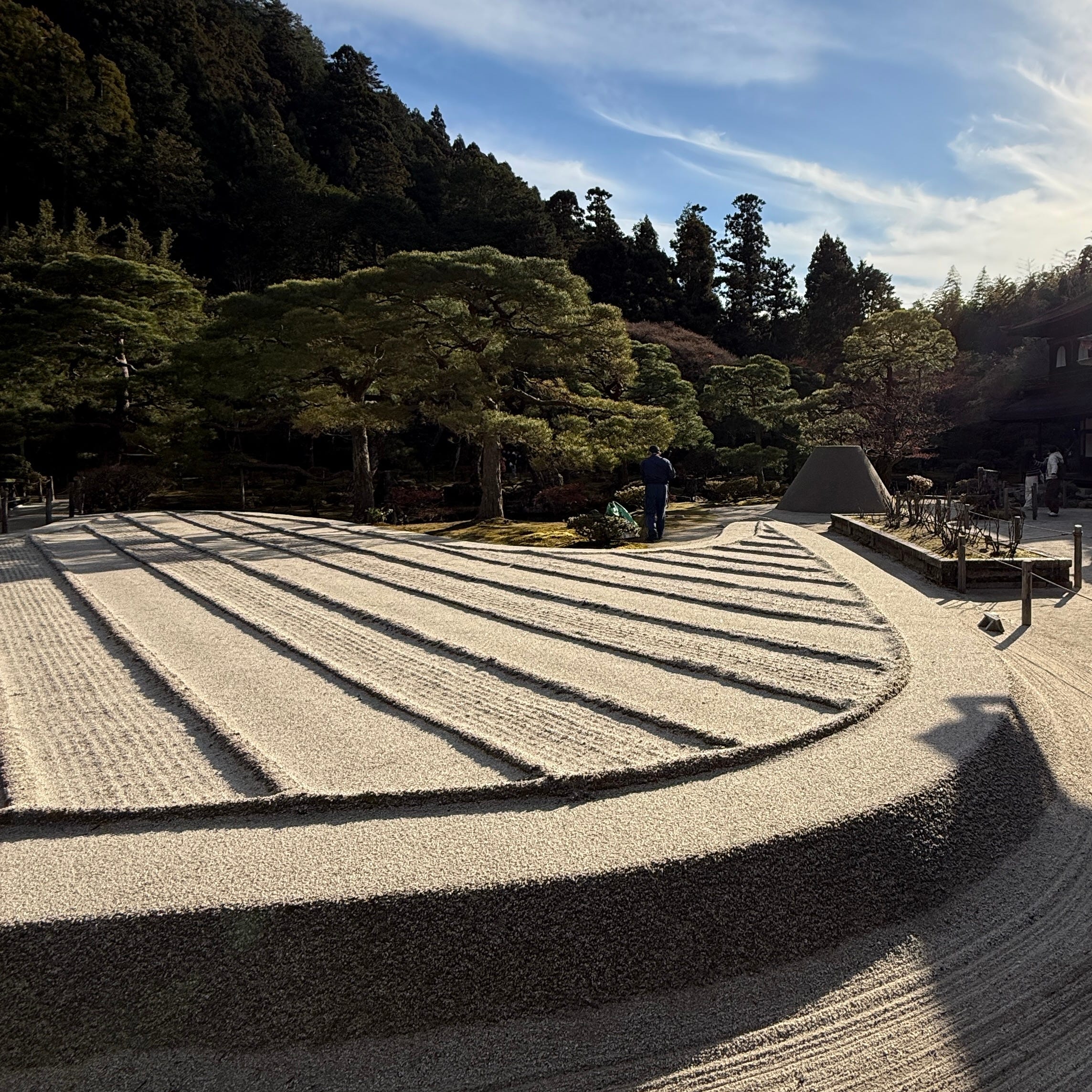
Returning to the main path, I walked along a big raised bed of gravel, raked into broad stripes that, after seeing the name, became schematic waves: Ginshadan, or Silver Sand Sea. It’s at this point that I began to hyperventilate in shallow breaths that frightened me. Was it something I ate? There was the boiled tofu that had defied my chopsticks at Ryoan-ji, while I struggled to get comfortable on the tea house floor. Was it the spice and tamari dip? Was it the cup of green tea? I only had one. Or maybe it was the fat, flour-crusted cashews that I bought at the exit shop of the Golden Pavilion. I ate just a handful of those before putting them away, and they weren’t in the least bit salty. Why was my chest fluttering? “It’s this place,” I whispered.
Past the sea of silver sand, I turned left, drawn by voices. Two gardeners were up a pine tree, well hidden behind a density of needles. I couldn’t make out their shapes but their percussive language, with its distinctive diction, was full-throated. To make the tree less dense and reveal more of its shape, I supposed, they were pruning it of small branches that hit the rungs of their ladders like stemmed pompoms. Were the men gossiping, or arguing, or commiserating? Given their noisy crosstalk, it dawned on me that they probably couldn’t hear each other any more than I could understand them. Their excited banter reminded me of primates screeching on high branches over some injustice on the ground. By extension, I felt like a primate too: the monkey left behind. I chuckled at the thought and searched for them with my eyes while enjoying their voices, the loudest I heard during two weeks in Japan.
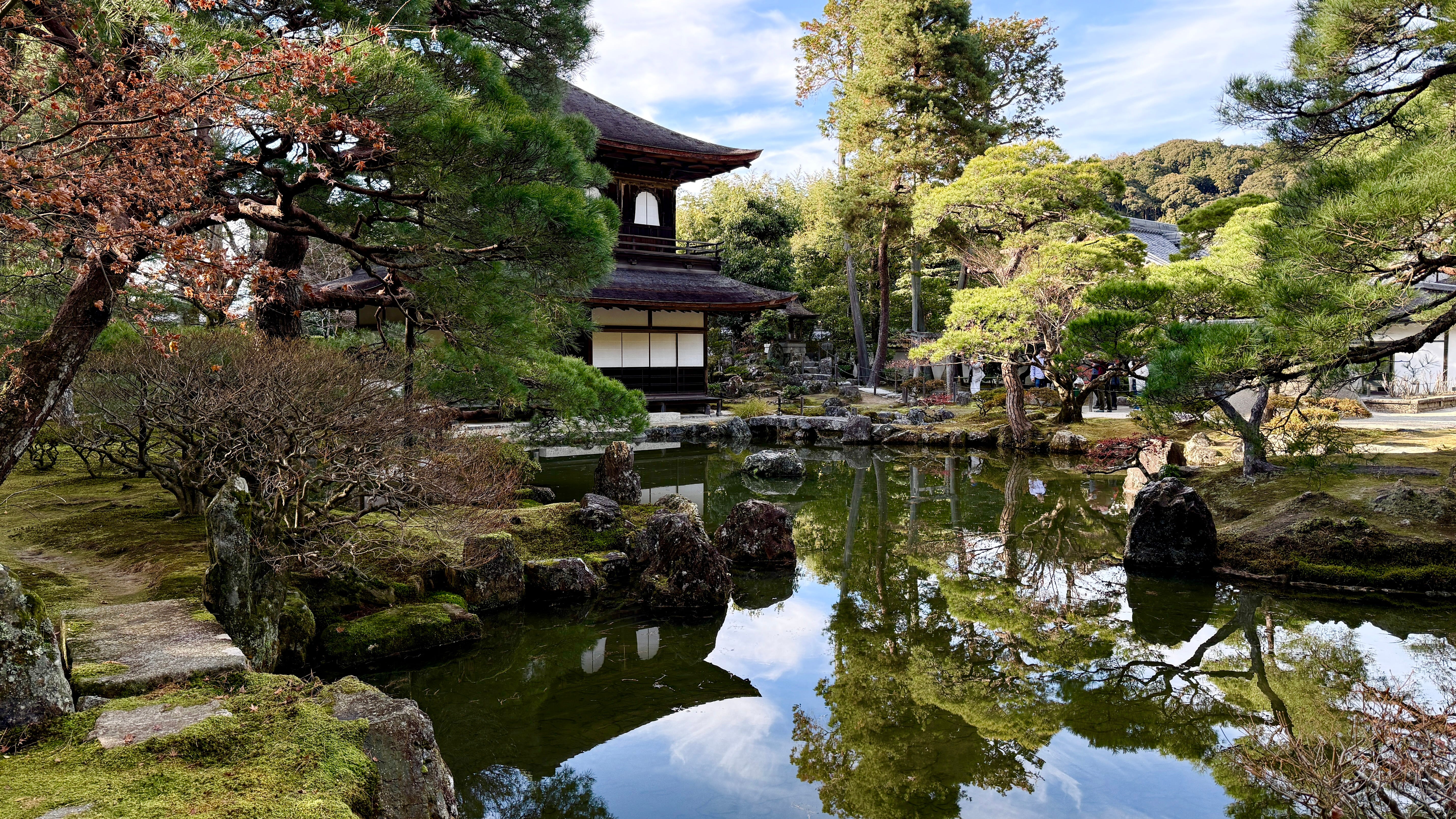
A blunt sign told me that I could go no further in that direction, so I turned around. That’s when I glimpsed a two-story building on the other side of a pond—old and dark, it framed crisp white shoji screens and hid behind dramatically sculptural trees on a variegated carpet of moss. I didn’t recognise the Silver Pavilion, probably because it wasn’t silver. (The Golden Pavilion had been brightly gilded.) And it seemed too close to the entrance to be the point of the place.
I was startled by a gardener in the pond. An older man about my age, he wore green rubber overalls with a white ball cap and was preceded by a long-handled net. He walked deliberately and slowly in the water as if performing aquatic tai chi. His eyes, squinting from the sun, searched the pond for something to scoop—a dead koi, perhaps, or a fallen leaf.
Encyclopaedic, the garden of the Silver Pavilion animates an estate built in the 1480s during the Muromachi-period. My emotional response to it was encyclopaedic too. The grounds have been altered considerably over the centuries, for example the Kogetsudai and the Ginshadan are thought to be from the Edo-period. I eventually found out that Ginkaku-ji is of great cultural significance for the Japanese, which didn’t surprise me—it’s so lovingly tended beneath its great trees.
The compound was built as a retirement villa for Yoshimasa—the eighth shogun of the Ashikaga dynasty—after the devastating Onin War (1467-1477), a civil conflict sparked by his fractious succession and the shogunate’s declining authority. Leaving day-to-day affairs increasingly to others, Yoshimasa had abdicated in 1473 when he was 37, in favor of his young son, and very gradually withdrew from direct rule. After the war, he spent his remaining years in the company of poets, painters, performers, tea masters, scholars, and monks. He was tonsured in 1485 and died five years later at 54.
Historians refer to the sensibilities nurtured by the retired leader as the Higashiyama Culture, named for the mountains where his former villa sits on a foothill terrace. Ginkaku-ji was constructed on the ruins of Jodo-ji, a Tendai monastery destroyed during the war, where his younger brother Yoshimi had been ordained and elevated to abbot before being drawn back to political life by Yoshimasa. The site aligns with geomantic ideas rooted in Chinese feng shui and the flow of qi, or vital energy. It echoes the history of Chinese cultural influence long studied and reworked by Japanese elites. Reviled and revered in equal measure, the politically disastrous Yoshimasa is considered a pivotal aesthete of Japanese ways, whose circle helped shift the nation toward cultural autonomy. Along with the rocks and trees brought here from war-damaged precincts, Yoshimasa’s seminal villa was returned to the site’s original Buddhist vocation after his death.
I saw other gardeners here and there, tending to their tasks in silence. For me, the presence of workers in the historically charged place made it more magical: a performance of care that warmed my heart. I felt a sharp envy and wished that I too could touch these exquisite plants and handsome rocks, and contribute my energy to the magic. I recalled the whole days I used to spend outdoors years ago, from first light to sunset, grooming the mountainside I owned. Repressing nostalgia, I was soon distracted by a mysterious tinkle.
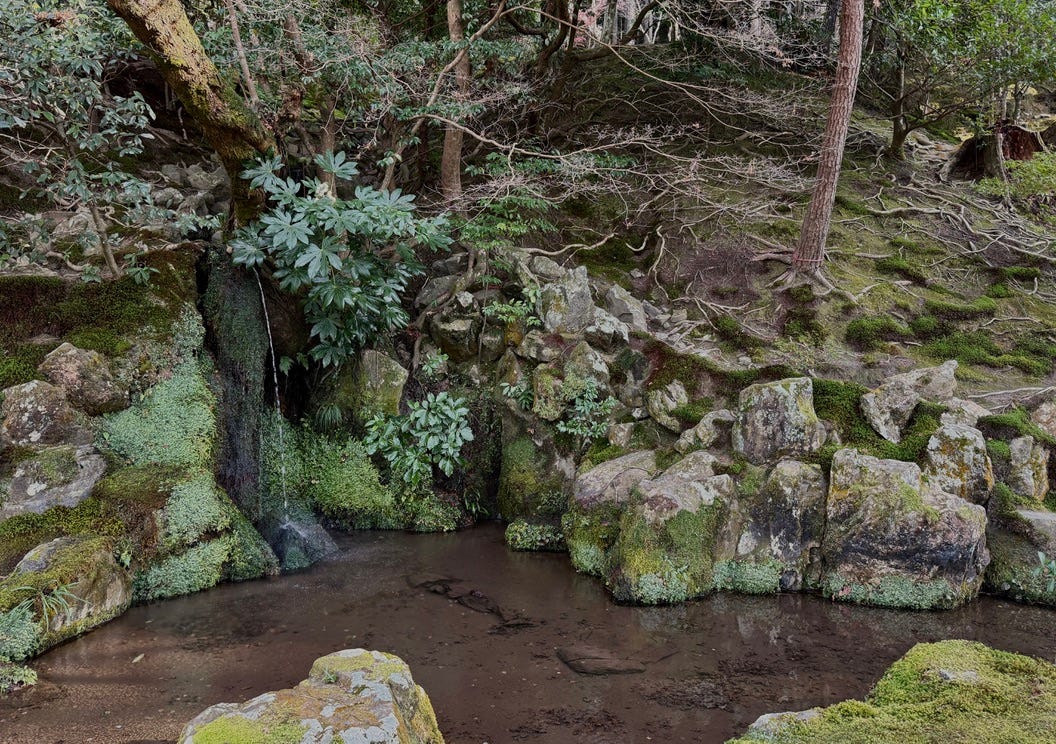
Heading uphill, I passed a shallow pool of water, transparent in the sunlight. The bottom was a shade of brown I knew well from twenty years of living intermittently beside a mountain brook. In fact, it was the same colour as every shallow mountain pool I’d ever seen, though that can’t be right. Dirt must be different shades of oxidation underwater, in keeping with the diversity of minerals. I walked slowly toward the pond, mulling this in my head, as the tinkle got louder. Scanning the vertical hillside, still lush despite the season, I found it: a doll’s house waterfall, no wider than a drinking straw, spouting from a clutch of mossy rocks. Its crystalline water fell in an elegant arc from ten feet up. “The mountain is peeing,” laughed the old child to the pond.
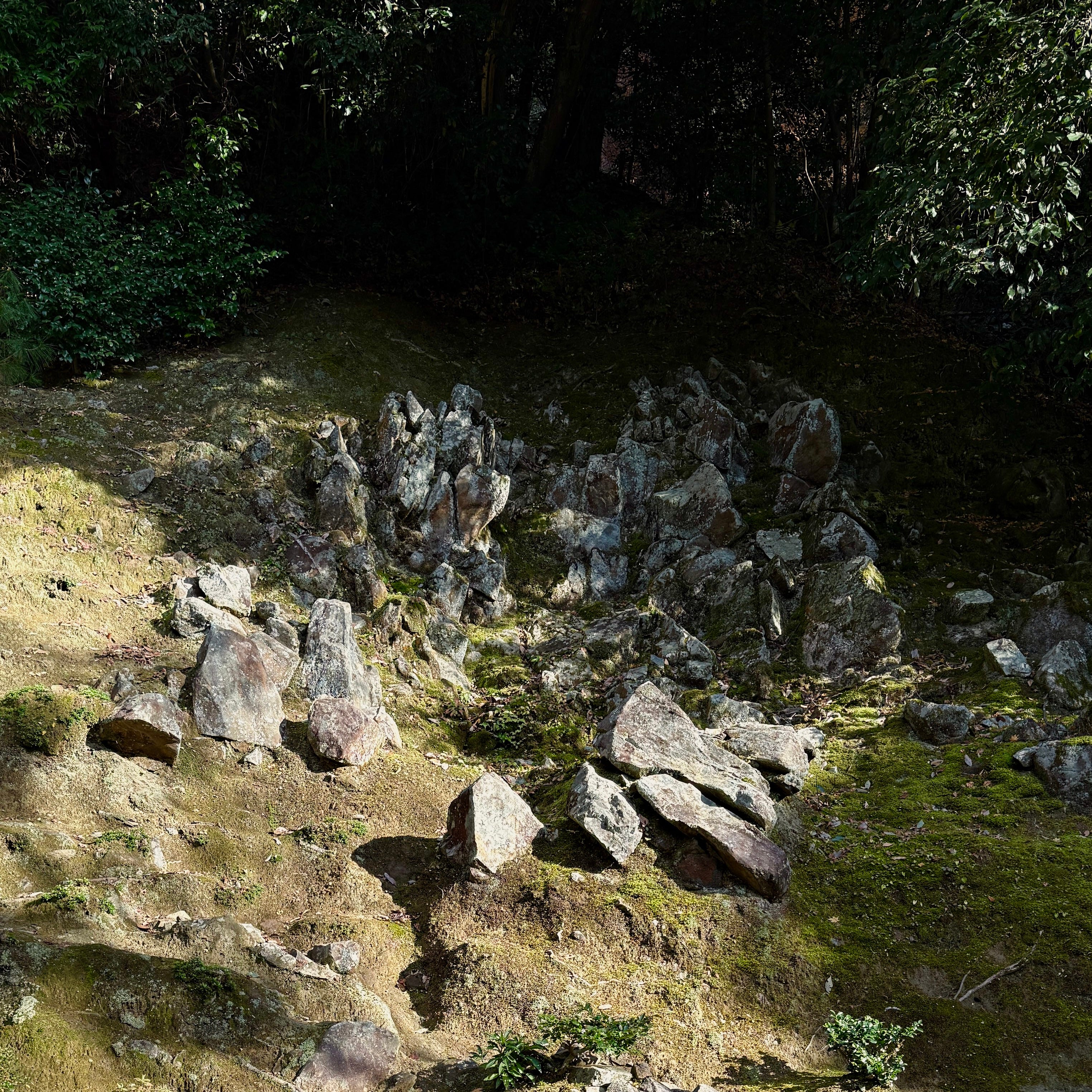
I came to an admirable bridge, handmade of bamboo and strapwork, with a floor of compacted dirt. The fresh green of the railings told me that it was new. On the other side, the path got steeper. I passed a pair of lovers holding each other and giggling sweetly. Then, I came to a steep mossy knoll —a slight depression in it was filled with pointy rocks. It looked as if a cairn had been dismantled and every stone stood on its end, like a serrated installation by Richard Long. A sinister looking thing from that angle, the slope bristled as if in a state of alarm. I took the nearby stairs to get above it.
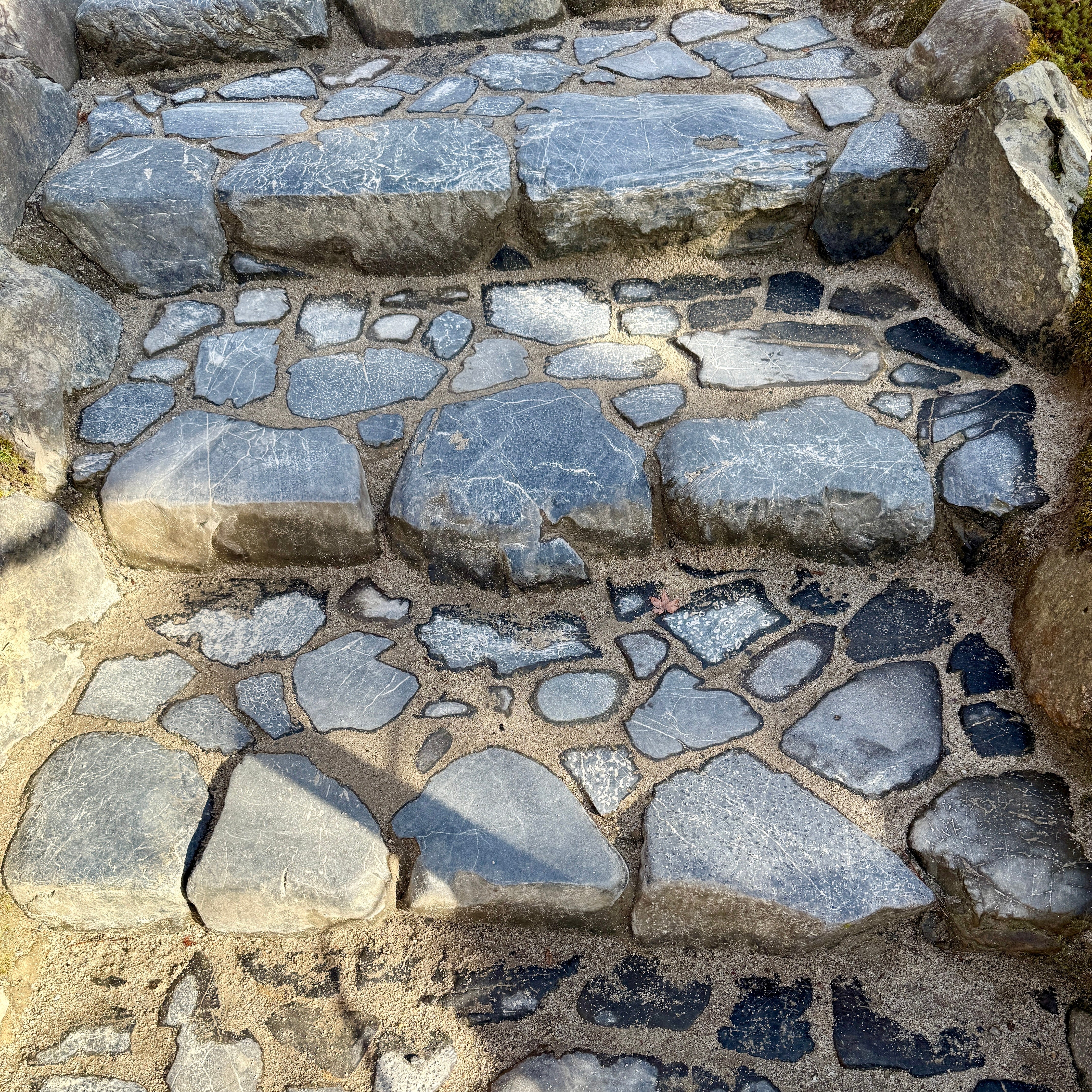
Weathered stone steps took me high enough to survey the whole garden, but I saved looking down for the top. Meanwhile, climbing slowly, I admired the stonework of the steps, a rubble pattern of rocks and skipping stones polished by countless shoes. I thought of the stone paths laid around my old farmhouse. Suddenly, I was overwhelmed with sadness. I said to the stairs: “Had I seen this place as a young man I would have had a different life.”
What did I mean by these words? They just occurred like a cloud that blocks the sun. I felt the weight of them in my gut and on my face. Was this about the farm I’d sold four years before? Would I have sold it had I seen the garden of the Silver Pavilion and walked its paths at 25? I hadn’t once mourned the sale until this moment. Would I have continued landscaping the steep woods and broad pastures until I dropped dead of exhaustion at 98? It would have been a strenuous life of hauling and stacking heavy rocks, of climbing ladders to trim old trees, of shovelling compost and snow and tilling hardpan? Would I have become a gardener instead of a curator and known a different kind of bliss? Or would I have moved to Japan?
A harder question commandeered my thoughts. Did you abandon your Higashiyama, I asked myself accusingly? Was it madness to have sold? There are poets, painters, and performers in the mountains of Delaware County, NY, where I had long planned to retire—scholars, even tea masters and plenty of monks. I could have cooked for them and relished their company. I might have had a shogun’s retirement and, by the looks of things, even a civil war.
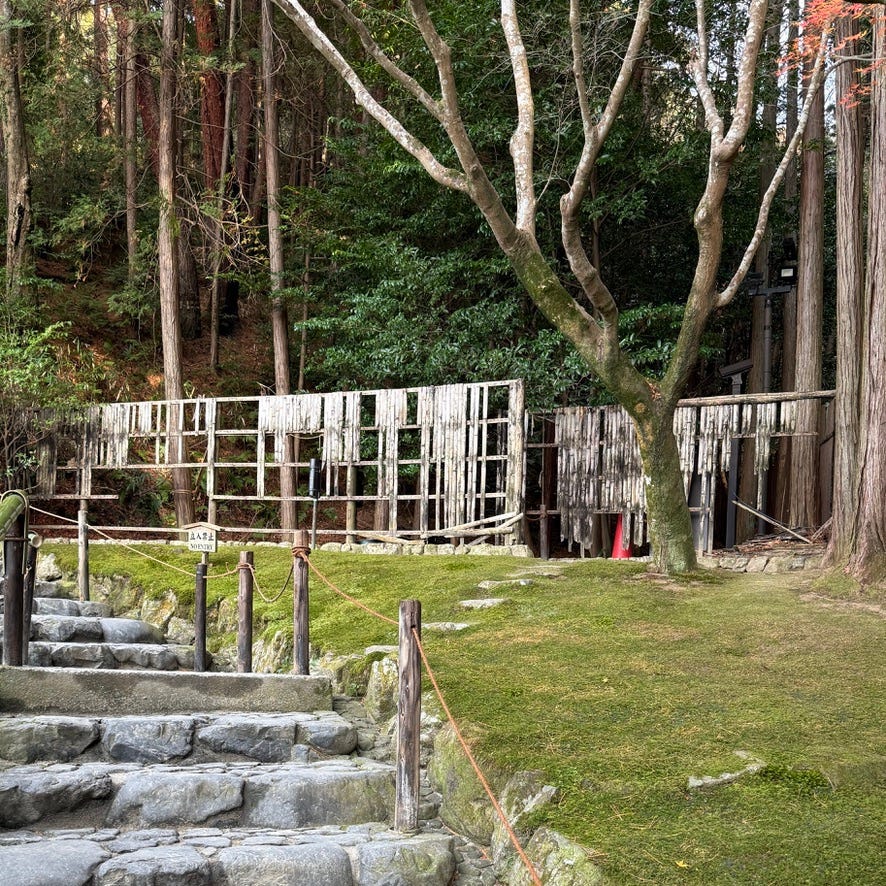
The top step reached, I saw a fence of rotting bamboo higher up . After all the strong sensations in the immaculate garden, the incongruous sight of a ruined barrier surprised me with glee. The emotional whiplash caused me to worry: “What’s going on with you? Should I be concerned?” Glimpsed through the missing pickets, the shadowy wildness of the mountain woods caused an erotic chill. I shivered and looked around to share my weird elation but was alone with it. I concluded that the shredded fence was an instance of sabi, the touching beauty of weathered age. Picturesque, the exaggerated neglect was surely deliberate.
I turned to look down on the garden below with its lost resemblance to Yoshimasa’s after six centuries of Buddhist control. But first, I noticed the blue mountains in the distance where I had started the day, and I smiled at Kyoto, spread out between the Kitayama mountains of the Golden Pavilion in the north, and the Higashiyama of the Silver, where I stood in the east. The ancient city glowed bright grey in the afternoon light.
Inexplicably, my earlier sadness had been eclipsed by a rotting fence, and was now being mocked by a thrilling view. I was buoyed again, on top of the Japanese world. I shook my head at the desolation that had gripped me and pointlessly enumerated the sound reasons for having sold the farm: the expense, the epic winters, the isolation, and the excellent timing.
I looked down at the Silver Pavilion among the trees, identifying it finally. What else would have been situated so felicitously? The rightness of the site changed my opinion of geomancy from superstition to good sense. I couldn’t help noticing that this was the same angle from which I once mooned over my farmhouse, a view I loved at dusk after a fulfilling day of exertion—chopping firewood, taming water, and snaking paths through boulders orphaned by glaciation. I loved the gold light of the windows and the white smoke of the stove signalling me to dinner. An encouraging insight completed these thoughts: fond memories need not lead to nostalgia, let alone to regret. They are the treasures, and the present is the crucible of more.
Despite its dark wood, Ginkaku-ji seemed luminous from up there, the very spot where Yoshimasa could have mourned his burnt capital. After he died, he was given a posthumous name, Jisho-in, and the villa renamed Jisho-ji by the monks to whom it was left: the Temple of Shining Mercy. It houses a golden effigy of a seated bodhisattva, enthroned within a grotto carved of wood: the Kannon in the Cave. Kannon is the Japanese name for the Indian Avalokiteshvara—known as Guanyin by the Chinese—an awakened being postponing nirvana to remain in the world of suffering and help poor souls like mine. Sequestered on the closed upper floor, its presence must be intuited and appeals to its compassion made from outside.
Kannon’s hermetic sanctuary drew me back down the hillside. The blackest of weathered browns, why do they call it “silver”? It seems that cladding it in silver leaf had been Yoshimasa’s intention, in restrained emulation—following his Zen sensibility—of his grandfather’s Golden Pavilion, a structure this one mirrors. After the rigors of a long war, Yoshimasa must have been short the means to pay the gilders.
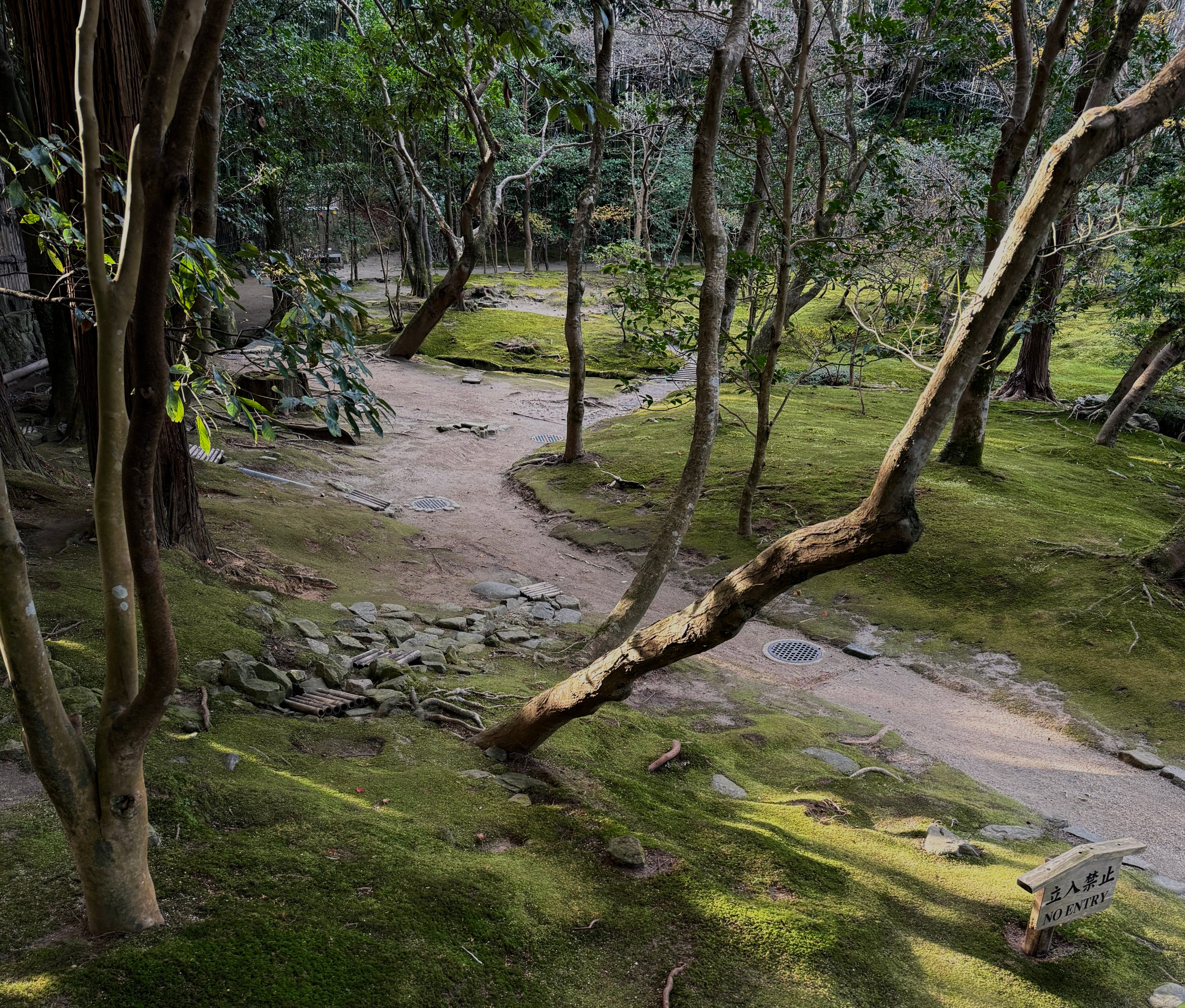
But more garden lay between me and the Silver Pavilion in an itinerary that had yet to exhaust its enchantments. I was soon on a winding path through a glade of gesticulating trees, posed as if by an expressionist choreographer. The light under the canopy was mystical. The mottled green mosses were mystical. And mystical too were the half dozen ghostly camellias—the only flowers I saw—fallen on a mossy ground faded in blotches by winter. I began to weep.
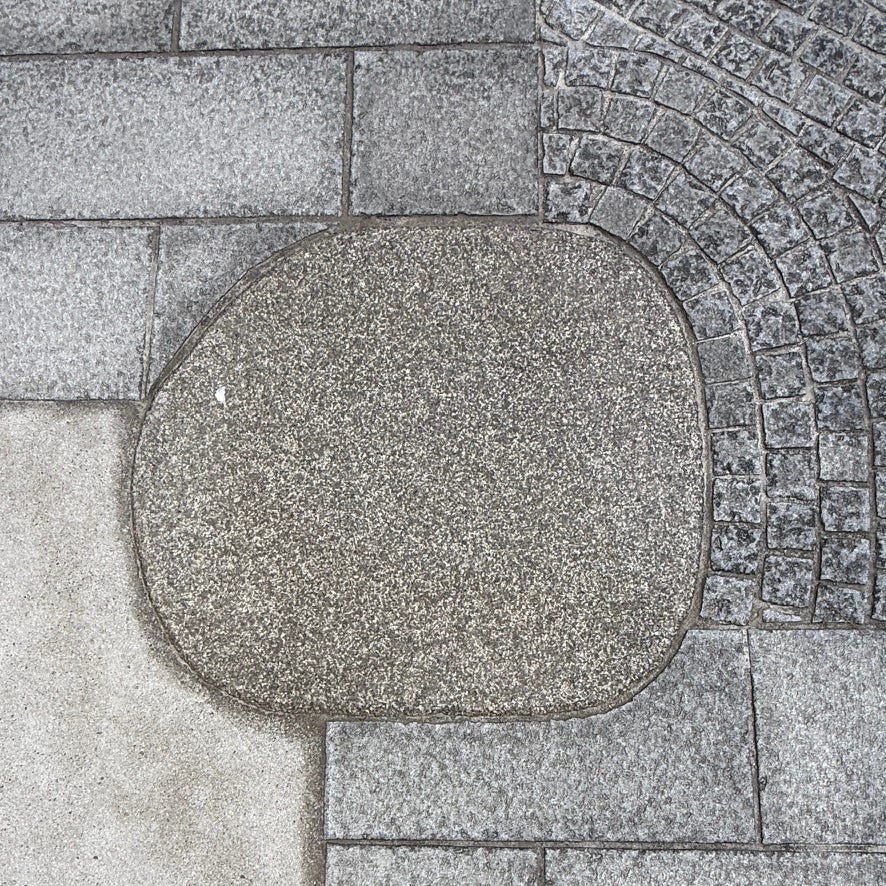
My emotions had been so well exercised by its garden that I struggled to perceive the temple when I finally got close to it. But I felt it vividly—too vividly to stay near it for long. Fighting great hesitation, I marched behind the ancient house and toward the exit restroom, mostly to keep moving. Then I sat for a moment beside the giftshop to gather my feelings. I studied the pavement of cubes, rectangles, and rounds laid as if by a jeweller in a pattern too large to discern. Everything I’d seen here was like this: crafted with confidence, worked, and placed by invisible hands that I could only intuit, like the presence of Kannon and the blessings of mercy.
Later that night, sitting up in bed and reviewing the day, it struck me that I had never experienced such a range of emotions in a garden, or anywhere for that matter—not a logical sequence of them, but a motley assortment of moods that unfurled, one by one, from the moment I stepped through the gate. I was breathless, teared up, frightened, and surprised; I laughed out loud, sank into alarming sadness, became giddy, and smiled again and again at the relentless beauty. The garden’s infinite variety of perspectives seemed impossible—looking back had no resemblance to looking forward: a thousand views of six acres.
Scholars write about the illusion of dematerialisation that you experience in a gothic cathedral. By contrast, this was hyper-materialisation, the illusion of an endless paradise conjured by an arrangement of plants, rocks, gravel, and water: the simple elements of a mountain bower. The words genius loci throbbed in my mind like hazard lights.
Although it isn’t at all large next to the three other gardens I visited that day—parks by comparison—I had stretched out my stroll at Ginkaku-ji to a long hour and had to force myself to leave. In fact, I fought off a strong desire to stay until nightfall and only exit when forced to. It’s the sort of place you want to see in every light, in every season. But I had more to see before calling it a day; for all I know, I may never return to Kyoto.
Why isn’t gardening among the canonical arts of the West? Why didn’t the Greeks assign it a muse? That was an error.
Wonderful piece, Marc. You've caught the disciplined magic of Japanese gardens. C x