
I Visited Berlin

Berlin, the frigid East Elbian metropolis, is where I weathered the winter of 1984-85. It was still a walled city back then and everything stank of lignite. “Wie Sibirien, (Like Siberia)” you would hear all day. Shivering, tongue-tied, and poor, I fell into a bromance with a philosophy student from Vancouver. “I want to read Heidegger for a living,” he said, unrealistically. A pair of flâneurs fresh out of McGill, we spent our days walking the truncated Straßen und Alleen, whispering in cafés and shouting in nightclubs, trapped in an endless dialogue. To take a break from talking, we danced.
Forty years later, the Esther Schipper Gallery hired me to write the essay for their Ugo Rondinone show in Berlin. A Rondinone groupie, I flew over to attend the opening. It gave me a chance to revisit a city equal to Paris and New York in my sentiments. Berlin seduced me at an impressionable age; wizened now, I walk its streets in an altered state.
The capital of the former Kingdom of Prussia is once more the capital of Germany. Against the long odds that are its specialty, Berlin has become a global node of contemporary art since reunification, supplementing its great riches in every other kind of art. Despite their skimpy soil, dark history, and relative youth among European societies, Prussian elites produced some superb aesthetes. As a result, artistic culture took root in their capital. But unlike its rivals—New York, Paris, and London—Berlin is far from the engines of prosperity in Germany’s west and south. The administrative hub of the old Reich and the new democracy is in the northeast, near Poland.
Incongruously for a government town haunted by the past, Berlin has long been a magnet for vanguards, free spirits and intellectuals. The 20s really roared here before the 30s crack-downs. If encumbered with attics-full of clashing symbols, the city is blessed with sensible rents and a reasonable cost of living, along with vacant factories and warehouses perfect for studios and galleries. Now that it has reconnected to the zeitgeist, my nostalgia for Berlin is acute. But my thoughts are more ensorcelled by the place than are my senses. Fate has mostly kept me from it since that winter of fond memory forty years ago. I would live there again.
A walker, I came to know West Berlin like a local when every street ended in a wall. The infamous obstruction now gone, flat and dead straight thoroughfares peter out to infinity in a Brandenburg mist. Physically, the place is jarringly different today compared to the one I knew. It has also changed demographically. At long last, Berlin is cosmopolitan again, as it was before the Nazi madness. It’s the only city in my nomadic repertoire that I’ve had to relearn from scratch. And the population has variegated in the ensuing years. I remember walking down busy Kurfürstendamm one sunny day in the spring of ‘85 and feeling conspicuously dark-haired. The city has since regained its colour.
Landing at noon on the day of the Rondinone opening, I rode in from the severe new airport with a witty Turkish cabby. I left my bags at the hotel and found a decent vegetarian lunch with an excellent NA beer on Unter den Linden. Curiously, I kept hearing French at every turn on Berlin’s Champs Elysées—tourists from the west. Apropos of French, Montrealers—or rather the few remaining francophones downtown—are known to switch to English at the slightest accent. Not the Berlin waiter who reacted kindly to my rusty Deutsch by answering me in comprehensible High German. I’d heard him speak serviceable English to others, so was touched by his consideration. Through his smile, I felt him rooting for me as I braved the craggy shoals of his grammar and diction. Not all Germans are charmed to hear their handsome tongue ill-treated, but Berliners almost are. Only once in three days did I stop someone from pulling the Montreal switch.
After lunch, I continued east on sunny Unter den Linden, past the man on a lawn chair in the median with his Israeli flags and big black and white IDF banner. I turned to admire the old princely piles that have now become schools, and Knobelsdorff’s grand Opera house of 1743, commissioned by Frederick the Great. Before the boulevard curved onto the bridge to Museum Island, I glanced across the street at the Neue Wache. In my Greek Revival days, Schinkel’s Doric guardhouse of 1818 was an object of reverence. Today it’s the federal memorial to the “victims of war and dictatorship.” Mother with her Dead Son (1937-38) by Käthe Kollwitz is a bronze pietà that yanks at your heart from the black granite floor. Otherwise, this is the emptiest room in Germany.
With purpose, I walked toward the Berliner Schloss, angled obliquely beyond the bridge. Although it was bombed by the Allies, enough was left of the royal and imperial palace of the Hohenzollern dynasty to restore it. Instead, the East Germans blew it up in 1950 to build a glass and steel Palast der Republik, a pro-forma parliament that they hung with optimistic murals. Angela Merkel, the long-tenured Chancellor of reunified Germany, spent the first 35 years of her life in the DDR, or the German Democratic Republic. She isn’t nostalgic for the Soviet client state of her youth, evidently. Merkel demolished the modernist Palast—“It’s full of asbestos.”—and rebuilt the baroque Schloss at an eye-popping 700 million euros. Zum Wohl, Kommunismus! Now it's called the Humboldt Forum after Alexander von Humboldt, for a long time the most famous scientist in the world. He’s still the least controversial Prussian. Along with its function as a special exhibition hall and a local history museum, it houses the fine ethnological collections of the former Prussian State, brought back to “der Mitte” (the center ), from the outskirts in Dahlem.
Years ago, I went on a hardhat tour of the unfinished site, so I was eager to see the result. It’s big. In fact, it’s too big for artefacts scaled to the human body, as I would soon discover. Maybe it was the jet lag, or the shameful dessert that I had after the vegetable strudel, but my mood dimmed upon entering the building. It could also have been the giant Ukrainian flag sculpture in the lobby reminding me that millions are suffering just a car ride away. The walking and climbing required to glimpse a first object didn’t cheer me up, but that’s my own fault for only wanting to see the ethnographic collections on the upper floors. In any case, I was now in a mood and should have turned back.
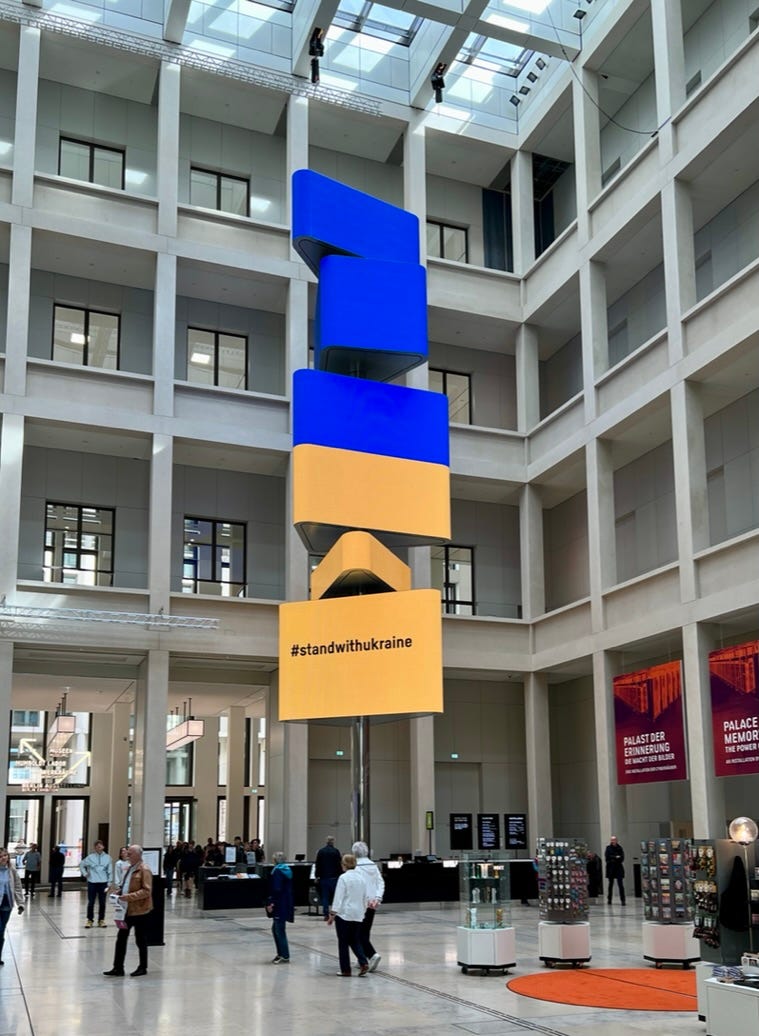
Given the style of the building they tore down to reconstruct the palace, I found all the glass and steel in here ironic. Incapable of standing still on stairs, even when they’re moving, I huffed and puffed my way up two long escalators. At the top, a cheerful guard asked: “How may I direct you?” Miffed at her linguistic presumption, I replied curtly “Ich suche Afrika (I’m looking for Africa),” and felt myself become a jerk. With a tolerant grin, she waved in the general direction of the African displays saying “Sie sind da” (You are there).
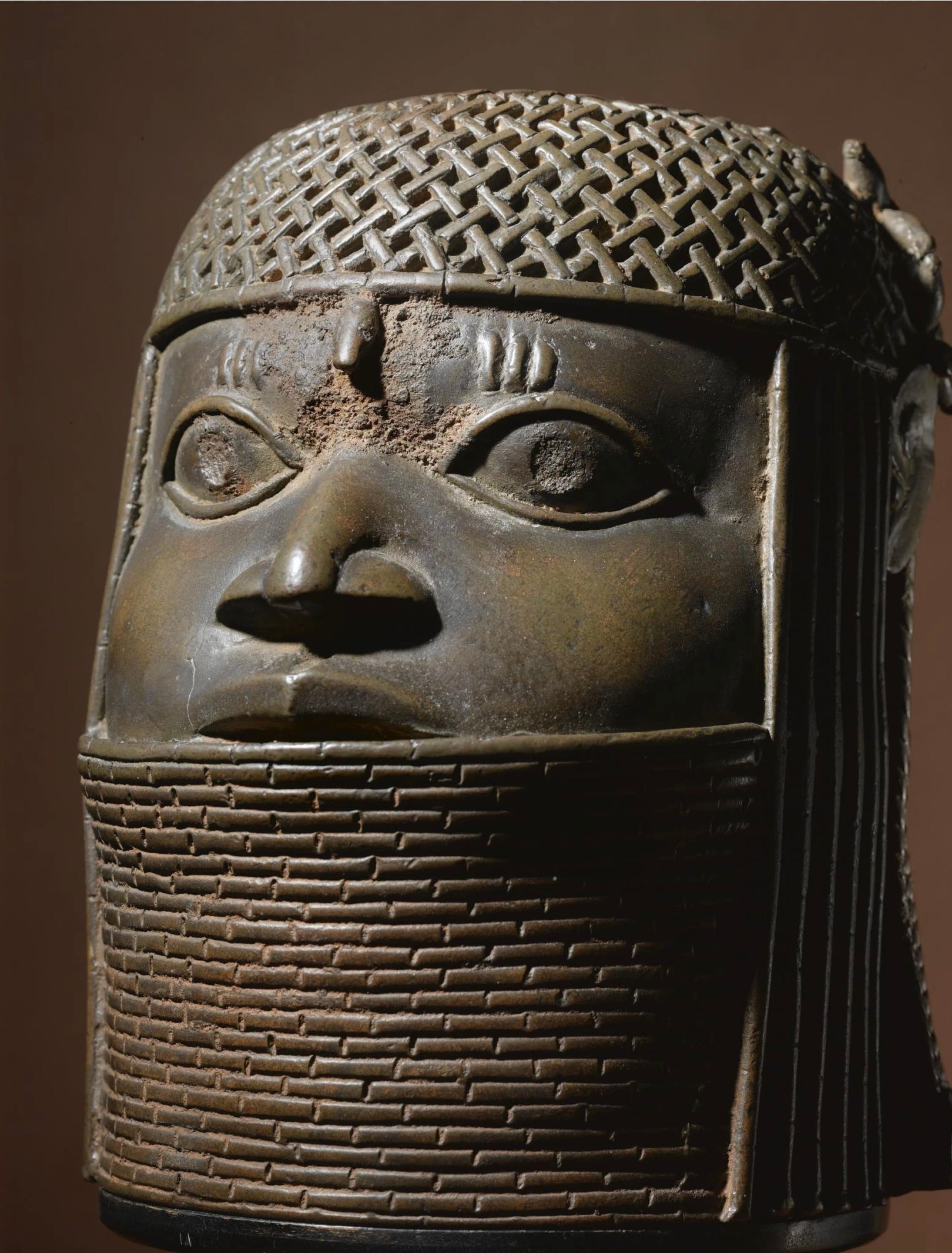
Not quite. Two more empty galleries and I finally reached a display. It told the ugly story of how the British looted Benin City in 1897. After making off with its fabulous treasures, sacred objects numbering in the thousands, they absorbed the once mighty kingdom into their Nigerian colony. Scattered to the four winds like so much booty, some of it landed here. In 2022, Germany committed to returning such objects to Nigeria.
Benin bronzes are astonishing feats of lost-wax casting and they can be grippingly life-like. Royal and military portraits, the earliest date back six hundred years. My first encounter with one was at the former Albright-Knox Art Gallery, now the AKG Buffalo, where I was a fledgling curator. A powerful object since returned, it instantly dissolved my puerile indifference to African art.
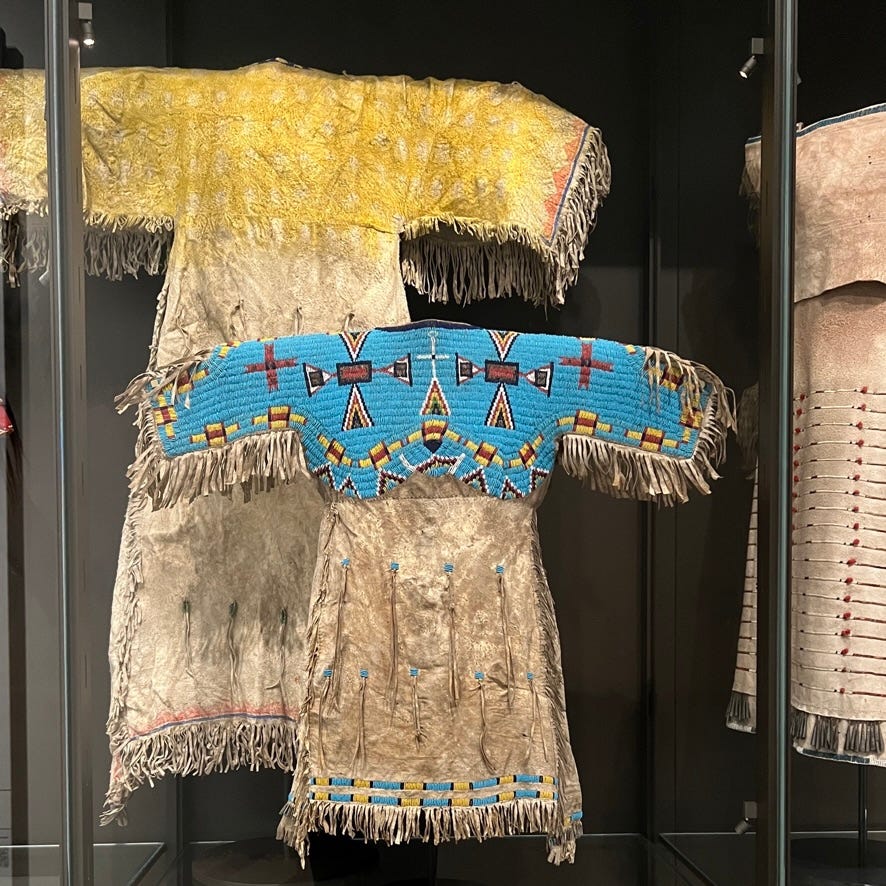
Something made me pick up the pace in these grandiose but melancholic rooms with their banks of text. I decided that I didn’t care to look at African art this way today and kept moving. Nor did I tarry in the galleries devoted to the Indigenous cultures of my native North America. I spotted some stunning Plains beadwork—the only photograph I took here—but in my haste I forgot to record the label and find no mention of it online.
A giant photomural of Francis La Flesche stopped me. The Indigenous anthropologist, ethnologist and pioneer of decolonisation worked with Prussian colleagues between 1894-98, while the Brits ransacked Benin. He brought them objects by his Omaha people for the Kaiser’s safekeeping, fearing their neglect back home. Such stories make the calls for immediate and universal repatriation, like those that have dogged the Humboldt Forum, sound irresponsible and rash. That’s likely one of the reasons for the prominent display that tells the story of La Flesche’s time in Berlin.
Normally, I would have been happy to learn all about La Flesche and admire his people’s objects, but I felt an urge to leave. Was I even in the building a whole half hour? It’s stupid of me, I know, and I barely saw a thing, but I was disappointed and cranky. In any case, I’ve learned to distrust first impressions and vowed to return another day better-rested.
2
At the Rondinone opening that evening, I met a local art aficionada to whom I mentioned my peek inside the Humboldt. “Horrible, horrible, horrible,” she said lividly, throwing in a final “horrible” in case I hadn’t caught her drift. Perhaps my earlier scowl wasn’t only caused by jet lag or the war down the road. Was she an advocate of repatriation, an outraged aesthete, or a tax payer shocked at the expense? I don’t know because decorum forced us to change the subject in the crowded gallery.
Honestly, I’m not the right audience for ethnographic museums, where art takes a back seat to pedagogy. Aesthetes are pained by the demotion. And then there are the moralists who find such places shameful. I’m not a moralist, but I get the point. Still, how are world cultures of the past and present best preserved and disseminated, and how can they be kept meaningful for our giant, homogenising societies? This is one of the pressing cultural questions of our time.
As for the Rondinone show, it resonated with this very question, and was dazzling and moving and smart. But then I would think so. the alphabet of my mothers and fathers, 2022, is a large collection of old hand-made cooking and farming tools that the artist has brightly gilded. They are arranged on 26 milk-white squares—each for a letter of the alphabet—that line the walls like a treasury.
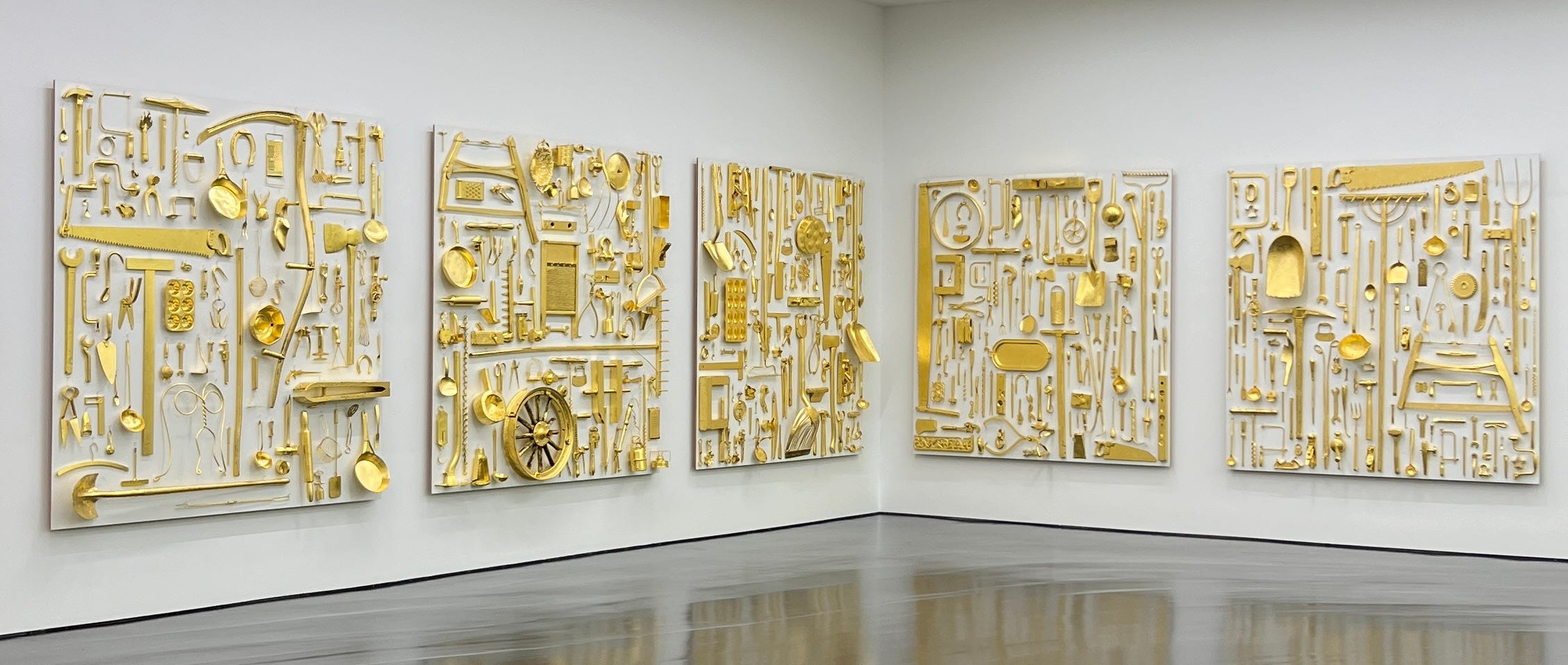
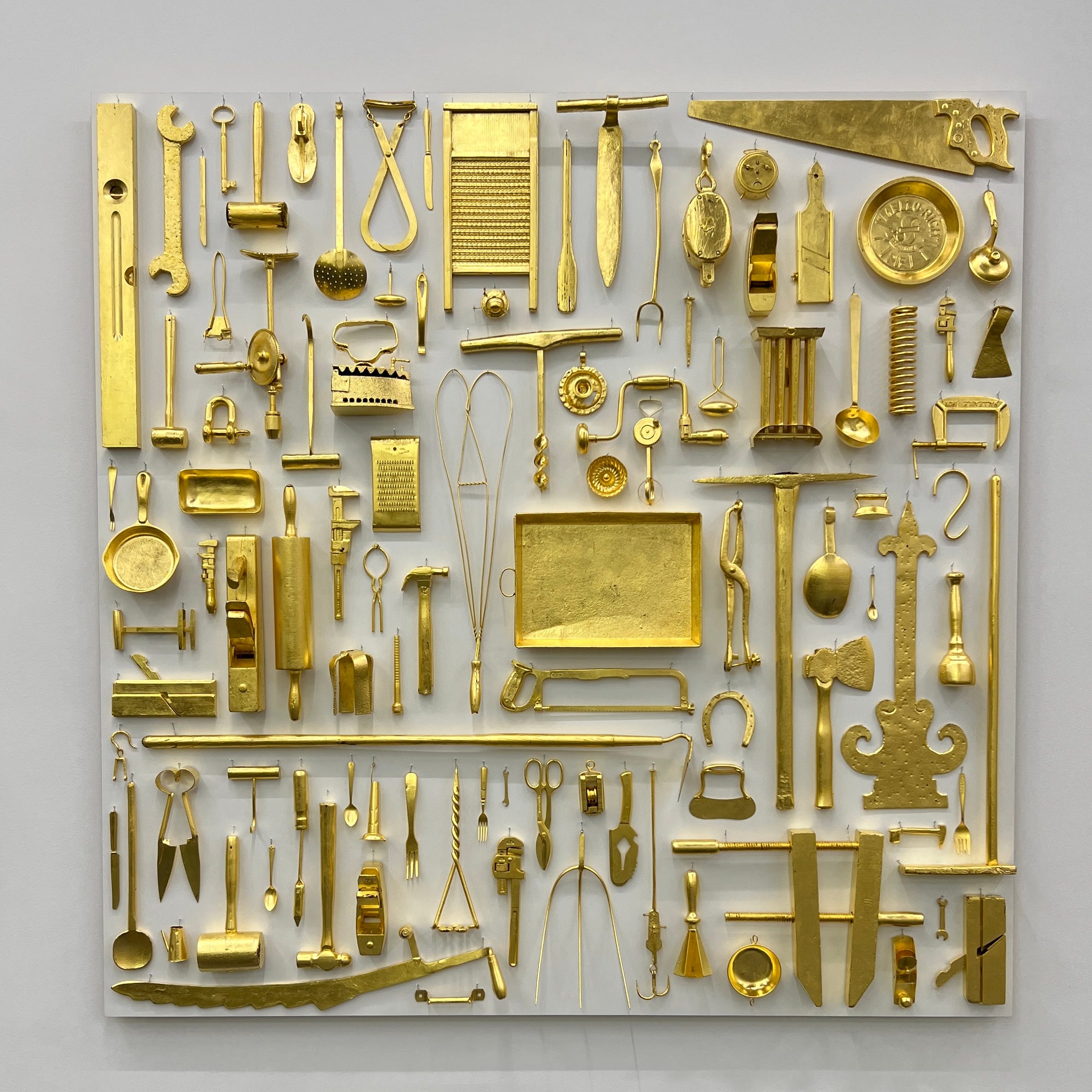
Parenthetically, because these tools belong to traditional European culture, you’re unlikely to see any (ungilded) in an ethnographic museum. In museological terms, ‘ethnolographic’ and ‘ethnological’ refer to collections of non-European material which makes no typological sense. But then the concept has faded outside the world of museums, especially in North America, replaced by ‘cultural anthropology’ in other academic contexts. Max Weber, one of the “fathers of sociology” considered ethnicity to be a social construct like race, which has no basis in science. As social constructs go, ethnicity is fluid and mutable, though the museum context presents it as fixed for the purposes of typology. Given the stability of forms in many traditional cultures, this is understandable. But racial distinctions between instutions is not. In the future, we will make cultural distinctions without racializing artefacts.
Berlin is a centre of advanced museology with the objects, the infrastructure, the ethos, and an enviable heritage of erudition. In fact, ambition in this regard is all around you in a city that, among other things, very much values art. But displaying non-Western artefacts in a former imperial palace is pretty awkward. If it didn’t last more than thirty odd years, imperial Germany was indeed a colonial power and a brutal one in Africa to the point of slavery and genocide. I predict that in some more thoroughly postcolonial time, the grandly resurrected Berliner Schloss will have a new mission.
Back to Rondinone, with apologies. As I moved among the white and gold panels, I thought of Frederick the Great’s Sans Souci (French for “No Worries”) in nearby Potsdam. Like this recent work by my favourite Swiss artist, the Prussian king’s Rococo home also overwhelms you with white and gold, a pairing beloved of 18th century European princes. By marrying peasant tools with royal extravagance, Rondinone exalts his hard-scrabble ancestors in agrarian Southern Italy. He was inspired by the chance discovery that many Italian immigrants to America returned to farming in rural New York after exhausting themselves on the docks and factory floors of lower Manhattan. They saved their proletarian wages to buy their way back to the land, only this time as proprietors.
I once came close to acquiring a farmhouse in Upstate New York from such a family, so Rondinone’s alphabet is that much more meaningful to me. The old man moving out showed me through a low-ceilinged workshop attached to the barn, full of old tools just like these that might have been mine had the sellers not ultimately decided to keep the property in the family.
Now that agriculture has thoroughly automated in the West, Rondinone’s alphabet is a welcome commemoration of yeoman farmers and farm labour that represented up to 90% of us in the 19th century. Today, well under 2% of us work growing food in the US and Canada, about 4% in Italy, which has been under cultivation for millennia. In heavily automated Germany, farming employs less than 1% of the population. These are tiny numbers when you remember that most of us farmed all day not so long ago. In fact, compare them to industrial behemoth China where a quarter of the workforce is still engaged in agriculture. What will become of those 350 million people when their technophilic country automates food production in earnest?
3
My first stop after breakfast the next day, was the Andy Warhol ‘Queer’ show at the Neue Nationalgalerie. Oops, here comes another digression. An architect I met at the opening told me that Mies van der Rohe’s famous square building wasn’t originally designed to be an art museum. It had been commissioned by Bacardi for its head office in Cuba. What? White rather than black, the Caribbean project was scuttled in 1959 when Castro’s communist revolution seized Bacardi’s Cuban assets. A second opinion told me that the story was apocryphal, but the published elevations look uncannily alike.
The story goes that Willy Brandt, West Berlin’s charismatic mayor in the 60s, was impatient to build a shiny new liberal institution in the heart of his blasted metropolis, across the street from illiberal communism. Mies was approached, the modernist magus who had moved the Bauhaus to Berlin from Dessau in 1932. The Nazis made him the last director when they shuttered the progressive school in ‘33. Mies fled to America to erect one high modernist marvel after another. Who else could invest a German museum of modern art with more gravitas or glamour? As luck and revolution would have it, he had a really good design up his sleeve. In any case, it would be his only building in his native Germany, and his last anywhere. After six years of restoration and renovation, I was thrilled to see the black temple looking as strong as ever.
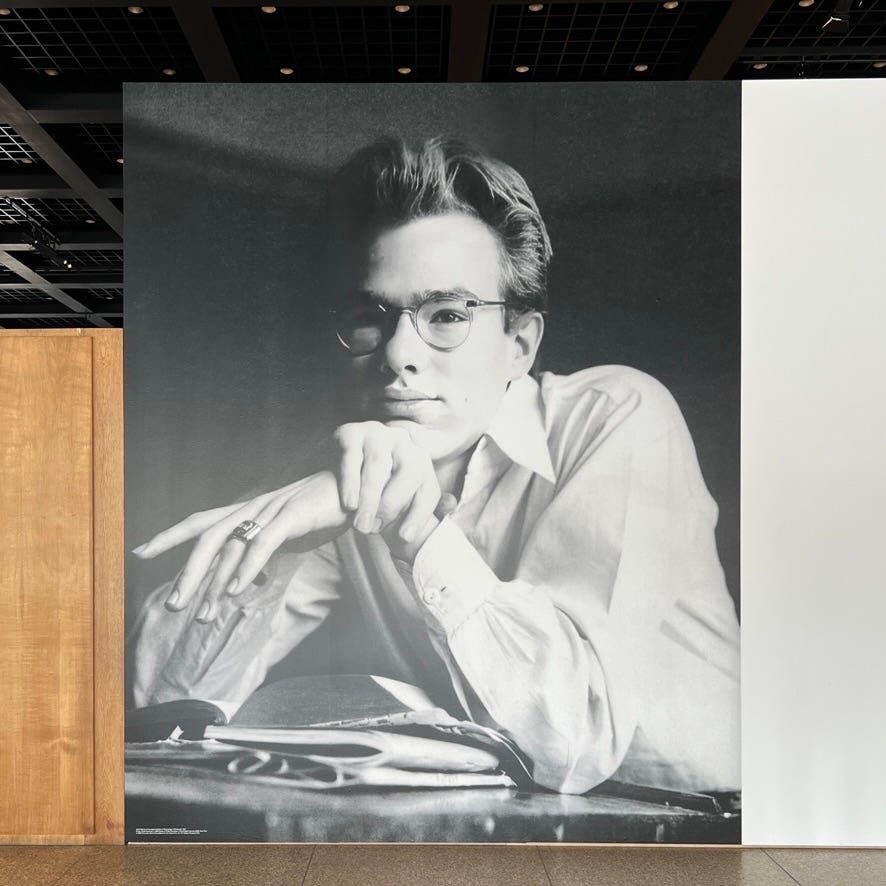
Warhol drew, painted, photographed, filmed and interviewed good-looking guys, from “superstar” Joe Dallesandro to superstar Mick Jagger. Both were well represented in this show, along with Warhol’s one-time partner the camera-shy Jed Johnson, another beauty. Much less known are his painted silkscreen close-ups of gay sex, à la Betty Tompkins, or his gaily coloured pictures of genitalia. I was only aware of one image of Warhol in drag, but there are many such polaroids in this show, showing him in various wigs, along with large portraits of drag queens painted as flatteringly as he did the high-society set at Mortimer’s.
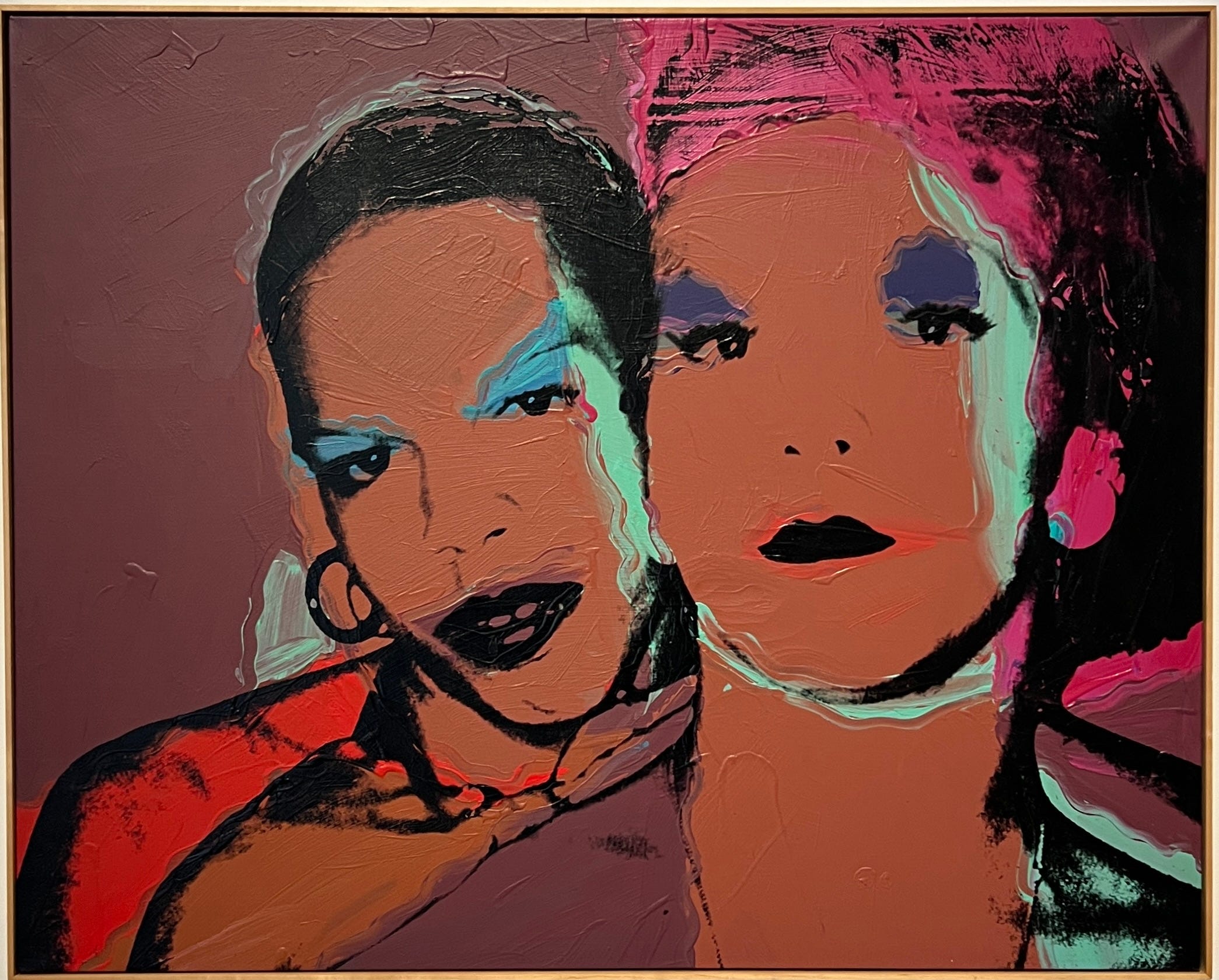
The exhibition gets more explicit as you work your way into the centre of the maze, a square space preceded by understated warnings. This former libertine found it cheering to note that the pictures don’t have a separate character or scale compared to Warhol’s mainstream work. Given the same treatment as his more famous images, they’re the furthest thing from dirty doodles shoved to the back of a closet. Self-censorship is unlikely to have kept this material from the public for so long. It’s also unlikely that you’ll see much of it outside Germany, a rare country where public nudity is normal.
Klaus Biesenbach was born to curate this show. Co-founder of KW (or Kunst-Werke), an important kunsthalle in Berlin, he then became boss of MoMA P.S.1. Biesenbach had some notable years at the Museum of Modern Art proper as Chief Curator at Large, building up its media and performance art programme. His Marina Abramovic: The Artist is Present of 2010 ranks among MoMA’s more memorable shows. After a stint running MoCA LA, he returned to Berlin in 2021 to lead the Neue Nationalgalerie and the forthcoming Berlin Modern annex under construction next door. Biesenbach’s engagement with celebrity culture, for which he’s had his heels nipped, may have something to do with his 300K+ followers on Instagram, where you’ll often find him selfied with someone famous. He was perfectly suited to organise this fascinating Warhol show, working in collaboration with curator Lisa Botti.
Warhol was among the most celebrity-besotted artist who ever lived. And, according to the TV adaptation of The Andy Warhol Diaries, he was more conventional than his eccentric public persona would lead one to expect: he lived with his mother, was a regular church-goer, collected antiques and tchotchkes, had commitment issues, engaged in endless phone calls with his girlfriends, was self-conscious about his looks, and loved movie stars—a gay uncle from central casting.
Which brings me to the show’s curious subtitle: Velvet Rage and Beauty. It refers to Alan Downs’ 2005 book The Velvet Rage: Overcoming the Pain of Growing Up Gay in a Straight Man’s World. An intriguing section considers the classic queer über-achiever. Apparently, if in early childhood you didn’t get enough attention, and especially affection from the right parent in the Freudian “family romance”— your father in the case of a gay boy—you naturally conclude that you are unworthy of love, even if you were doted on by the other parent. To compensate for the intolerable invalidation, you might make yourself so very good at something that you are forever showered with praise and admiration. But there are less attractive consequences of such emotional neglect, flaws that might emerge later in life—shopaholism, compulsive gambling, self-destructive risk-taking, sex addiction—that might cause you to seek the help of a clinical psychologist like Alan Downs. I can’t tell you anything about the relationship baby Warhol had with his labourer dad, but he sure did make himself good at something. Prolific and ubiquitous, Warhol is a major figure of 20th century art whose posthumous influence refuses to wain. This show puts his queer cards on the table.
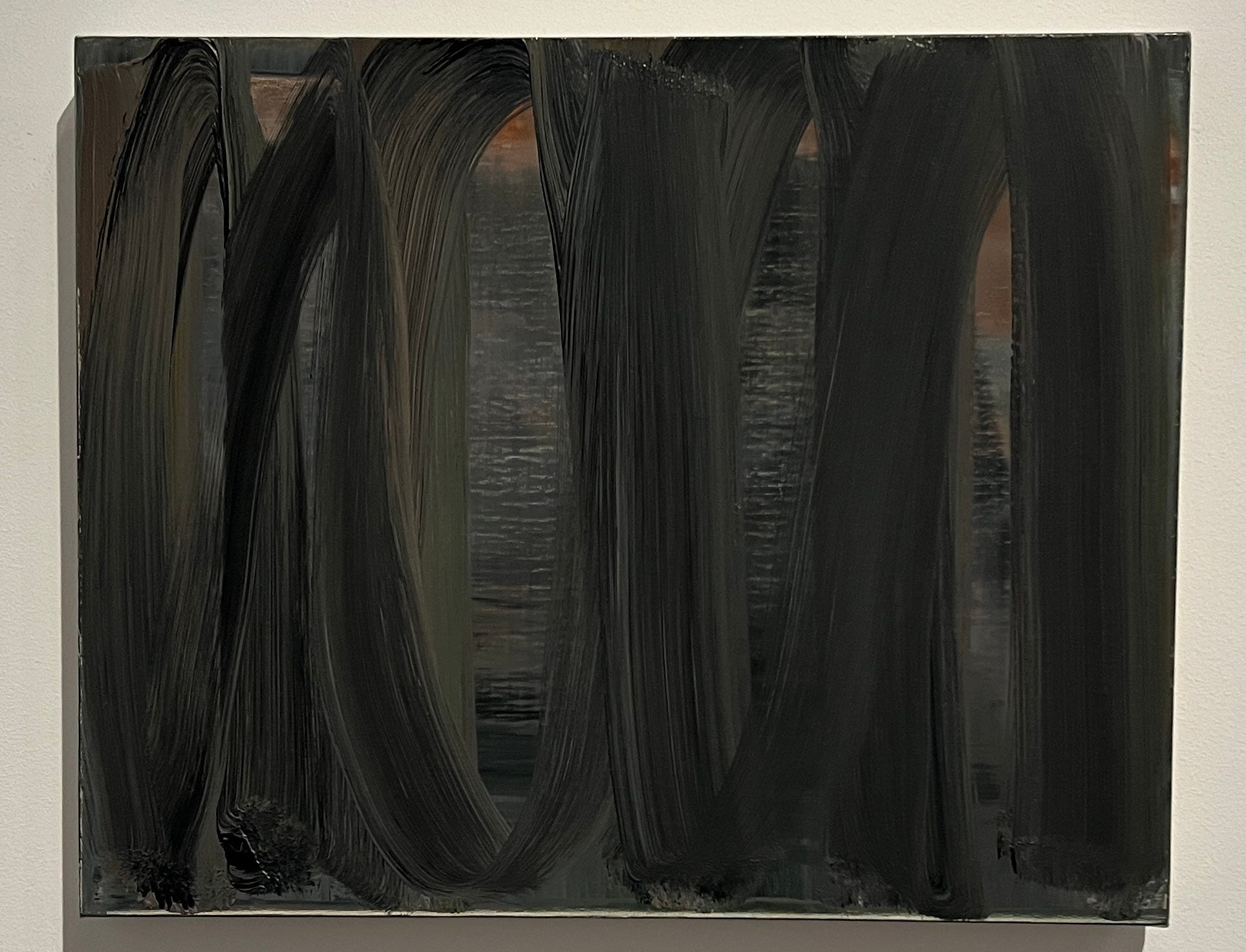
On a quick trip to the permanent collection galleries on the lower level, I was startled by a fantastic hoard of art by Gerhard Richter. A hundred works covering his entire career are on “permanent loan” to the museum, a condition that will afford him and his heirs an ongoing role in the arrangement. Some excellent things, they make the Neue Nationalgallerie a key repository for this most famous of living painters, now 92. It includes richly coloured ‘squeegee’ abstractions, as well as the recent sombre and troubling ‘Birkenau’ series. There are some Berlin-themed grey scale Atlas pictures like the ones that launched him in the 70s, among other wonderful things, such as a wall-full of Overpainted Photos from the 90s—the little paint-smeared snapshots that I find as exquisite as Renaissance miniatures. Richter’s corpus embodies the story of post-war Germany, an epic of resourcefulness, ingenuity and redemption despite the darkest history on record. He will always be a reference for German art, a figure who matured under one political ideology to become a global phenomenon under the other, and with the grace with which he moved back and forth from figuration to abstraction.
As for the museum’s permanent collection display, it tells a good story, not one that suits this year’s curatorial fashions, but the tale of what actually happened in German modern art through choice examples, including work by non-German artists who were influential here. Even significant works from the once communist east are presented, a decision that I found intelligent. Brief, clear, and smart didactic panels, in German and English, don’t overwhelm the art. This is how it’s done. I’m presuming that the same team will plan and install the collection at the forthcoming Berlin Modern annex, so that’s something to look forward to. Maybe they’ll finally take down the temporary walls inside Mies’ great hall and fill it with installations and big sculptures. That could be glorious.
Afraid to be late for lunch, I raced through the Warhol film galleries, having seen many of the moving icons before. I raced even faster through the shop, just long enough to overhear two men looking at a T-shirt—a Warhol painting of a very long penis. “Oh,” said one to the other, “I thought that was a neck tie.”
4
My late lunch was with a senior artist who may also have suffered from the paternal neglect in infancy that leads to prominence in adulthood. We had hoped to share artworld gossip from either side of the Atlantic. Due to our advanced age, however, we couldn’t remember anyone’s name. Gossip and anonymity being incompatible, we reverted to trading anecdotes about the benefits and bother of aging, salted with ageless snark about the lamentable state of the world. It was a fun lunch.
Afterwards, I headed to the Hamburger Bahnhof to meet with artist Jeremy Shaw. As its name suggests, the Bahnhof used to be the station where you caught trains headed northwest in the direction of Hamburg: a Musée d’Orsay for contemporary art. I was already a fan of Shaw’s, but after hearing a pair of German curators gush the night before about his seven-screen video installation, I was itching to see it.
We greeted at the door and moved toward the great hall where we stopped a moment to catch a performance of Alexandra Pirici’s Attune. I immediately spotted a portly security guard facing the performers. A figure out of George Grosz, he rolled his eyes at them, opened his arms like an orant begging for mercy, then turned his back, folded his arms with a huff, dropped his head in despair and shook it theatrically. The cartoon rustic did everything but thumb his nose at the earnest young performers and flip them the bird. He couldn’t possibly have been part of the piece because his victims appeared so unsettled by him. In fact, he was so distracting that I couldn’t tell you a thing about the Pirici. We walked on
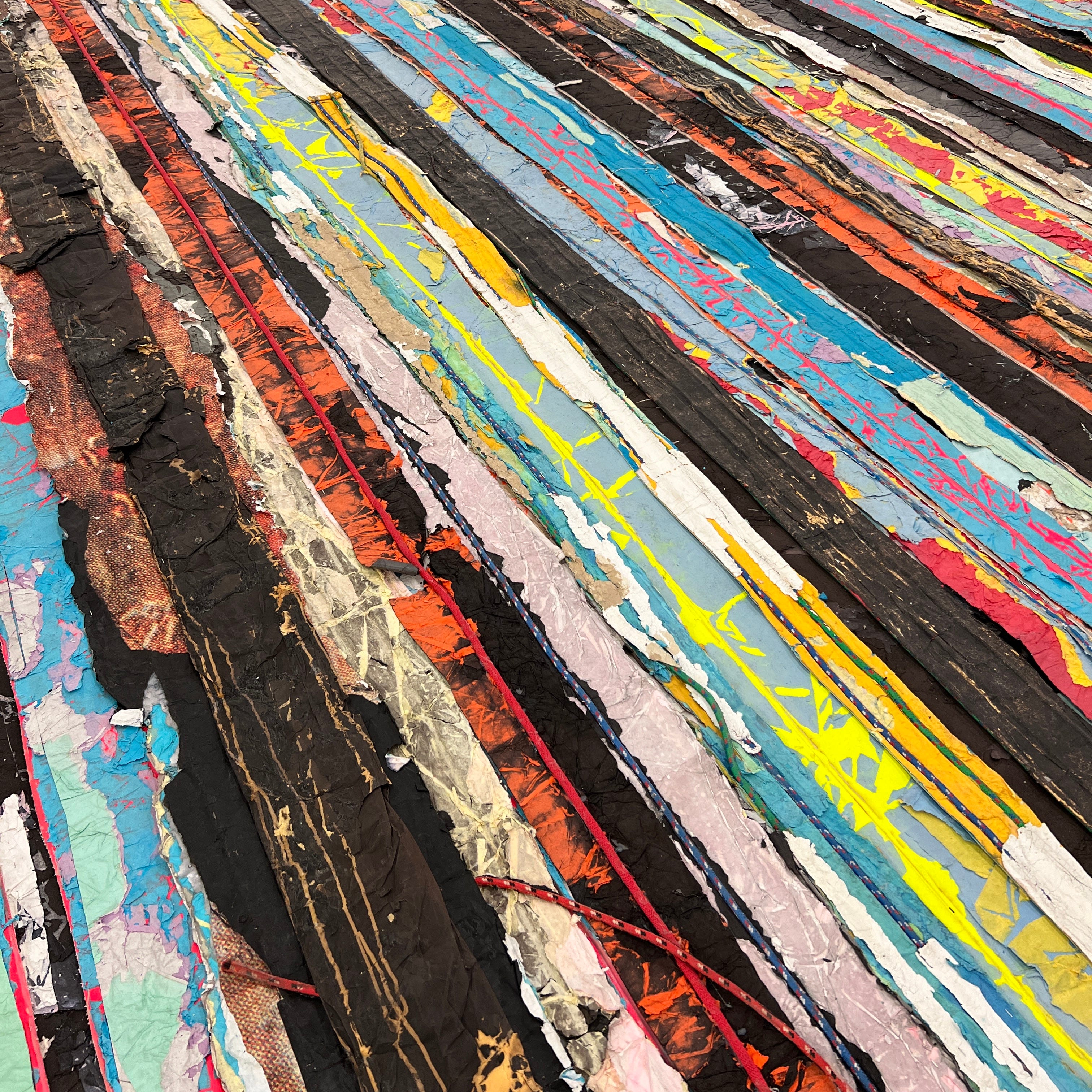
Jeremy wanted me to see his Phase Shifting Index (2020) from the beginning, so we ducked into the Mark Bradford show. An artist and philanthropist for whom I have enormous admiration, President Biden recently gave Bradford a well-deserved medal. His work Float, 2019-24, is meant to be walked on. It’s a giant braided carpet of torn-up paintings that covers the floor of an otherwise bare gallery. It looks like a giant catalogne, the thick rag rugs of my backcountry foremothers.
Standing on this work was not at all like standing on a Carl André sculpture of metal tiles. First of all, you could trip on the rough surface, and it scrunches rather than clinks in response to your step. I remembered walking on a massive Richard Serra steel sculpture decades ago, directly beneath an identical plate installed in the ceiling: terror! Bradford takes walking on art to a different emotional dimension. It’s like visiting a site of epic tragedy that must have been bright and beautiful before it was shredded beyond reimagining, and turned into something else altogether. I thought of transubstantiation, of dogged optimism, and of art’s perpetual rearticulation of luxury and beauty. And, of course, I thought of once-flattened Berlin.
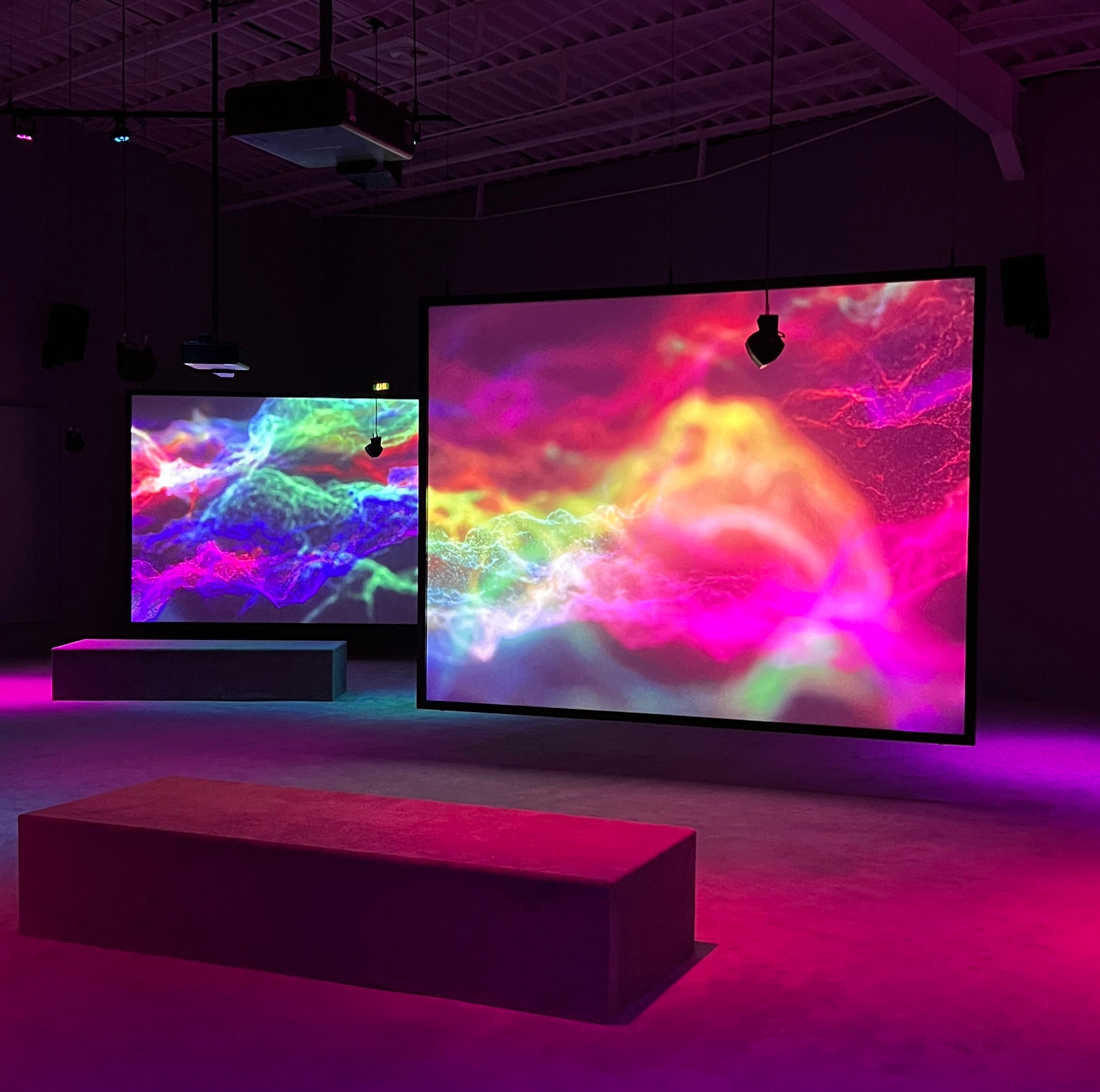
Shaw led me into his gallery when the time was right, and left me with the promise to collect me in half an hour. I moved about the room to take in the installation, then perched myself on the carpeted bleachers facing seven large screens staggered forth and back. Projected on them are an assortment of films and videos, various time-worn artefacts of “new media.” Each one shows a peculiar form of group dance or coordinated movements.
Working from memory, in one black and white projection, a troupe wearing 70s gym togs goose-step through calisthenic paces to the click of a metronome. On the right, in the garish colours of 90’s public access TV, a deranged band of death metal nihilists feign epilepsy. At one point, a sweaty girl barks “Fuck the world!” with increasing earnestness. To the far left and at the back, in softly degraded 80s VHS hues, the movements address isolated body parts; there’s talk of chakras and pressure points. A grainy black and white projection shows a spotter attending disheveled young subjects moving in a trance. I spent the first 20 minutes trying to identify the subject of each projection and what might connect them, beyond bodies in motion.
Despite their categoric difference one from the other, I felt a haptic euphony to the disparate choreographies. Was there a theme they all shared and, if so, what should I call it? As I was struggling to synthesise the data before me, the incongruent soundtracks converged and the movements became coordinated across all screens. I was looking at one dance now, instead of seven, as the work synthesised itself. The previous cacophony merged into a single powerful beat; my body responded automatically to the unified rhythm and I became a virtual dancer myself.
By the time I deduced that, to reach this synchronicity, the recordings must each have been staged rather than found, the beat faded into a dirge and the image melted into a smeary red abstraction reminiscent of Richter’s signature blur. Discernible body parts floated by in an electromagnetic ooze. I thought of the human fragments that similarly float past the famous Ghat at Varanasi where, for lack of firewood, impecunious Hindus are only partially cremated. I thought of the chaos of our origins and destiny. Then the whole thing turned to particoloured pixel dust, wafting apocalyptically in a soft breeze across the seven screens. I teared up.
Though it did nothing to alleviate my chronic dread, I love this work. It’s Shaw’s verisimilitude that stays with me. It came back to mind when I saw the elegiac Fischli and Weiss show a week later at Matthew Marks in New York. Like them, Shaw turns mimesis into its own subject. Unlike the Swiss duo, Shaw is also known for using found documents, so he sets you up to presume.
For me, Phase Shifting Index explores the idea that we are still blind to ourselves, despite a mind-bending capacity for self-observation and centuries spent in self-reflection. Our favourite subject, we have built institutions and specialisations to help us understand our species, its cultures, subcultures, and quirks. We know how to gather infinitesimal amounts of data about humanity to make uncanny representations in countless forms. And yet we retreat to the comforts of our archaic illusions, the old faith that revelation will come from within, and from fully inhabiting our soulful bodies, rather than more reasonably inhabiting nature, which too many of us consider external and alien. Maybe that’s because we have to think in order to understand and productive thinking requires isolation and introspection. Is the cult of interiority a professional deformation of our thinkers?
Shaw’s work makes the point that we seek revelation inside ourselves, be it through faith, ego-suppressing substances, putting our bodies in extremis, or all three. But the larger point that his verisimilitude makes is that knowledge, and arguably truth, comes most successfully from without, by describing ourselves and our world from an objective distance. That we have the capacity for both is our great advantage as an organism. To be the sensate thing itself, genuine and specific, and, to be imaginatively outside the thing enough to grasp it, is the “sapiens sapiens” duality that defines us. Or at least that’s what was going through my head as I reflected on Shaw’s magnificent work, which the label says the museum has acquired.
5
Caroline Monnet had an opening that evening at Setareh. I’m still proud of the show we presented of her work earlier this year at Arsenal Contemporary New York. Monnet fuses Indigenous symbolism with industrial housing materials. She’s a consummate inventor and also a good conversationalist so I was happy to run into her in Berlin. The gallery’s director, Lee Plested, is from British Columbia and also fun. A number of ears must have been burning in Vancouver because he is still young enough to remember names.
There’s a tension between the Indigenous traditionalists and those who, like Monnet, show in the big tent of global contemporary art. The first are engaged in transmitting the timeless forms and skills handed down to them by an unbroken sequence of elders going back to the remotest ancients, the sorts of things you would see in places like the Humboldt Forum only new. You could call them conservative, which they are in the most authentic way. The incomprehensible stability of the forms these artists are preserving goes back largely unchanged, not hundreds of years, but thousands in some cases. I’ve seen five-thousand-year-old stone objects that are stylistically indistinguishable from things made today by someone you could shake hands with. There is no equivalent in European art, which is a story of discontinuity and formal instability by comparison, with the notable exception of the hand-made tools that Rondinone gilded.
And then there are those Indigenous artists, such as Monnet, who animate their people’s wisdom, lore, and cultural perspective for a global audience. They integrate new ideas, new forms and materials to express the point of view of an ancient living culture engaged in the larger reality of life today. This latter category has been growing in prominence for decades in the art world, alongside new art from every other society where artists are encouraged to invent. My solemn respect goes to the first group, but my enthusiasm belongs to the second.
If you wanted to be critical, the ‘traditionalists’ might be accused of ossification and nostalgia, while the ‘contemporaries’ of assimilation and self-tokenism. Both critiques are wrong-headed. Although I’m more partial to the second group for relating to my own mentality, both perspectives are not only legitimate but socially beneficial. Europeans and their colonials can visit the pantheons of their abandoned ideals, museums full of functionally expired artefacts, named and explained in their own languages. Colonised people, on the other hand, have typically had their cultures and languages taken from them through conquest and forced assimilation, along with the treasures that anchor identity. These are typically held in far-off collections like the Humboldt where they are interpreted by others, though Indigenous voices are starting to become increasingly prominent in such settings at long last.
The eternal recurrence of ancient forms says something profound about humanity that does not necessarily bolster arguments for ‘ethnicity,’ but rather for the resilience of collective choice, especially when faced with threats of cultural erasure. Unfortunately, the equally profound heritage of linear disruption and endless caesuras unjustly overshadows the complementary truths of cyclical recurrence. Progress is a great thing, but it’s also evidence of a curse: the obligation to continually innovate as a domino consequence of radical changes that first occurred too long ago for memory. It’s wrong to presume that stability of forms and cyclical life ways are in any way inferior, let alone “primitive,” compared with the progress imperative of linear cultures. We are retiring such ignorant terminology with reason. How can a culture’s successful evasion of the innovation treadmill, with its looming resource exhaustion, associated climate collapse, and disquieting psychic effects be construed as inferior? That’s illogical. Alexander von Humboldt understood two centuries ago that sustainability is the answer and that forced assimilation is like burning libraries. For the people who made the objects now gathered in the shiny new Forum that bears his name, sustainability may have been his insight, but it was already their ancient faith.
A ‘big tent’ booster when it comes to art, for me, inclusion is not an ethical issue but just common sense. It’s not for reasons of fairness that talented women like Caroline Monnet should be encouraged, but because the culture is blinkered and impoverished by a single-gender perspective. Similarly, when people from entirely different cultural, historical, or economic backgrounds avail themselves of the radical freedom that contemporary art allows, our understanding of humanity is enriched and expanded. With art, we learn things about ourselves that are not to be discovered elsewhere, certainly not as efficiently, elegantly, or with the same poignancy. For example, it was eye-opening to discover, through non-representational abstraction, that we could dispense with symbols to communicate emotionally across cultures. Inclusion multiplies the perspectives that a metaculture can encompass to the extent that civilisation becomes an honest aspiration, and not just the pretence of achievement. Through diversity, art can match the universality of science by other means, by introducing complexity and a constant expansion of aesthetic intelligence. You might protest, “But that’s progress!” I prefer to call it solidarity.
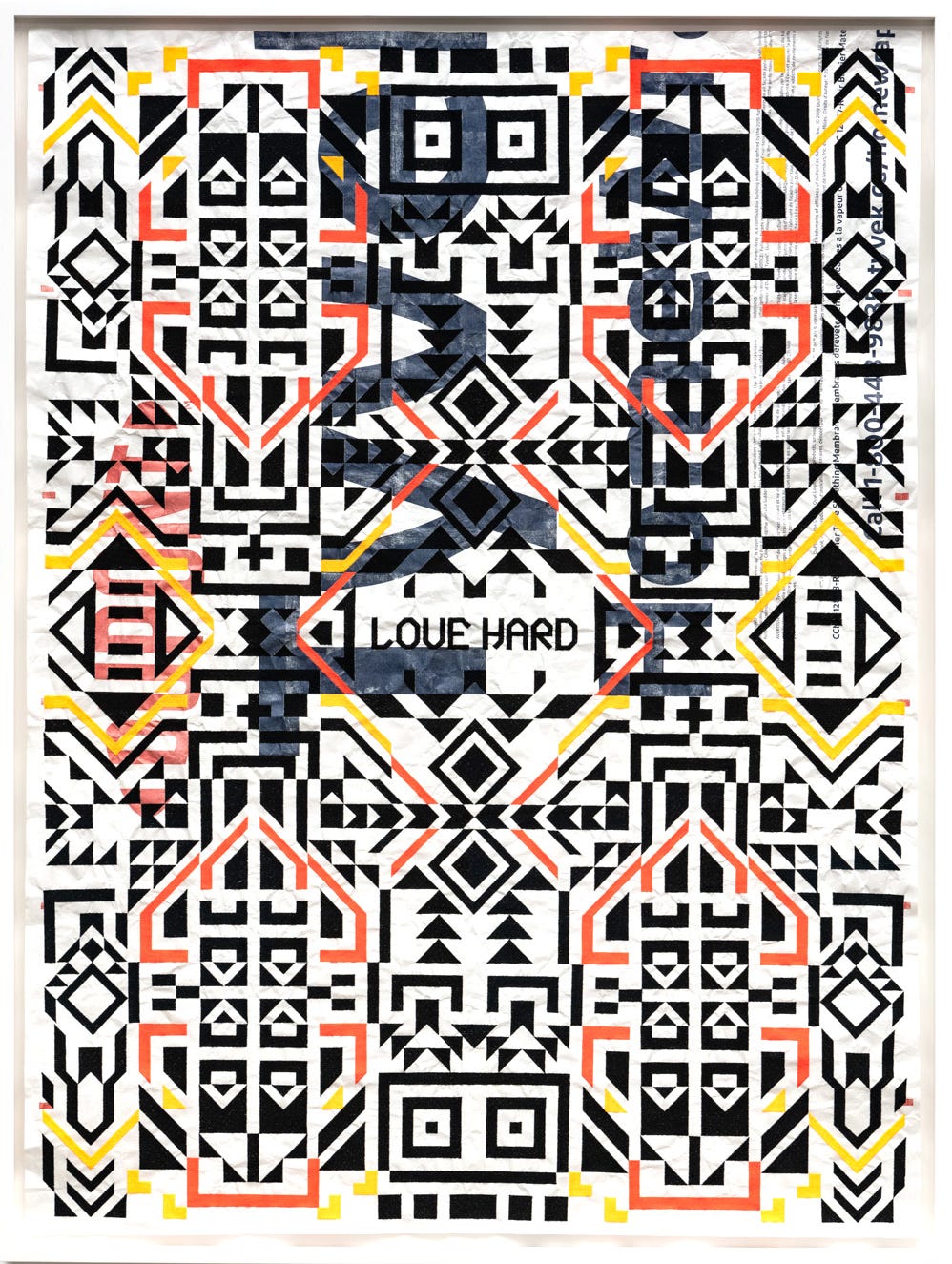
In the traditional Indigenous cultures of North America, those practiced by Monnet’s Anishinaabe ancestors for example, shelter, clothing and ritual objects are derived from, and informed by the environment: plants, animals, and the elements. Her work explores what such practices look like when made with the hyper-specialised, purpose-specific materials used in contemporary house construction. Not only does her approach permit a wide range of creative experimentation and surprising new forms, it also invests her work with a sardonic lyricism and a scalable metaphor for what it’s like to be pre-agricultural and post-industrial at once. The specialisation inherent in modern materials is flouted in service to beauty and wit. Maybe I was projecting, but the Berlin audience at the opening did seem to get it.
6
The next day started with a visit to the Thomas Schulte Gallery to see the modest Rebecca Horn show. With the artist’s death at 80 a day or two before, it became a memorial. There was a lit candle, flowers, and her framed picture on the counter.
When I was coming up, my women artist friends all admired Horn. A German artist of considerable originality and versatility, she was a contemporary shaman, after a German fashion. Kurt Schwitters’ line: “Was ein Künstler spuckt ist Kunst” (“What an artist spits is art”), summarises the neo-shamanist vein that runs through German modernism and post-modernism. Joseph Beuys is the most familiar shaman-artist, self-styled in his case. Like his, Horn’s work expands what we mean by shaman practices, closer to a personal visual poetics. Horn is known for unorthodox and poetical juxtapositions of found objects animated by small motors, and even her body in the case of wearable sculpture, for which she is also known.
The last echt German shaman probably died a thousand years ago, whereas Anishinaabe equivalents are still part of their contemporary communities, dispensing sacred medicines and interceding with the spirit world. What does it say about contemporary art that modern Europeans like Horn and Beuys make the spirituality of materials and actions central to their aesthetics, while a contemporary Anishinaabe artist like Caroline Monnet does not? My own thought is that post-formalist artists like Horn and Beuys use their non-conformist iconography to make more room for anecdote and sensibility, rather than to revive shamanism. For them and even non-Germans such as Marina Abramović or Matthew Barney, ritual and shamanic models are convenient strawmen that helped them think their way out of semiotically neutral formalism and back to the production of meaning.
Monnet and other contemporary Indigenous artists, on the other hand, are investing art with the signs and spirit of their inherited specificity. They explore avenues of resilience and dissemination for ancient living cultures brought to the brink of extinction by foreign domination. Shamanism is too local and hermetic a strategy for that and, besides, you risk inviting charges of affectation or sacrilege. By attempting to universalise cultural specificity, facilitated by enlisting contemporary art’s ever-expanding inventory of tropes, non-European cultures can mitigate exotic alienation and assert themselves in the global context. That’s what I mean by the enrichment that a big tent perspective offers both its audience and its practitioners, a place where specificity and universality can negotiate with each other toward general elucidation.
Like Indigenous artists of either school, Rebecca Horn uses shiny copper in some of her work, such as the installation I saw and another smaller work nearby. It took me a while to appreciate the point of the copper funnels that sprout like flowers from the pile of broken skids in the middle of the room. In truth, I only got it when I read her poem, of the same title, stencilled on the wall to animate the piece. (Reprinted verbatim):
Concerto dei Sospiri
A pile of debris.
From the rubble of venetian houses
the copper funnels grow like blossoms
guarded by an old woman
veiled in dust.
Marat speaks from the opening in his grave
a shoulderblade pierces through his suit.
Whipping the walls with laurel branches
until stones jump out from the piles of debris,
clinging fearfully to the walls,
drawing the faint blue of the heaven-cloud.
Voices whisper from the copper funnels
lamenting in many languages their pain
the storm swells to a scream,
beat of black wings over the embers.
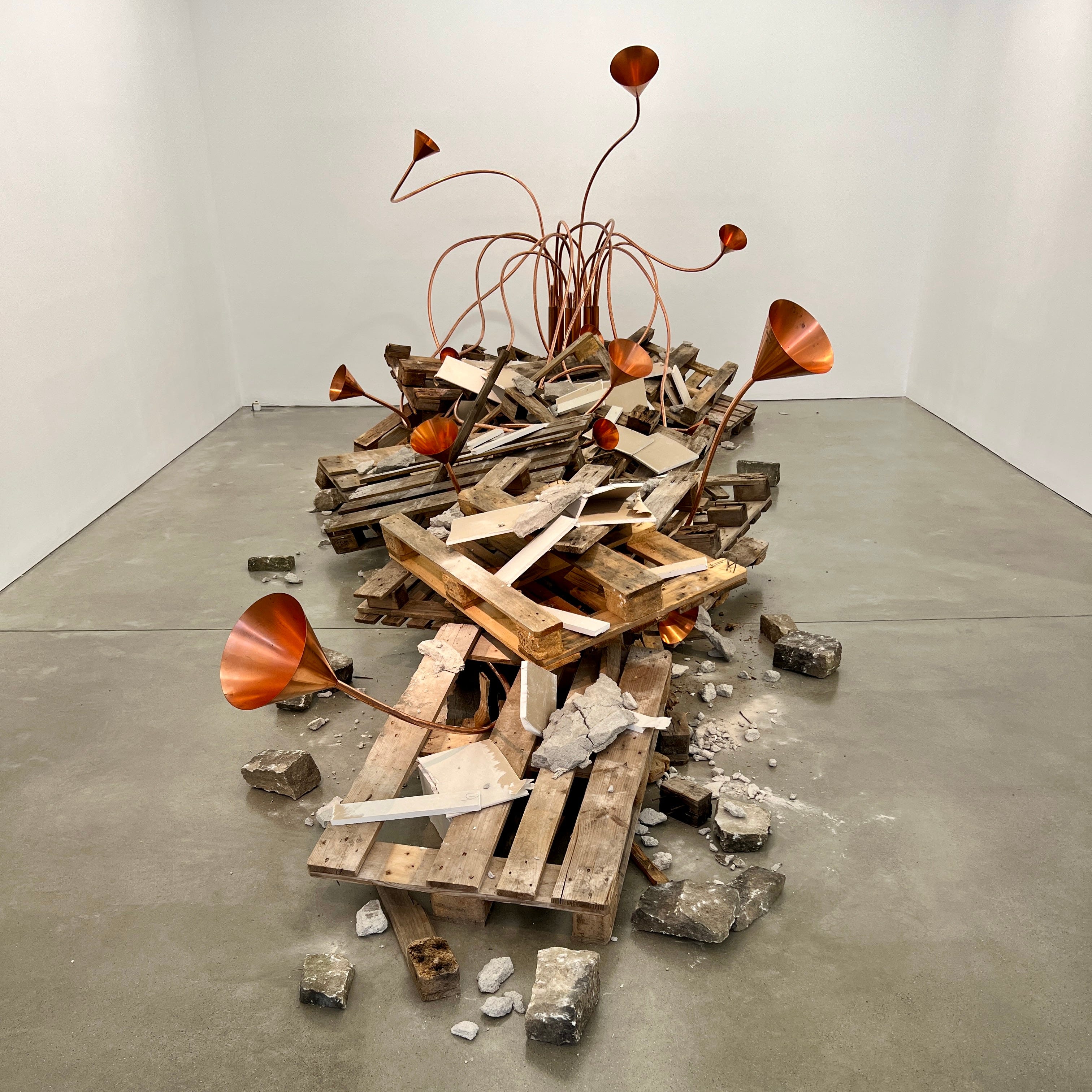
She wasn’t so much suggesting that the conductive copper funnels will help us hear the ghosts in the debris, but rather that they can enable the dead to speak. They are intended to assist the mute rubble, rather than its perceiver. I heard faint whispers emanating from the piece in various languages as it gradually went from messy to creepy in my mind. The work was first shown in the Venice Biennale of 1997, a city where sighs have their own bridge.
Her work is also poetically absurd, following another vein of German modernism since Dada. For example, a kinetic work entitled Schlupfloch (Loophole), 2019, shows the mechanised intercourse between a seashell and a hairbrush that slowly turns to stopper the pink nacre cleft. Bristles slowly comb the air before the brush becomes a door. Telepathically, the motorised movement echoed Jeremy Shaw’s choreography for me, but very, very faintly, and in another tongue.
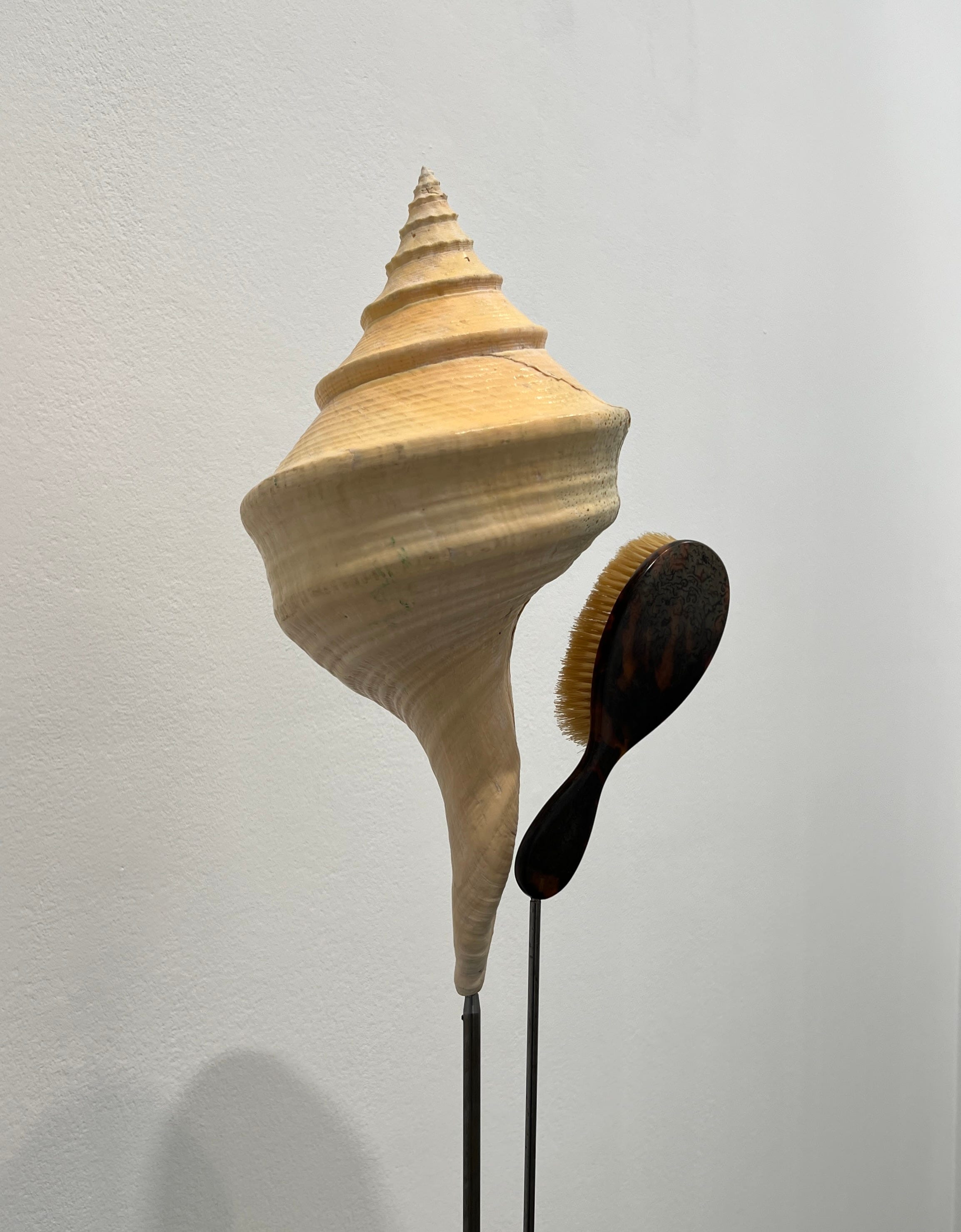
Horn’s materials and found objects become autonomous actors through a practice that transforms the artist into more of a mediator than an author, or better yet a medium. I thought of Anselm Kiefer, a very different German artist who also occupies himself with exorcising the past, though a more specifically German one. And I couldn’t help the cliché feeling that, like her installation, Horn herself was speaking posthumously through the fragments of her personality in the room. Cringe if you like, but I felt it.
7
After hitting a dead end that my phone’s map hadn’t updated; and after trying some locked doors facing a small plaza, I finally found the entrance to the Schinkel Pavillon under a shadowy porte-cochere. I had come to see Bice Curiger’s dense survey of the late Sigmar Polke.
The condensed show was shoe-horned almost brutally into all sorts of unorthodox spaces in this modest and odd post-war facility. Given the artist’s signature informality, though, it worked.
Sigmar Polke belongs to the German post-war genius generation that zoomed to the top of the international art world, not unlike the post-war German car industry. He took Anglo-American pop art and soured it, dragged it down a dirt road at night behind a loud, carbon-belching Volkswagen, figuratively speaking. His work can be tough as shoe leather but also silly and impudent. Histrionically sentimental, the cheap printed fabric he used instead of canvas evokes for me, metaphorically, a sweet child enduring an oblivious parent sick with drink. Polke is definitely an acquired taste, but he can sneak up on you emotionally if you let down your guard. Just when I think that he’s my least favourite of his generation’s celebrated artists—because he’s pessimistic, self-indulgent, or not rigorous enough for a square like me—I come across a picture that scrambles my evaluation because of its inexplicable rightness.
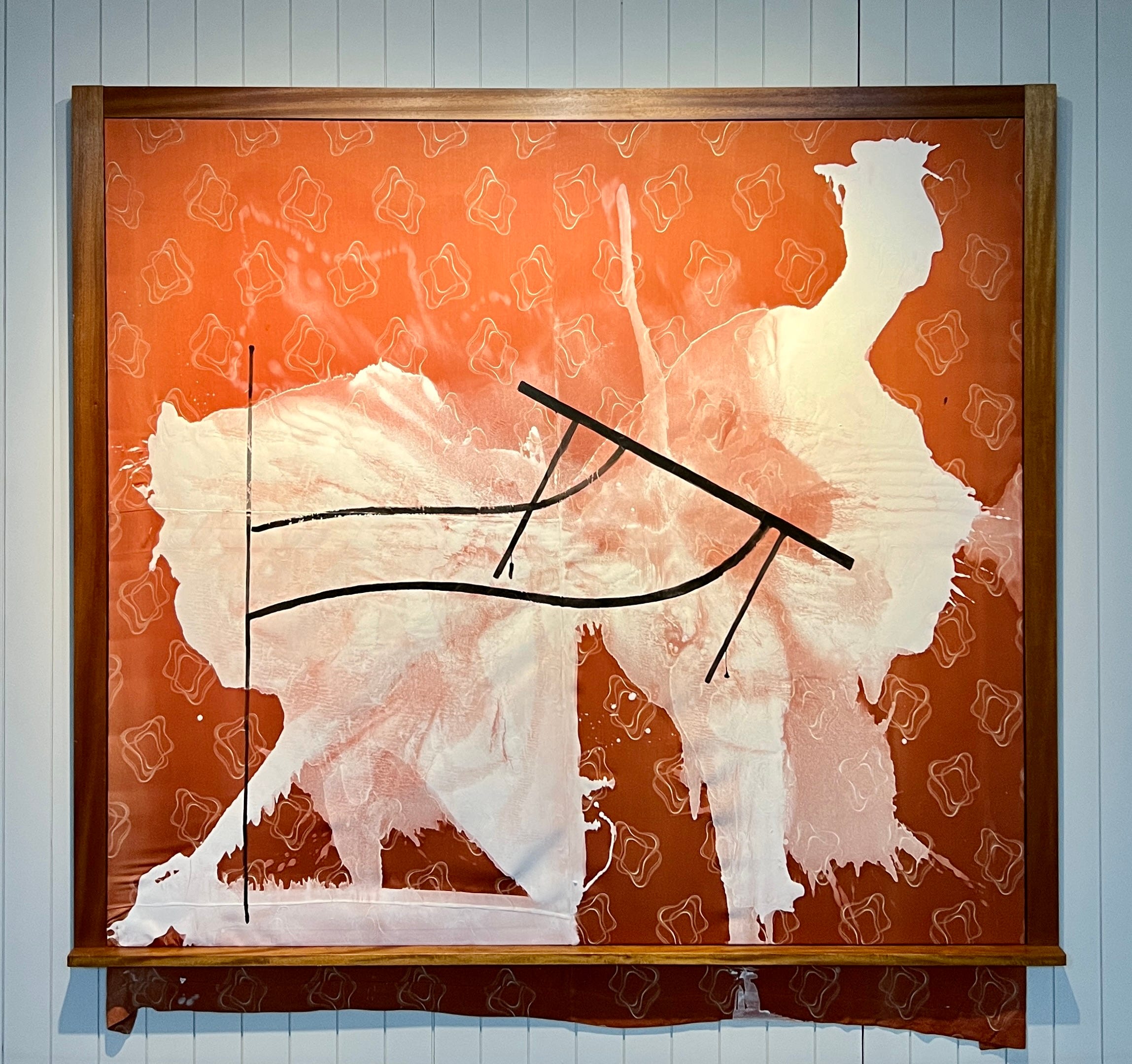
Polke’s unorthodox practice pulls off emotional parlour tricks that are unique within his cohort. I’m thinking, for example, of Tischrücken (Séance) [Table Turning (Séance)] of 1981, at once deliberate and random. A printed length of burgundy fabric is spread with a big load of white paint that comes to resemble a trilby-hatted ghost escaping the picture plane: Monsieur Hulot in a tutu? A flying, rubber-legged table is diagrammed in black across the elongated figure. It’s also frozen in mid-scram. Spooky, silly and weirdly compelling, this big square mess is one of Polke’s most reproduced pictures. Rather than intentional art, it looks like a salvaged studio accident that the artist laughs off, the vision of a clownishly nihilist clairvoyant. Schopenhauer, the great pessimist, felt that art’s role was to console us for a life of bad news. Is Polke contradicting the philosopher by making a work of art that couldn’t possibly console anyone, aside from a vandal? And yet it makes me feel lighter and less encumbered by my taste.
Polke was also a shaman. By comparison, his teacher Beuys was a showman. I don’t say this to denigrate Beuys because, as showmen go, he was among the finest. But Beuys had a libretto. Polke’s magic is real and unscripted. He walks a slack tightrope between psychosis and epiphany.
I had never seen any of his films. One in particular in this show stays with me, Der ganze Körper fühlt sich leicht und möchte fliegen (The Whole Body Feels Light and Wants to Fly), 1969. The part I saw shows him walking along a rough masonry wall and, every few feet, putting his ear to the stone.
8
The last stop of the day, and of the trip, was the Gropius Bau two blocks west of Check Point Charlie. It’s a favourite place to see new art. Martin Gropius designed the museum that reminds me of an enlarged Bargello. Opened in 1881, it’s a cube, sgraffitoed on the outside and frescoed on the inside, with a big atrium under a glass-roof. Badly damaged during the war, the architect’s more famous grand-nephew, Walter Gropius, lobbied for the restoration. It reopened in its centenary year, 1981.
In ‘84 or ‘85, I got to hear my then hero Holger Czukay perform in the atrium in a fantastically disappointing concert. He didn’t play a single hit, though there was only the one, Persian Love (1980), a narcotic aural collage that I play quinquennially to conjure the innocent years. The pioneer of sampling jammed with himself on his uncooperative machines, in a vain attempt, I gathered, to create a new piece of music on the spot. That’s what I took to be the point of the confusing event, packed with fellow fans who frequently erupted into paroxysms of boos.
I was glad for a second chance to see a big Rirkrit Tiravanija show; I stupidly missed the recent one at P.S.1. It too will be fantastically disappointing if you haven’t been properly briefed. Tiravanija is central to Nicolas Bourriaud’s “relational aesthetics.” Even if you know what that is, you’re still wandering through a long series of rooms where something happened at some point, but nothing is happening now. It was a good workout for my imagination as there weren’t enough ‘interactors’ at that hour—the word ‘viewer’ isn’t quite right for this artist—to activate most of the pieces. An exception was the installation where staff were screen-printing phrases redacted by black bars on give-away T shirts. That room was thick with impromptu collectors. Until you get the hang of Tiravanija’s practice, you’ll have to read the labels or talk to someone savvy. I got plenty out of the show, though I didn’t wait for a T shirt.
Rirkrit was briefly an art handler at 49th Parallel, Centre for Contemporary Canadian Art in New York when I worked there. That was 35 years ago when SoHo was Chelsea. A Thai national, he was part of the Canadian artist community in New York in those days for being an alum of the Ontario College of Art. Now OCADU, I seem to recall a residency that the school ran in New York in the 80s for a handful of students a year. The ambitious ones stayed behind to launch their careers. Despite not being an object maker, Rirkrit’s is among the very few that launched.
In 1990, I was at the Paula Allen Gallery in SoHo where he first cooked pad thai at an opening. That’s all that opened that night in the empty space. But despite there being nothing to look at, it roused the shared elation of a good party. I didn’t know what to make of Untitled (Pad Thai) as art quite yet, but I liked the food and there was a nice turnout for what would go down as a legendary event. I promptly moved to Paris and forgot all about it. Soon enough, though, Rirkrit was creating his situations in Paris too, having become a paradigmatic figure on the international scene.
Tiravanija, who teaches at Columbia and spends part of the year in Berlin, is a best-next-move type of vanguard artist—among the last of the breed it appears. His work will be more easily appreciated if you think of modern art as a sequence of eliminations. By eliminating the subject, abstraction wrestled form away from reference. Hiding behind commercial iconography, pop artists eliminated themselves. Minimalism was elimination tout court. Conceptual art is misconstrued as having eliminated the object; what it really banished was manual skill, which had still been part of abstraction, pop, and minimalism. Idea Art, conceptualism’s other name, may not be very physical but creativity is still work. And conceptual art usually involves looking at something, a documentary photograph, an orphaned label, or some words on the wall.
Tiravanija’s work eliminates the subject, the object, the artist, and, unless he’s cooking for a crowd or silkscreening T-shirts, skill and labour as well. Looking is demoted to seeing and ‘viewers’ make their own fun. Ingeniously, such radical art is perfectly legitimate, thanks to art’s aggregator function. Openings and exhibitions are social situations fundamental to artistic culture. For Tiravanija, an heir to the Dada-Fluxus tradition, everything is social—the artist is a party planner, an event coordinator, a host. Besides dollops of leftist politics and a strong whiff of civics, that’s it. He makes nothing in any conventional artistic sense, certainly no objects of contemplation. Just think of the millennia of looking that he’s engineered out of art’s equation, to say nothing of things to buy. Duchamp objected to what he called the “retinal hegemony,” but you still need a retina to take in a Duchamp. Not so Tiravanija; you just have to show up, or hear about it later. It's dry as dust once the revellers are gone, but not uninteresting. Creativity survives, but the signal is weak.
The slogans on his printed T-shirts, wall graphics, and recycled Thai newspapers are typically borrowed riffs or quotations: Power Doesn’t Work Here (adapted from Lord of the Rings); Fear Eats the Soul (from a Fassbinder film); Police the Police (a found urban mantra); Never Work (advice from Guy Debord). They can be alarming too: The Days of This Society Are Numbered (more from Guy Debord), or confrontational: Rich Bastards Beware, paraphrasing a French Maoist slogan of ’68. These borrowings, or recyclings, do triple duty as recommendations, knowing winks, and identifying subtitles for his untitled works. The title of the show, Happiness is Not Always Fun (Fassbinder again) could serve as an apologia for the dormant art I saw. Through the use of quotation, a ghostly residue of pop settles over Tiravanija’s work, but his ego is ghostlier.
A good label can turn indifference to admiration. I left most of the verbose labels unread, being already an admirer, and I was running on empty. Working with the web site, and at random some weeks later, here’s what I remember. Untitled 1996 (Rehearsal Studio No. 6), is enough musical instruments to equip a band; you’re welcome to play, and why not with strangers. In the big central atrium where I’d watched Czukay flip switches, there were a number of activities including Untitled 2024 (Tomorrow is the Question)—from the Ornette Coleman album—eight ping-pong tables ready to play; the foreboding subtitle is printed on each tabletop in a different language and colour. I peeked inside an orange tea-tent, Untitled 1994 (Cure), where you can make yourself at home and choose from a few Thai teas; the colour honours the Buddhist ethos: fellowship over materialism. Untitled 1993 (sleep/wake) is a squat in one corner of a large gallery, with a clean sleeping bag, a camp stove with some food to cook, and a TV monitor playing Godard’s La Chinoise, a film of 1967 about radicalised youth. One of my favourites is Untitled 1994 (Angst essen die Seele auf) or Fear Eats the Soul, a reprise of the Fassbinder film quote he put on T-shirts and newspapers. The Gropius Bau iteration is a long bar scattered with yesterday’s empties where a radio at one end was playing Turkish Arabesque, which I happen to like. I felt a bit forlorn in there, though, like the guy who got the date wrong. Unless you were at the opening, or there during high attendance, Tiravanija’s work is all aftermath.
9
Berlin’s aftermath ambiance was still palpable in 1984, but there’s not much left of that now. Perhaps the most contemporary city in Europe, human-scaled, shiny and new, it wears its history frankly, but lightly. The past feels past and only artificially present in monuments, memorials, and the occasional bullet-riddled façade that survived the carpet bombs. The people I encountered on this recent trip were cheerful and relaxed.
But great national traumas take generations to fade. "Cheerful and relaxed" is not how I would describe the East Berlin of forty years ago; I found it ontologically sad, a place where smiles required alcohol. When I returned five years later, the wall had come down, but the DDR administration remained in place, and there was still a border for foreigners. To cross over to the east for my train to Prague, I was locked in a room with a sullen young officer who stamped my passport as if to puncture it. (His ink pad had run dry.) Pump Up the Jam was playing on his transistor as loud as it would go. Though his country had all but evaporated, he could still make me nervous as hell.
To take the train, I had to line up so that a gruff clerk could tell me the schedule, then line up again to reserve a seat, and a third time to buy the ticket. Communism solved unemployment by exploiting inconvenience. The taxi driver from West Berlin who had taken me to the Lichtenrade station (no border for him) summed up his anxiety: “We’re about to absorb sixteen million welfare recipients who don’t trust newspapers.” 1989 was exhilarating, but my West German friends had stopped celebrating by 1990.
What was East Germany? The Potsdam Conference of 1945 had transferred large parts of what had been Prussia to Lithuania, Russia, and especially Poland. Stripped of its name, what remained of Prussia—aside from the three-quarters of Berlin filled with Allied forces—became communist under Soviet occupation.
Today, feeling left behind and disillusioned, a high proportion of the former collectivists support the far-right Alternativ für Deutschland party that wants to ditch the Euro, dump NATO, check immigration, secure the borders, reverse the gains of the “anti-family” feminist and LGBTQ crowd, all while muzzling the press to make Germany "great" again. You would think that the Gollum Putin dreamed up the AfD as yet another of his monkey wrenches, but it’s homegrown and born of reunification woes. Stoking reaction and xenophobia might get a fool elected, but with decades of negative birth rates, Germany needs immigrants like anaemia needs iron. Sure, it can make up some of the difference with robots, but being the champion of automation won’t cheer up a proletariat born angry.
Germans are as old as German hills, but the country is younger than Canada. Prussian leadership engineered Germans into an empire in 1871. So what was Prussia? The first, or “Old” Prussians were indigenous Balts whose language was related to Lithuanian and Latvian. They were slowly conquered in the 13th century by the Teutonic Knights, a German religious order of medics fresh from tending to wounded crusaders in the Levant. At the invitation of a Polish duke grown weary of his uncouth neighbours, the Knights, blessed by the Pope, became a Christianizing army to launch the Prussian Crusade. After forcing the heathen Prussians to pray for their sins, the Knights colonized them into extinction and assumed their identity.
Fast forward to Frederick the Great, whose grandfather transformed a dukedom into the kingdom of Prussia in 1701. The capital was moved to Berlin from Baltic Königsberg (now Kaliningrad in Russia), where the Teutonic Knights had built their fortress. Frederick’s father, the Soldier King, was a pious brute who left his son a massive army and plenty of trauma. When the teenager had tried to run away from home with his best friend, he was caught. To punish the boy, his father forced him to watch his friend’s decapitation. Frederick was a wild-eyed imperialist by the time he was king at 28, but he also had a taste for philosophy and décor. And he played the flute. An advocate of religious tolerance and freedom of expression, he supported the arts. It was he who introduced his peasants to the the joys of the potato. Their descendants are still grateful and keep fresh spuds on his grave at Sans Souci, where he’s buried with his dogs. But dear “Old Fritz” was forever marching his boys off to war, compulsively invading his neighbours—Austria, Bohemia, Poland, Bavaria. It was he who started the Seven Years War in 1756 by invading Saxony, foreshadowing future global bloodbaths with domino consequences to this day, including for my own French Canada.
Later, there was Otto von Bismarck, the wily landed Junker and son of a cold mother. Named the Prussian Kingdom’s Minister-President in 1862, nine years later he would become the “Iron Chancellor” of an Empire after winning the Franco-Prussian war. A conservative aristocrat, Bismarck put his faith in “iron and blood.” He engineered Prussia’s supremacy over Germany by boldly challenging Austria to a Seven-Week duel in 1866, and then duping Napoleon III into declaring war on him in 1870. With good reason, the smaller German states between Paris and Berlin feared the French. Needing protection, they agreed to unify under Prussian authority in exchange. That’s when Berlin, the capital of royal Prussia, became the capital of imperial Germany.
Least, but not last, was Wilhelm II, the rookie third emperor who fired Bismarck—his father’s and his grandfather’s man, now 75—out of impatience with his stabilising Realpolitik. The young Kaiser wanted action. Long bereft of a seasoned schemer and no stategist himself, by middle age he impetuously bungled his way into the chaos of 1914 in persuit of territorial expansion and a grand legacy. Why not? It had worked for the Knights, for Frederick, and for Bismarck. But after four of the goriest years on record, it failed spectacularly for him, bringing great hardship upon Germany and seeding a deep resentment in humiliated Prussia.
After the failed Kaiser’s abdication, center-left democrats (SPD), declared Germany a Republic, preempting the communists, and formed a provisional government in Weimar. The democrats worked hard to clean up the imperial mess, but the exiled emperor’s gaseous old generals shortened the runway. Hindenburg got himself elected President in 1925 by falsely claiming that the socialists, communists and Jews had lost the war, not him—“They stabbed us in the back!”—and that they botched the post-war negotiations, causing all the misery. The seething plebs gave the far-right Nazis the most seats in the Reichstag, though not a majority. Hindenburg, the eighty-five-year-old head of state, was compelled by a rogues gallery of fellow conservatives to name Hitler, the firebrand leader of the populist Nazis, as his Chancellor. He could be controlled, they insisted, and help them consolidate their power by harnessing the hate-fuelled bumpkin’s popularity. You know the rest.
Berlin, Berlin, Berlin. How a glittering, liberal, tolerant, sophisticated, and relatively affordable city with four universities, seven orchestras, three opera houses, a proliferation of great museums, up-to-the-minute art galleries, terribly chic restaurants, countless lively taverns, and a large population of foreign creatives emerged from this soul-scorched region is a great curiosity. Being a heavily subsidized and self-administered city-state helps. It keeps me on edge to be there, but Berlin is a personal Shangri-La, and I always hate to leave.
Thanks for taking the time to writes this absorbing article.
Exquisite! I am\ in Berlin with you virtually - immersed in your adjectives, expressions, selection of the specific works of art - compelling, risky, on the tipping point of classicism, majestic,
passionate and extraordinary. As my mind is now urging for a break - and I am only one third of the way through this labyrinth, to be continued...