
Korai Chawan

for Douglas Coupland
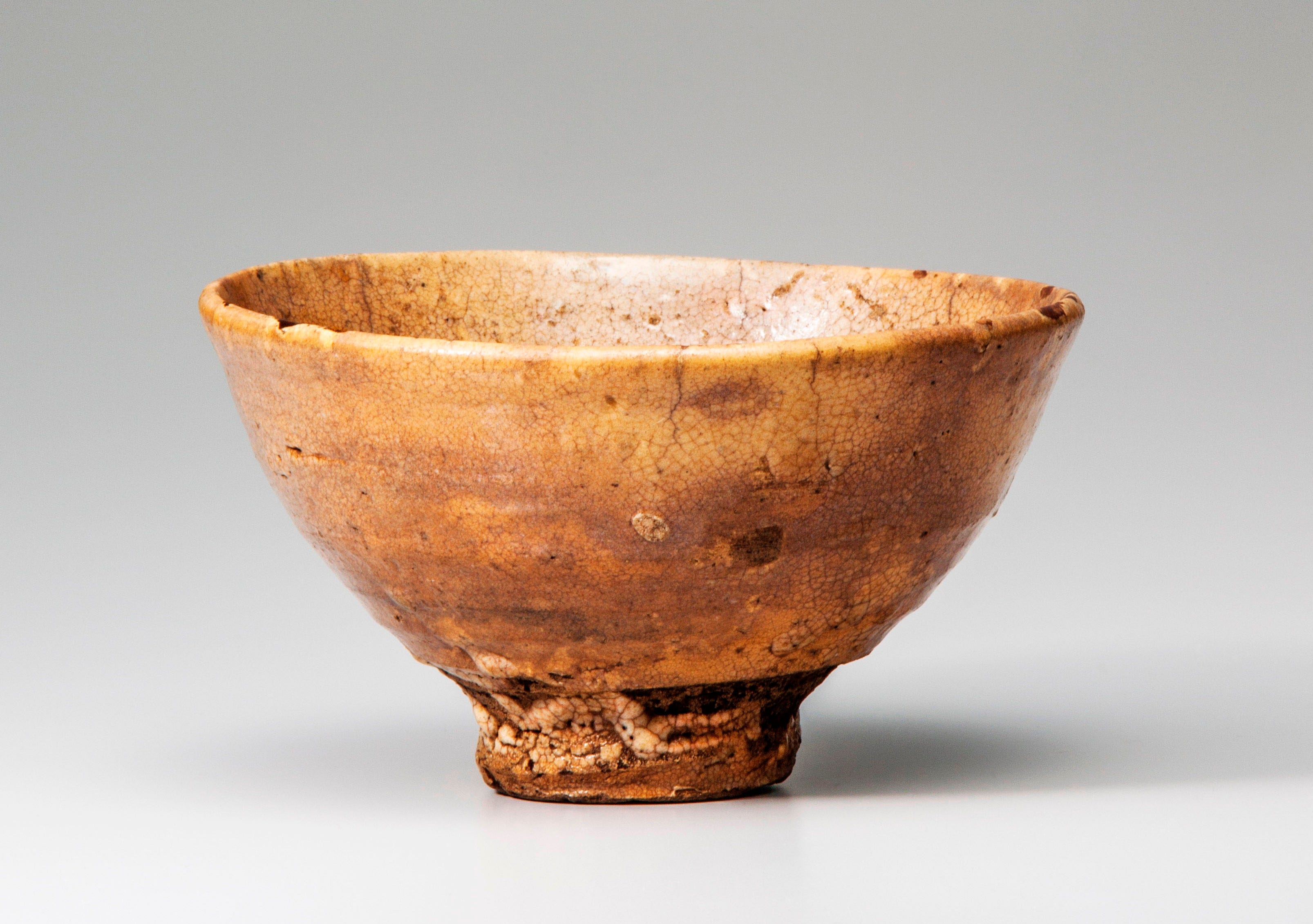
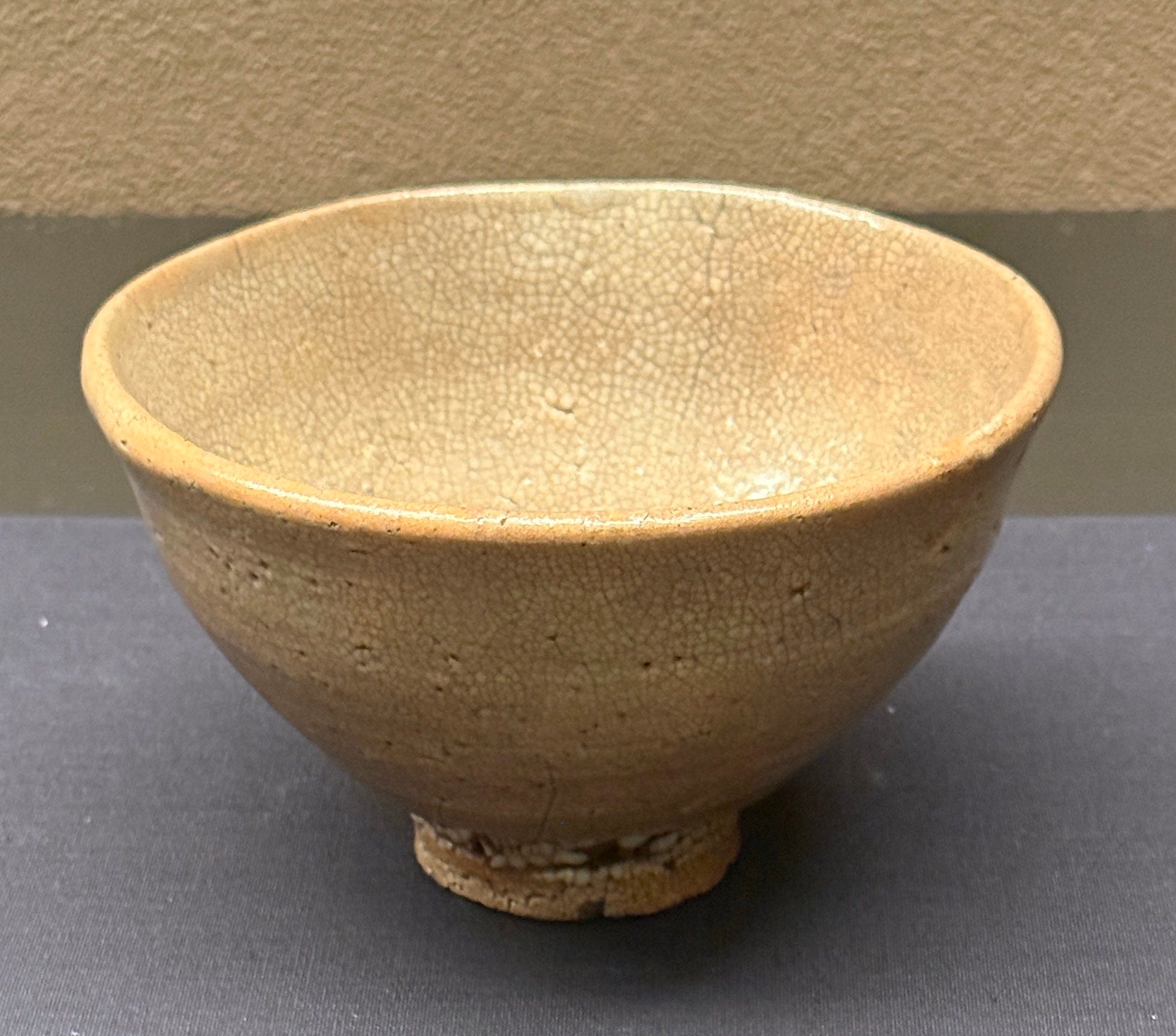
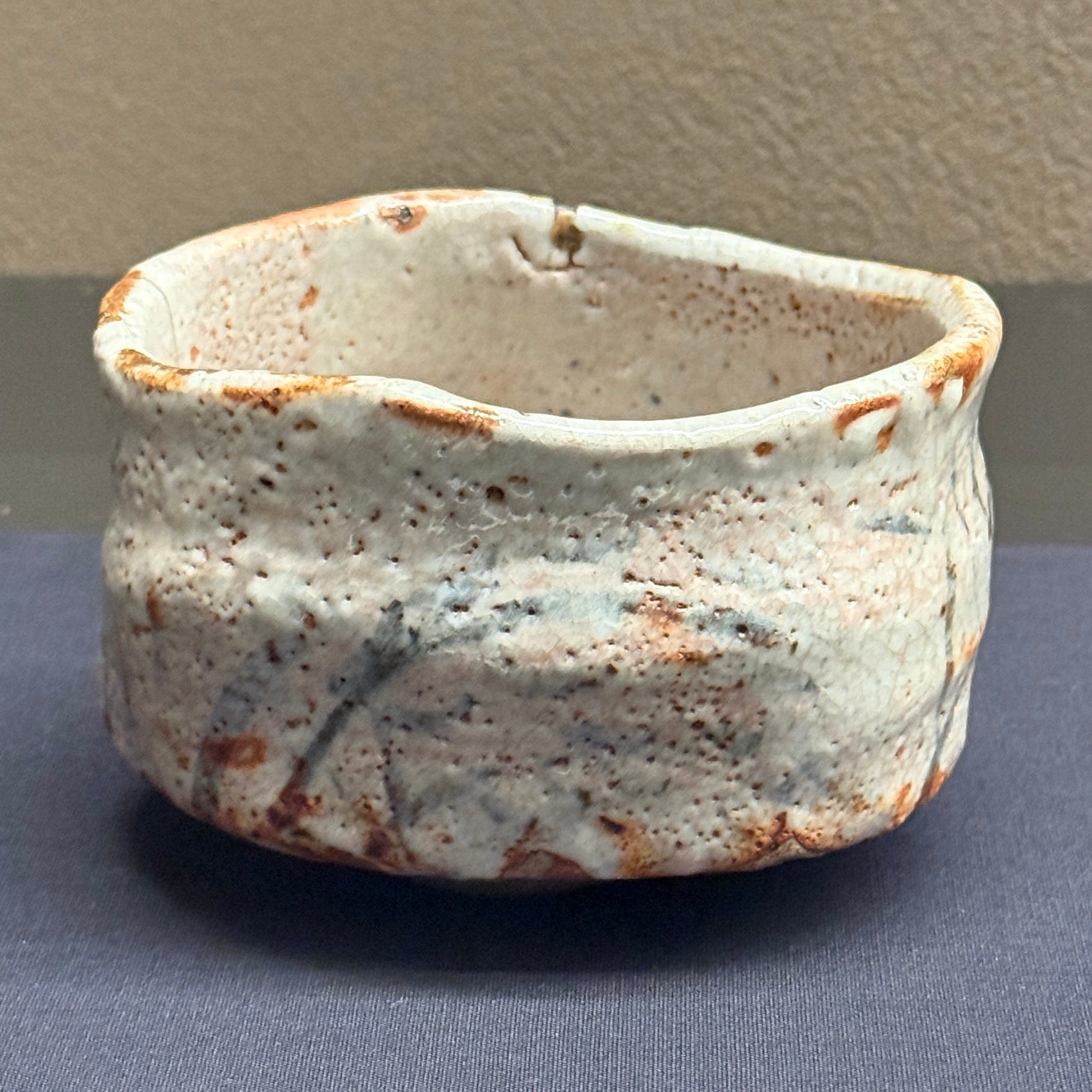
Starting in the 16th century and for a long time, Japanese high society liked to drink tea from plain Korean rice bowls. Crackled and pinholed right out of the kiln, the mottled old stoneware now held in Japanese museums—with the red stamp “National Treasure” on the label in some cases—was hastily turned and casually glazed. Workaday potters of the Joseon era produced it at scale for use in modest Korean homes, a sea away from the elegant villas of samurai, daimyo, and shoguns for whom the bowls were precious trophies. The very homeliness of the imperfect vessels seduced the warrior elites, tutored by tea aesthetes of the Late Muromachi, Momoyama, and Early Edo periods. Multigenerational, it wasn’t a fad so much as an artifact of cultivation.
From the 15th century onward, preparing hot drinks for guests was slowly codified in Japan into a beautiful ritual: an elevation of simple hospitality. Everything must be just so, governed by restraint and humility, and calmly executed using plain utensils in a small tea house. For centuries, aspiring Japanese aficionados have sought schooling in the techniques, philosophy, and lore associated with a proper bowl of tea.
To make the famous “thin” preparation called usucha, sifted green matcha is measured into the bowl with a thin curved bamboo scoop. In what strikes me as a gesture of reassurance, the implement is first “purified” with a silk cloth in front of the guest. Hot water is poured over the powder with a bamboo ladle. Using a bamboo whisk, the host vigorously works the two ingredients into a froth. After turning its (often hypothetical) front to face the guest, the bowl—well under half full—is offered with a bow. The guest bows in turn and takes the bowl with both hands—admires it, enjoys the heat, appreciates the froth, savours the aroma—before carefully turning the bowl to avoid drinking from the “front.” Then comes the aerated first sip. All of this unfolds with host and guest sitting on their heels, shins down on the tatami.
Why did wealthy Japanese elites prefer such basic imported ceramics for their lovely ritual? Because influential tea masters maintained that the imperfections of “good enough” honoured honest work, and that homely bowls and tea kits could embody virtue. As the story goes, by the mid 16th century, a Kyoto potter named Chojiro pioneered early Raku tea bowls under the patronage of Sen no Rikyu (1522-1591), tea master to a sequence of powerful warlords. With the advantage of being locally made, these deliberately plain and sometimes theatrically imperfect bowls were considered better suited to the ceremony. Like the fancy Chinese bowls before them, plain Korean bowls gradually lost their earlier centrality as tea culture embraced domestic wares and a new confidence in local craft.
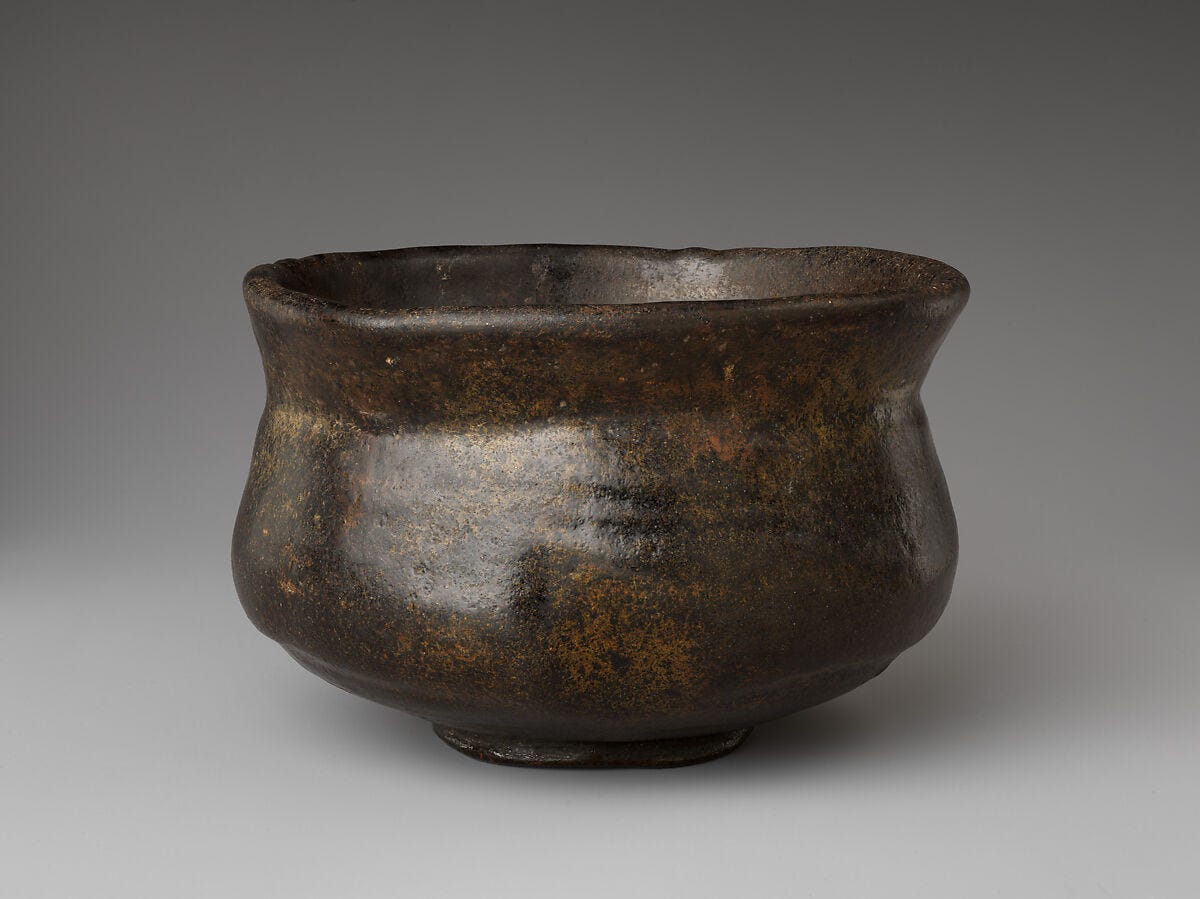
Aesthetics are socially constructed, the result of education, emulation, patronage and the seduction of compelling ideas. The tea ceremony’s minutiae are a performance of refinement. Zen-inflected taste shifted noble sensibilities from splendour to sobriety as if in self-imposed penance—in the case of tea at least. By the Edo period (1603-1868), the term wabicha had come into use, a marriage of wabi—roughly ‘austere simplicity’ in this instance—and cha, the word for tea. From a practical perspective, the volume discrepancy of a cup of tea served in a bowl meant for rice accommodates whisking without splashing. But it also makes the drink appear rationed. That too is consistent with wabicha.
Freighted with meaning, wabi entered Western vocabularies paired with sabi. I regret that English usage puts wabi and sabi together as a single hyphenated term—as they appear in the OED—because each word has a distinct meaning. Despite the catchy rhyme, not every situation wants them both. Things can be wabi without being sabi, and vice versa.
Wabi evolved as a reference to material deprivation that evokes insufficiency, bitterness, isolation, and disappointment. Tinged with the forlorn, the definition of wabi was expanded by 16th century poets and tea aesthetes who sought a name for the bittersweetness of rustic simplicity. Sabi, on the other hand, refers more specifically to the weathering of use that I hear echoed in Susan Sontag’s phrase “time’s relentless melt.” In my mind, the twinned words form a sentimental equation that makes me mildly uncomfortable: the union of poverty and old age.
Japanese culture is very attached to the rhythms of time, which explains the prevalence of the seasons in the arts and cuisine. In his book Yoshimasa and the Silver Pavilion, Donald Keene observes that what pulls at Japanese hearts during Sakura matsuri, the cherry blossom festival, is not the thrilling pink of the blooming trees but the touching sight of dropping blossoms. Keep that in mind when walking down an immaculate Japanese street where the only litter is fallen leaves.
It did not take long for my investigation into the cultural curiosity of korai chawan (Korean tea bowls) to result in seduction. Dull and unremarkable, they have become beautiful to me, and desirable—almost certainly because they are to the Japanese. It’s hard to advocate for the inherent beauty of these things, given the glories of world ceramics, and yet I can’t help wanting one. I thrill at the sight of an authentic Ido bowl—the most basic type—in a museum vitrine. Its prestige fits more comfortably into the history of taste than of art but, like wabi and sabi, it’s a struggle to pry those ideas apart.
My seduction tells me that the sociology of beauty can short circuit its physiology. It demonstrates how artists, writers and teachers play a determining role in how we see things, and it reveals the extent to which nurture can shape nature when it comes to beauty. It also says a lot about the power of suggestion.
If these bowls became beautiful through collective agreement, we need a theory of how such agreements form—and how they become contagious. René Girard provided a useful term: “mimetic desire.” The French Catholic scholar argued that desire is triangular—‘I want it because you want it’—and prone to igniting rivalries that can lead to violence and, ultimately, to the scapegoating of the defenseless as a convenient resolution: ‘we aren’t the problem, they are.’ Girard treats the Judeo-Christian prohibition against coveting—expressed directly by the tenth commandment—as a pre-emption of the rivalrous spiral that mimetic desire can trigger. The evidence is thin that this religious prohibition has had much effect on history—for example on the coveting of goods, women, and land by Christian armies. And doesn’t mimetic desire presuppose a seed of autonomous desire at some point? Who hasn’t experienced wanting something for its own sake? Girard called that an illusion, the “romantic lie” of autonomous desire. In any case, the term he coined is helpful, especially when discussing the art market.
Mimetic desire neatly articulates an indirect warning to artists who have experienced soaring results at auction: don’t be too quick to raise your prices just because two bidders tussled over your work to the wild benefit of a seller. The sudden price spike may be a fluke that has less to do with value than you may wishfully think. What if contagion doesn’t ensue? There are consequences to being overpriced that can ruin a promising career.
Like cultures, cultural markets are susceptible, erratic, and hard to forecast. Who could have foreseen the 16th century Japanese craze for Korean bowls, any more than the 1630s Dutch mania for Ottoman tulips. Having said that, we must acknowledge that both were, if perhaps not engineered, amplified by savvy tastemakers who stood to benefit. The early tea masters, though not all merchants themselves, came largely from merchant families and served powerful patrons with commercial interests.
The Joseon era potters who produced these bowls are unlikely to have benefited materially from the mimetic desire their work excited in Japan. For one thing, age and patina—sabi—often enhanced their appeal. Many of the potters were likely long dead before their rice bowls ever held tea. An exception resulted from the invasions of the 1590s when Korean potters were abducted to set up kilns in Japan—Satsuma, Hagi, Arita—where their descendants still make pots.
Provenance plays a role in the aura of these “named things.” The ones with interesting ownership histories have gained titles like works of art. They were even used by military leaders, along with other ceremonial tea utensils, to reward retainers as an alternative to the grant of a fief. This was the age of meibutsugari, or “hunting famous things”, such as wabi tea equipment. Given the epic martial rivalries of the time, the hunt must have led to violence and mortal sacrifice on occasion.
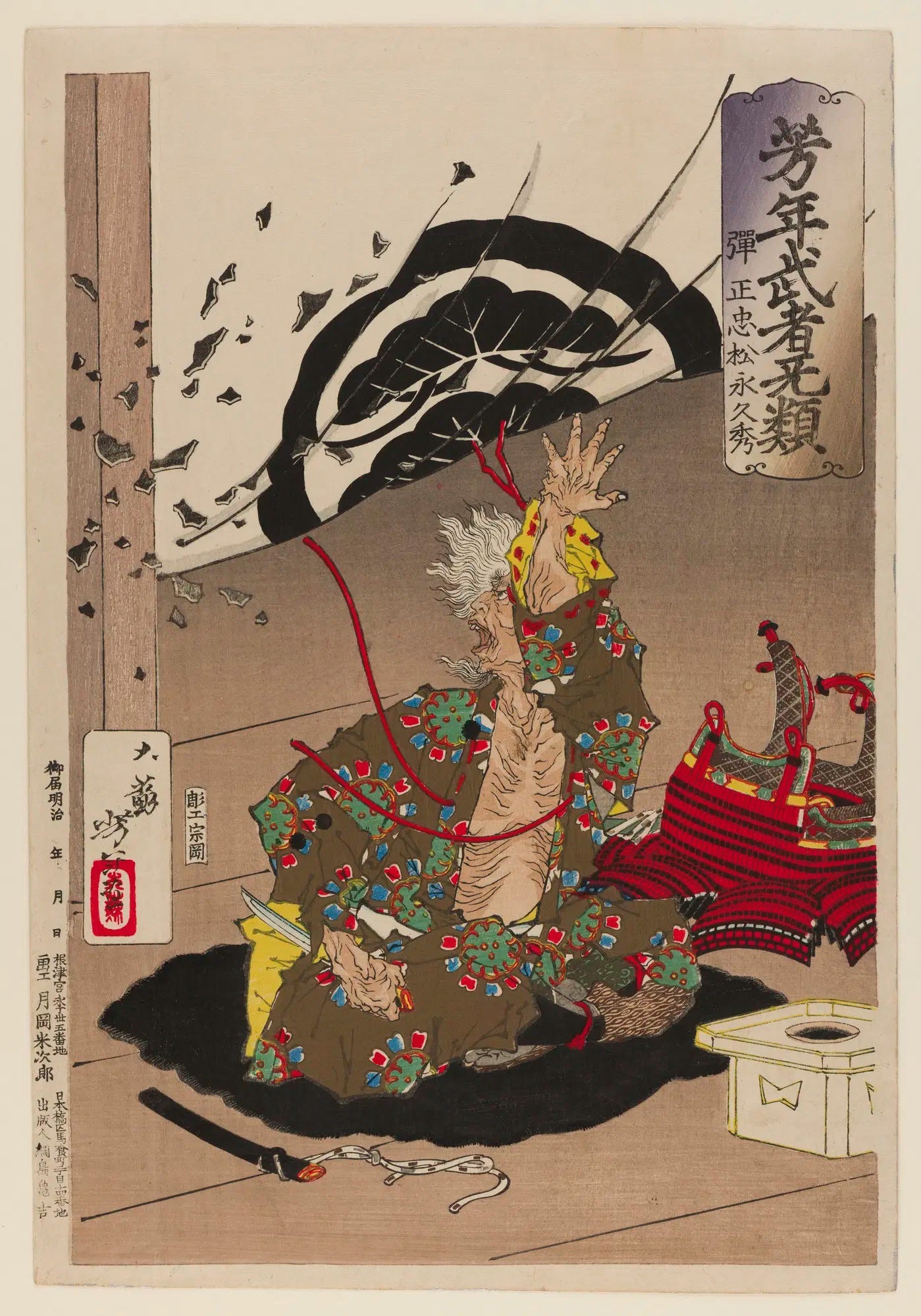
The Brooklyn Museum holds a jarring 1883 woodcut by Yoshitoshi Tsukioka. It shows the famous Muromachi-era samurai Hisahide of Matsunaga as he is about to enact seppuku with his unsheathed dagger. He has just flung the shards of his treasured tea kit into the air after having smashed it. The fragments are depicted aloft as if the two acts were synchronous. The idea of breaking your tea bowl before extinguishing yourself conveys the emotional power that these objects had over their owners. It’s as if their bodies and their bowls had a mystical equivalence: neither can be surrendered to the enemy.
The cultural phenomenon of korai chawan is a unique story, but status leaping isn’t unknown in the history of trade and cultural exchange. Think, for instance, of the peasant cuisine of working-class bistros rebranded as fine dining outside France. If you want to see good examples of old chippy farm furniture from Québec, you would do well to knock on bourgeois doors in New England. In Beyond the Wall, Katja Hoyer explores the 1970s craze in East Germany for American blue jeans. Well-suited to the sensibilities of a proletarian revolution, the GDR fad for capitalist American workwear was awkward for the communist authorities. They wanted to frown hard at the politically objectionable pants. Instead, they set up domestic jeans factories but, unlike Raku, that only increased the glamour of the imports.
The spread of fine craft and high culture from developed societies to aspiring ones is as old as the hills, and a fundamental lesson of art history. Rough-hewn early Rome imported art from the advanced Greeks, the agrarian French from the cosmopolitan Italians, the feudal Germans from the federated French, etc.
Once you accept that beauty can be taught, you’re forced to think about how taste travels. Centuries ago, before developing a self-conscious canon of their own, Japanese elites imported their high culture from Korea and especially from China: writing, religion, art, administration, town planning, and luxuries such as tea. When they got around to encouraging local crafts, it turned out to be a very good idea. Japanese art and architecture would go on to exert a disproportionate influence on modernism.
It has become a cliché to say that the modern world looks the way it does because modernists looked at Japan—its houses, arts, and gardens. The fluid relationship between inside and outside in Mies van der Rohe’s seminal Barcelona Pavilion strongly recalls Japanese buildings, such as Katsura, the 17th century villa in Kyoto that reads like a poem to fluidity. It’s hard to imagine the art pottery movement without japonisme, when French and British potters looked intently at wabi ceramics. The post-impressionists knew the prints of Hokusai, Hiroshige and Utamaro intimately; Vincent van Gogh collected them. To decorate the houses he designed, Frank Lloyd Wright sold (sometimes spurious) Japanese woodblock prints to his clients. You can foresee both surrealism and action painting in Sesshu Toyo’s ‘broken ink’ landscapes of the 1490s. After the Second World War, Japanese artists reconnected to the art world by devising a uniquely performative style of gestural abstraction: athletic Gutai. Its leaps and splashes articulate the zeitgeist of the 1950s with an irresistible force.
Following over two centuries of compulsory isolation under the Tokugawa shogunate—which ended with the arrival of Commodore Perry’s fleet in 1853 and the subsequent Meiji Restoration—Japan opened itself to the world. The revelation of seeing Japanese things caused a sensation in the West, especially among artists. Japanese things are so familiar today, indeed prevalent—cars, machines, food, art, housewares, clothes, cosmetics, pop culture—that we forget the culture was largely unknown in the West before the second half of the 19th century.
Western imperialism has left a legacy of devastation and ongoing disruption, but one positive result is the broad diversity of material and immaterial culture within its global sphere of influence where I’m happy to live. A mundane example: when I was a child, the decorative theme of my working-class Franco-Ontarian living room was Chinese. Among the Sinophilic decorations we had was Budai, the big-bellied, polychrome monk erroneously referred to as “Fat Buddha.” And there was a lithe Guanyin in white porcelain that I particularly loved. Bracketing them on the wall were framed copies of Qing dynasty ancestor portraits. These were acquired from the store where my parents bought their furniture. They had no connection to China, nor any Chinese friends back then; they were just trying to be as chic as they could within their means.
It’s anyone’s guess where the next cultural trend will originate. The pan-Asian fondness for bag charms is now a global phenomenon. Bad Bunny—a Puerto Rican pop star who sings in a Caribbean dialect of Spanish—is ubiquitous, even among people who can’t understand his lyrics. If you love food, extreme culinary diversity is among the great advantages of living in a Western metropolis. Beauty is like tea poured into a cracked bowl: it seeps. If the modern world were a bowl, it would be as crackled and leaky as an ancient korai chawan.
Perhaps I’m naïve, but I don’t feel as if we’re experiencing the compression of the world’s ethnicities into a single global culture, the dreaded “one world” anxiety that I hear on the right and the left. Rather, I think each specific culture expands as it absorbs what’s appealing from beyond its borders and transforms it, improves it, makes it strange, or less expensive. Yes, hegemonic societies with well-developed cultural industries have held sway throughout history. But I feel that dissipating more every year, certainly in the art world, as marginal polities get richer, more stable, and culturally ambitious. My cosmopolitan sensibility is pampered by the plurality of modern life. To be fair, pluralism too is as old as the hills; so is the dismal resistance to it.
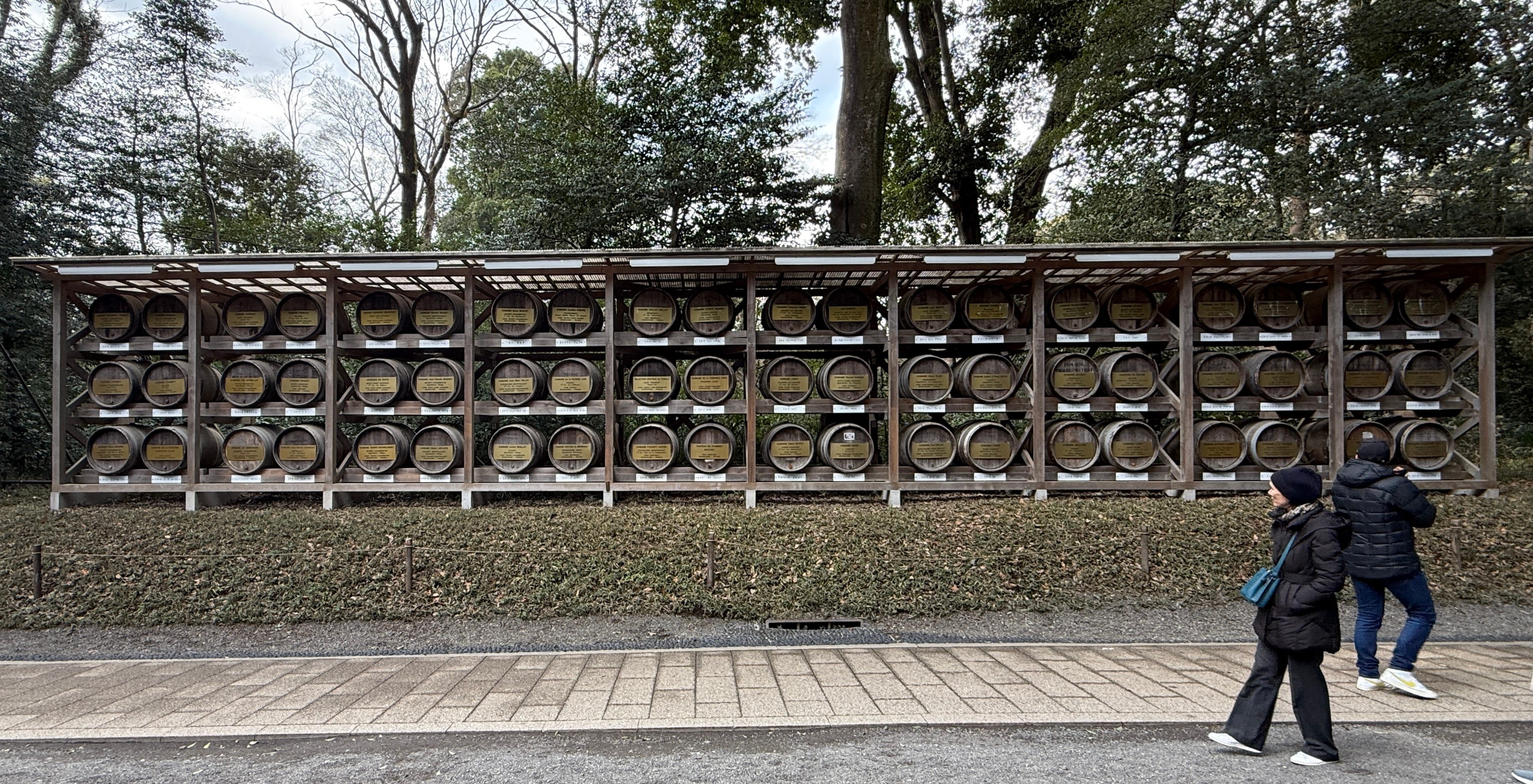
Near the entrance to Meiji Jingu, the transformative emperor’s large, elegant shrine in Tokyo, and next to the barrels of Burgundy sent from French vintners to honour his memory, a sign quotes a poem he wrote to explain his foreign policy:
By gaining the good and rejecting what is wrong,
It is our desire that we’ll compare favourably
With other lands abroad.
If there was magic in the sound of his words, it has faded in translation. But doesn’t he well-describe the point of cultural exchange? Doesn’t “gaining the good” and rejecting the bad explain the dynamics of trade, simply and clearly—the activity that has very slowly, over countless centuries, drawn us ever closer to universal fellowship? And don’t we all love it when foreigners admire our culture—never more than when they compete for its ordinary things? I feel lighter imagining a Joseon era diplomat having tea with a prince in Kyoto from an old familiar bowl.
Brilliant framework and widely shared with Asian family and potters. 💗
I enjoyed your meandering reflections, Marc, as heartening on a cold winter day as a warm cup of tea.