
Meaning

As I was drafting a press release the other day announcing an artist’s new work, I got to thinking—not about what the work might mean below the surface, but about why I don’t venture there. When writing a release on new art, standard practice doesn’t tinker with its deeper meaning, let alone with what it might mean. Susan Sontag had something to do with that: her 1964 essay Against Interpretation—“the revenge of the intellect upon art”—banished the practice. She jumped the gun by two years on Roland Barthes’ Death of the Author, relieving the critic before he could absolve the writer.
That I hadn’t noticed the taboo, after decades of writing releases on new art, is itself meaningful. Have I perhaps forgotten a superior’s admonition in my youth? Has avoidance of interpretation become second nature since Sontag and Barthes, or was it nature all along? Were all those centuries of exegesis just a phase? Maybe it’s contemporary etiquette, the idea that meaning is best left to the viewer when ambivalent puzzles want private solutions.
Ironically, if we postmoderns are less inclined to hermeneutics, we haven’t stopped grinding hermeneutic lenses—Marxism, Freudianism, feminism, post-colonialism, posthumanism, et j’en passe. But contemporary rhetoric tends to bring them in diagonally, and diagnostically. To expose hidden content is to speak over the artist, which is now considered rude. Under the postmodern condition, meaning might exist, but it’s beside the point—a temporary and local affair that ought not trouble deconstructive ekphrasis.
The decline of transcendent meaning in my case predates any knowledge of modernism, post or otherwise. In fact, meaning hasn’t meant much since I was 15. Sex, drugs and rock and roll evaporated the philosophical mists of childhood. By late adolescence, I was a seasoned hunter-gatherer of experiences, people, and places, that I took at face value. Meaning rarely came up, and only then as the pale residue of inherited mysticisms. Happily, thinking returned after the hormonal interlude. But an interest in what it all means, ‘at a deeper level,’ never resurfaced from the greater depths where puberty and Susan Sontag had sunk it.
A few years after dropping out of high-school (I kept failing), my need for information—and the knowledge that comes with hoarding it—began to burn as brightly as the other desires. Was I unconsciously longing for meaning in my life? Did I secretly hope to stumble on a fundamental truth to structure my days? I doubt it. Still hunting and gathering, I just wanted more of everything, mad with curiosity about the widest possible world.
At the dawn of my twenties, I was a busboy at a French restaurant in Yorkville, well after Toronto’s old hippie enclave had become posh. My days off and free time between shifts were spent at the big new reference library nearby. It was a paradise of information and I was a hummingbird, buzzing aimlessly about the stacks. One day, I locked eyes with a stranger through the books. We caught up with each other at closing time as we were hustled out the door. In the initial awkwardness of such encounters, I heard the accent and switched to French—the conversation smoothed out.
A tweedy and somewhat remote academic from Quebec, he said that he was in Toronto on a teaching contract—his speciality is forgotten. Eventually, he revealed the recent end of a ten-year relationship, a fresh wound that, to my mind, explained the neutral affect. Before learning of its cause, I had found his impassiveness erotic, and unusual in my limited experience of Quebeckers. But I sensed a base of kindness underneath that warmed me. The squarish Celtic face didn’t smile much, but he was attentive, had good eyes, and the talk was lofty. We went on a date a few evenings later and made affectionate love after that. I fell hard.
As it turned out, he wasn’t looking for an acolyte. Fearing my budding passion, he nipped it, planting me there on the sidewalk. I blinked in abject confusion as he walked away.
The devastation caused insomnia. I searched and searched our two-week conversation to make sense of the rejection. What did it mean? How should I interpret it? Soon though, another theme wriggled in. He had once said, in response to whatever, that I misunderstood the world, that I had far more agency than I thought, and that my intelligence deserved more than dope and discos. He said that university is not like high school, that students are clients, not wards, and that formal education is far more efficient than figuring things out for yourself by loitering in libraries. He encouraged me to go back to school and study whatever I want.
Naturally, the rejection cast a shadow over the advice, but he had planted a seed. When I was turned down for a flight-attendant job, despite being perfectly qualified, on the technicality that I was short a high-school diploma, I determined that this would never happen to me again. Soon, I was accepted at Glendon College as a mature student.
During the years of study that followed in a few more schools, and after decades of reading, traveling and working with intelligent people, it had never dawned on me that I had no interest in transcendent meaning. If I had had any at all, it was eclipsed long ago by sensations, patterns, causes and effects.
You hear it all the time: “What does it mean?” or “What do you mean really?” or the withering “It’s meaningless.” Honestly, I don’t understand why someone would crave ‘deeper meaning,’ why you would struggle to find it in a monochrome painting, say, unless it was put there, which is ill-advised. I’ve got energy for who, what, when, where and how but not much left for why. Has it ever even crossed my mind? It did once.
I spent much of the CoVID lockdown alone on the edge of the Catskill woods at the fallow farm I then owned. Despite having had the place for twenty years, it was only with unemployment and sequestration that I finally put in a vegetable garden, a lifetime first. When I think of the meals I pulled from that garden—a fresh tomato sauce made me weep with joy one evening—it was probably the most meaningful thing I ever did. The work was hard: preparing the soil broke my back, so did securing fence posts in the rocky Catskill dirt. Then there was the planting, watering, pruning, and the endless weeding. One morning in mid-summer, after I’d spent the previous afternoon pulling weeds, I went out to the garden for some parsley to sprinkle on my omelette. To my stupefaction, yesterday’s weeds had all sprung back, green as ever. The revelation hit me in a blinding flash and I cried out to the universe: “The meaning of life is life!”
You might think this tautology is a joke, but it’s the closest thing to a creed that I’ve held since leaving the Catholic Church half a century ago. I believe it completely; it explains everything and settles all mysteries.
Visiting The Met the other day, I was confronted with the meaning of death. In the 17th century section of the European galleries, I spotted a painting I’d never noticed, by an artist I didn’t know: Tobit Burying the Dead, 1640s, by Andrea di Lione. Something about it kept me there, looking. I took a good picture and keep pulling it up on my laptop. Why does it attract me? I went back to see it again. The thin paint surface has weathered the centuries of exposure unevenly, dissonating the colours. You can see the red oxide underpainting through the craquelure and, here and there, between colours; it structures the design. The artist might have got the technique from seeing Poussin’s pictures in Rome. Like Poussin, his figures are generic, but his faces are more roughed-in with the pale Neapolitan crustiness of a stone-washed Salvator Rosa. The wind-bent trees are Rosa too, but nothing else reminds me of the proto-Romantic in the harmonious classical scene. Pink ruins give the picture a “blonde tonality,” to borrow the label’s handsome phrase.
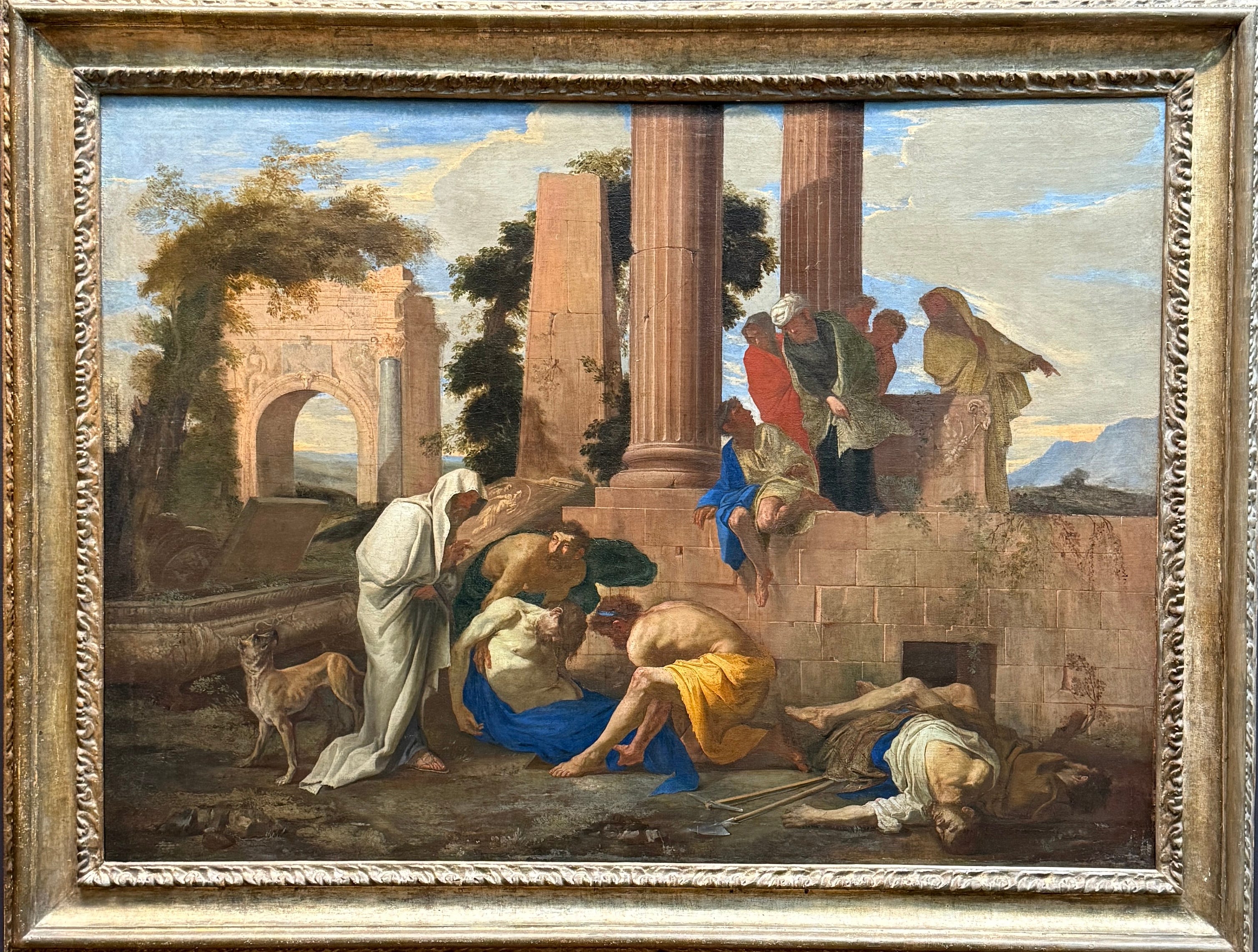
On the lower right, two corpses draped one over the other await burial. Left of centre is Tobit, cloaked in white (an archaic kittel?). He oversees the burial of a dead man, naked but for a loose blue shroud. Two crooked fingers emerge from Tobit’s cloak in a gesture of blessing. Among the dozen figures, the man holding the limp torso has the only legible face (aside from the questioning dog’s). There’s not much to read in it beyond patient straining. He looks up at Tobit before finishing the job, waiting for a sign that the prayer has ended. On the porch above, a group of agitated men keep watch in the shadow of two fluted columns and a broken obelisk hugged by a tree. One of them points toward the distance below, his vague face turned to Tobit as if in warning. These are Jews exiled in Nineveh after the Assyrian conquest of their native Samaria. We see them breaking the Assyrian king’s law by burying their dead within his city limits. As everyone knows, though, God’s law takes precedence over a mere king’s. That’s the message of the painting. It would have been obvious to Neapolitans in the 17th century, and meaningful, given the corpses that also littered their city. Only historical coincidence makes it meaningful to us, and let’s pray that it’s temporary.
The Naples that first saw this picture was a city of extreme disparity under the Spanish Hapsburgs. Neapolitans must have felt like refugees at home. Famine and disease were common and so were uprisings and corpses. But Naples was a religious centre too with several confraternities. Some of them specialised in burying the indigent dead; di Lione’s picture might have been made to encourage them. Volunteer undertakers, they worked in pious observance of the Seven Corporal Acts of Mercy. This episode from the apocryphal Book of Tobit inspired the seventh act: “to bury the dead,” the only one that church fathers took directly from the Jewish tradition. The six others came from Jesus, as quoted in the Gospel of Matthew. Tobit’s rite was added to Christ’s original six only in the 12th century, a time of too rapid urbanisation in some parts of Europe, when poverty and disease were rising with the rate of human remains.
There are often practical reasons behind religious doctrines. The phenomenologist David Abrams opens The Spell of the Sensuous with a lovely example. He noticed that his hostess in Bali placed little palm frond boats of cooked rice at the corners of each hut in her compound. When he asked about them, she explained that they were “offerings to the spirits,” which he dismissed as superstition. But when he saw that the rice had disappeared by the end of the day, he investigated the next morning and saw a long line of ants ‘spiriting’ each grain away. As it turns out, the “offerings” spared the huts from infestation by the “spirits.”
Why would an atheist be attracted to di Lione’s painting? Is it because it reminds me of our own callous states, of our modern Assyrias and Spanish Naples? We live in neo-tribal times so Tobit’s ancient predicament isn’t alien. On the face of it, di Lione’s picture is informing us about best practices. God or no God, it is hygienically smart to properly dispose of the dead. But he also paints a picture of resistance to cruel authority, which is all too legible to us.
Why, though, do I enjoy 17th century paintings in general, with their references to myths, histories, and doctrines that I have often to look up? The painters of the period liked to display their scholarship along with their command of paint, pleasing both the lettered and illiterate viewers of their day—and pleasing me. The pictures certainly meant something to those who paid for them, and who had probably requested their content. But the hermeneutic attraction for us latter-day mortals expired long ago. Even when we know what they mean, and what they meant to their contemporaries, we cannot feel these pictures with the same intensity. They weren’t made for us.
Look at the portraits we love of sitters whose names are long lost; no one has shed a meaningful tear for those people in ages. Or the commemorative depictions of forgotten battles that don’t look much like war: they sent shivers of pride up patriotic spines when the paint was wet. The West’s artistic legacy consists of objects whose meaning must be constantly tended, like vegetables in a stony garden, by long education and nurtured sensibility. We do it, not because their meaning is precious, but because they are: sacred relics of the human saga where meaning is perishable. Indeed, much of it dies with us.
Tobit Burying the Dead was a nice surprise, but I had come to The Met to commune with French Baroque pictures, not Italian. For some reason, the grand siècle had been on my mind lately. I craved the presence of a Philippe de Champaigne, a Le Brun, a La Hyre, a Bourdon, beyond all the Poussins and Claudes that make New York aesthetes proud. I was especially avid to see The Met’s Eustache Le Sueur, the “French Raphael” who, along with the others, established the Académie royale de peinture et de sculpture in 1648 that turned artists into professionals once and for all.
Like Raphael, Le Sueur died in his 30s, but not before asserting himself as the synthesis of his master Simon Vouet and his hero Nicolas Poussin. He took his generic figures from the great French classicist in Rome, and his high-keyed colour from Vouet’s style clair, the bright, post-Caravaggist manner he adapted from Guido Reni and the painters of Bologna. But Le Sueur has a vibrance of his own, a gift for colour that helped establish French painting as a distinct school.
Some years ago, while visiting the Louvre, I came upon his Life of St Bruno cycle (1645-48): twenty-two pictures commissioned by the Charterhouse of Paris to tell the story of their founder. Unlike other initiators of religious orders, Bruno of Cologne left no written rules for the Carthusians to live by. Instead, the monks take instruction from the saint’s exemplary life. My favourite panel in Le Sueur’s biography is Songe de Saint Bruno (Dream of St. Bruno) when the holy man was told to go to Grenoble and call on the bishop. The bishop, who would later be canonized as Saint Hugues (St. Hugh), led Bruno into the wilderness of the nearby Valley of the Chartreuse, named for the mountains that form it. That’s where the austere German priest founded his severe French monastery on June 24th, 1084, the Feast of John the Baptist. Christianity’s archetypal ascetic became the order’s patron saint.
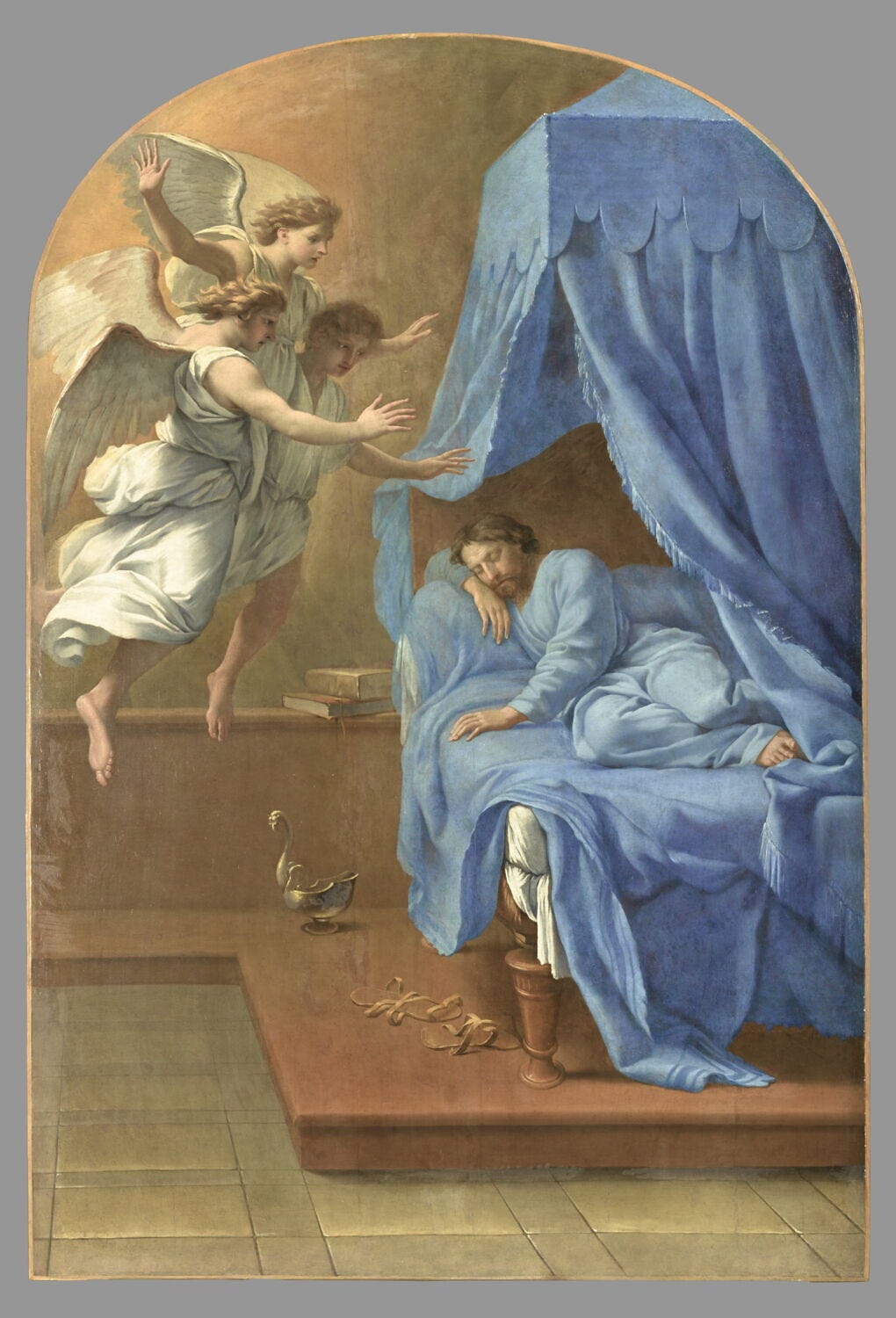
To make his charming picture dreamlike, Le Sueur painted the holy man’s robe, his bedding and canopy, a heavenly blue. After 600 years, the thrifty Carthusians were wealthy, so the artist used plenty of ultramarine, an extravant pigment made of ground lapis lazuli from far off Afghanistan. Without knowing a thing about Bruno, the Carthusians, Le Sueur, or the price of blue paint, the picture enchanted me—the arresting colour, the tidy composition, the sweet depiction of unconsciousness.
The Met’s Le Sueur, The Rape of Tamar, is less enchanting and more profane. A sordid tale from the Book of Samuel, it involves King David’s children in a sequence of crimes that, according to tradition, presaged the collapse of the dynasty and the destruction of Jerusalem—though it would take a few more centuries. We are told that the violation of Tamar by her half-brother Amnon grimly confirms the earlier prediction of the court prophet Nathan. His chilling words “the sword shall never depart from thine house” were spoken directly to the King. He was cursing David’s own sin when he “took” Bathsheba and arranged for her husband, the loyal Uriah, to be killed in battle.
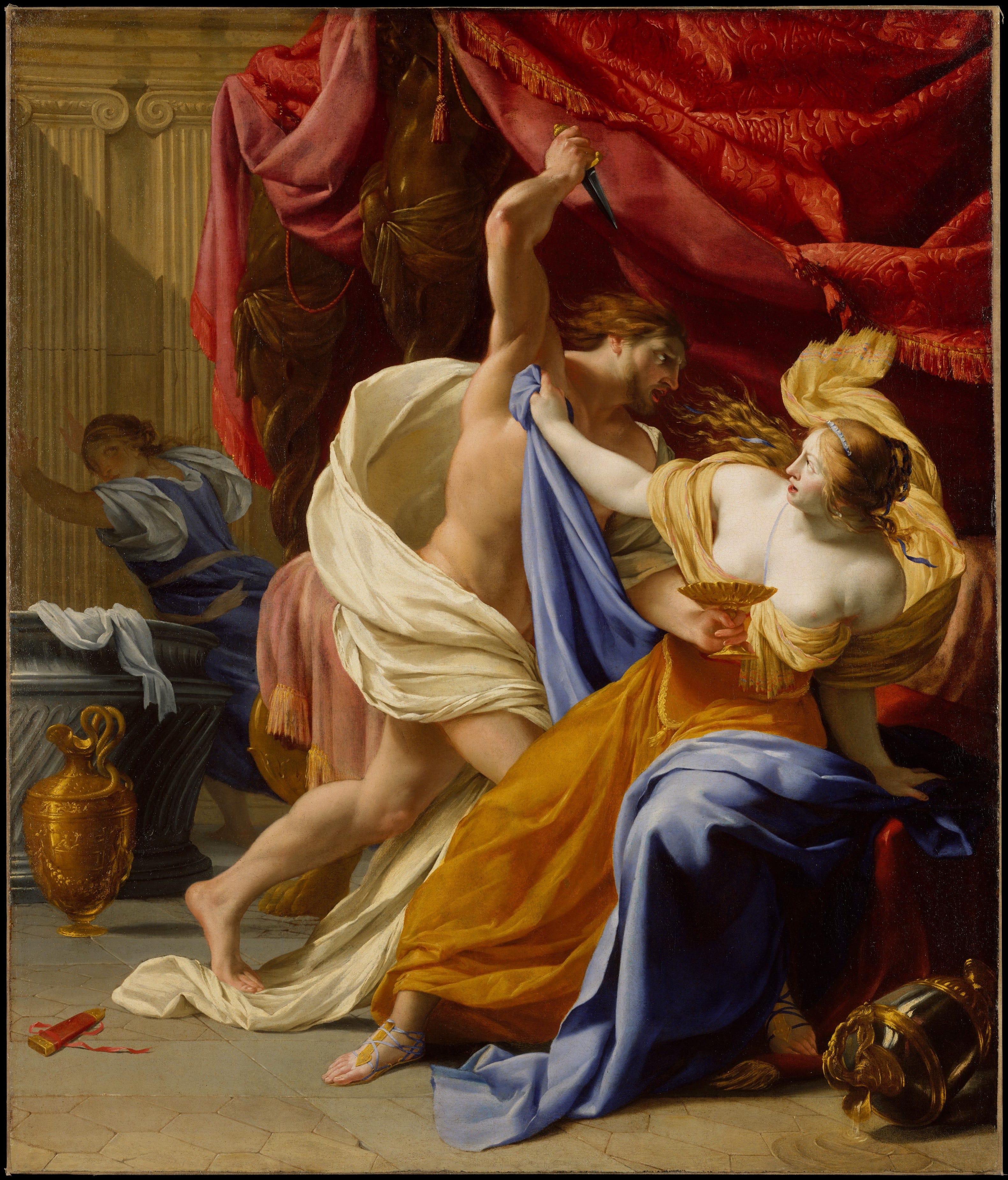
Born sick, the child of David’s crime died in infancy, but when the king made her his wife, Bathsheba bore him Solomon, who would become his heir. The succession was facilitated by the deaths of Solomon’s older half-brothers, the accursed Amnon and the tragic Absalom. Like Cain, Absalom killed his brother Amnon, but to avenge the violation of their sister. Absalom was killed when he tried to depose his sinful father. Another half-brother, Adonijah tried to seize the throne from dying David, but Bathsheba and Nathan outmaneuvered him.
Solomon would build the First Temple of Jerusalem, but he took too many foreign wives whose idolatry he tolerated, drifting his court from the faith of his ancestors. As a direct consequence, the interpreters maintain, Solomon’s realm fractured after his death; the northern half, Israel, would be conquered by the Assyrians (see Tobit), and the southern half, Judah, by the Babylonians, who destroyed Solomon’s temple in 586 BCE—some four centuries, by the way, after his death. Interpretation had very ancient roots when Sontag felled it in 1964.
Unlike the spartan Dream of Saint Bruno, there are many colours in this Le Sueur. The culprit’s bed—where he feigned illness to lure compassionate Tamar—is red and pink; his victim’s skirt is deep saffron. (If you squint, you might foresee Henri Matisse.) Although Poussinists, as a rule, didn’t paint emotional faces, Le Sueur gives it a try for the dramatic scene. He summons his inner Vouet, but without great success, I think. And the gratuitous dagger is unfortunate: it muddles the story by suggesting that Amnon means to kill her. The artist was still quite young—about the age I was bussing tables in Toronto.
For centuries, the transmission of meaning was art’s justification, though decoration was its purpose. Art always made some tangible point or other, until modernism reduced point-making to an option. Unlike new pictures, old ones speak plainly: “Look at me, your rich and powerful King,” or “we won this battle decisively; see how our enemies flee” or, “look how terribly the holy ones were made to suffer by the godless heathens.”
The nominal meaning of a ritual picture sets off a chain of interpretations that ultimately leads to a final truth: God is almighty, so don’t defy his will. But his will was only ever conveyed by mortal interpreters, giving rise to suspicion and, in time, to the secular societies that superstition still resents.
I enjoy 17th century painting because meaning is out in the open—though much obscured by time—unlike obscure contemporary art with its coy ambiguities. Although I have dedicated much of my life to coy ambiguities and love them very much, I find old pictures restorative, a tonic change of air.
Perhaps my indifference to meaning isn’t scrupulously sincere. Perhaps I’m nostalgic for a time when meaning was forthright—public, not private. No. I have no such nostalgia, but only gratitude for the treasures of the ancients and the intelligence of the moderns—and for a fleeting Quebecker’s good advice.
"It had never dawned on me that I had no interest in transcendent meaning. If I had had any at all, it was eclipsed long ago by sensations, patterns, causes and effects." Now this is a sad state of affairs. The inner life, the life of the soul is all about transcendence. A well lived life hopefully is as the Greeks said about "filling one's flesh with spirit, one's spirit with flesh." Incarnation means bringing spirit into matter.
On the deepest level great art does this, spirit enters the painted plane.