
Orientalism
The Conqueror Conquered

Impatient to see Orientalism: Between Fact and Fantasy at The Met—what could be timelier—I went on the evening of opening day. But by the time I found it, deep inside the vast museum, I was in no shape to concentrate on objects. The thunderstorm my phone had predicted for eight o’clock showed up ninety minutes early, defeating my umbrella and drenching me to the socks. I had surrendered my gall bladder to a robot only four days before, so the wet shirt chafed the charcuterie that was my belly. Inexplicably, the signage led to the show’s last room rather than to the first. Confused, I asked the guard about the introductory panel and was informed that there wasn’t one. That turned out to be false, of course, when I finally found the entrance after walking through the dense show backwards. I tried to re-navigate the unorthodox floorplan, reclaimed from permanent collection galleries, but was worn out from all the grievances in my head. I bought the catalogue and went home.
This sorry museum visit is no reflection on the quality of the exhibition. I mostly saw it from the corner of my exasperated eye, but it seemed worthwhile from there. It’s more modest than I had hoped, but I enjoyed the catalogue’s illuminating essays. Under the circumstances, I can’t write a review with a straight face, so I’ll take the occasion to consider related issues I think should come to the fore.
My initial enthusiasm had stemmed not only from its novelty—Orientalism remains marginal in art history’s conventional teleology for not having been proto-modernist—but also because the history that produced the movement continues to shape our world. I knew better than to expect a Met exhibition to address the current East-West crises directly, but the curators know the wars are on our minds. Few artistic phenomena remain socially relevant two centuries after their emergence, even if art history has had other priorities.
An academic art that coincided with great advances in painting technique, Orientalism remains tainted by its association with the institutions against which modernists defined themselves. While Orientalists enjoyed pride of place in the official salons of their day, work by our own day’s nineteenth-century heroes was relegated to the Salon des Refusés, the exhibition of the excluded where Manet, Whistler, Cézanne, and Pissarro got lumped in with the mediocre.
The formalist master narrative that I was trained in has little use for official artists of the mid-nineteenth century onward. It tends to treat movements that fall outside its account of stylistic evolution as matters of social history, regardless of the status they enjoyed when the paint was wet, and despite their continued relevance for history proper. Even if it can illuminate the ideology, politics, economics, taste, and foreign relations—in brief, the spectrum of the colonial mentality—Orientalism is stuck in one of art history’s blind spots.
The novelty of the theme is confirmed by the museum’s promotional admission: “… the first exhibition at The Met to explore Orientalism as its central focus…” That it should only now be getting the attention of America’s most comprehensive art museum—one that has collected it modestly, but with acumen—says as much about the blinkers of scholarship as it does about the objects themselves, which cannot be understood through aesthetics alone.
More curious still, the centrality of Orientalism in scholarly polemics about the Western eye has not reformed the curriculum. Edward Said, restricting himself to literary examples, exposed the entanglement of culture and imperialism, and challenged the authority of the West to represent the East with any justice. His watershed 1978 book Orientalism inspired Linda Nochlin’s influential 1983 essay “The Imaginary Orient,” which brought Said’s critique into art history.
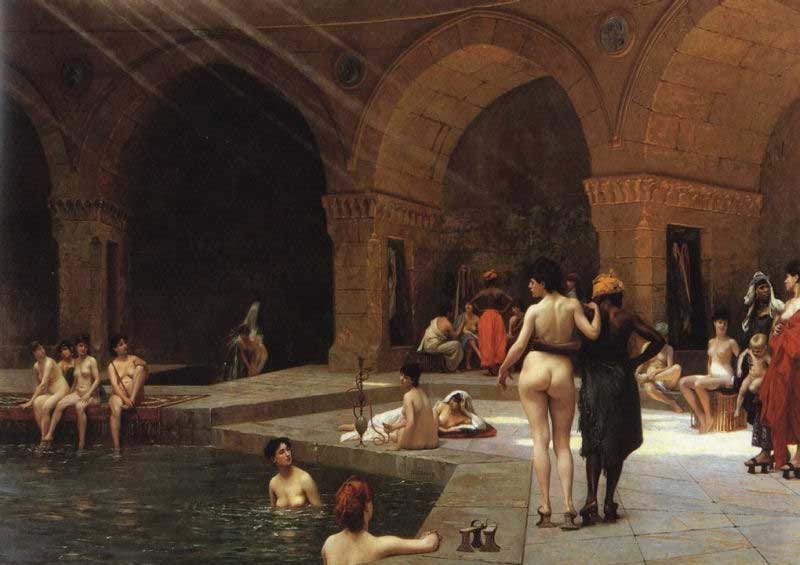
Nochlin treats Orientalist painting not as innocent exoticism but as a technology that exemplifies colonialism while implicitly endorsing it. She sharpens the condemnation by cataloguing a series of absences in the vivid pictures of Jean-Léon Gérôme, her Exhibit A: the absence of the coloniser in scenes of people living under occupation; the absence of history, as though the Islamic world were frozen in time; the related absence of modernity, of machines, or imported goods; the absence of agency in a preference for passive subjects—merchants, servants, languid nudes—over the social actors of the local elites; the absence of the Western spectator whose gaze the pictures address; and the absence of the artist himself.
Gérôme treats his subject anachronistically and with a healthy dose of fiction—for example, he never set foot in either a harem or a women’s hammam, but that didn’t prevent him from painting them with striking confidence. His technique was so advanced, and his telling details rendered with such uncanny verisimilitude, that the pictures easily passed for truth. Borrowing from Roland Barthes’ 1968 essay “The Reality Effect,” Nochlin exposes the dubious rhetoric of Gérôme’s forensic realism, which he adapted from the documentary photographs he collected and commissioned. His paintings read as evidence, slices of life in the picturesque East. For the purposes of formalist art history, they are also early stirrings of photography’s displacement of drawing in the preparation of paintings—Gérôme’s light is unmistakably photographic—a transition now largely complete in conventional figuration.
The highlight of The Met exhibition for me was not Gérôme, but Osman Hamdi Bey, a major figure I was astonished not to know. Defying my mood, I did take the time to look carefully at his pictures. Not only was Hamdi a superb painter and an intelligent iconographer, he brought an Eastern perspective to Orientalism, painting it from inside. Born into the Ottoman elite, he became a court official and an archaeologist who built institutions and facilitated scholarly collaborations with the West. A monographic survey in a big European or North American museum is embarrassingly overdue, not only because he complicates assessments of Orientalism, but because he’s so good.
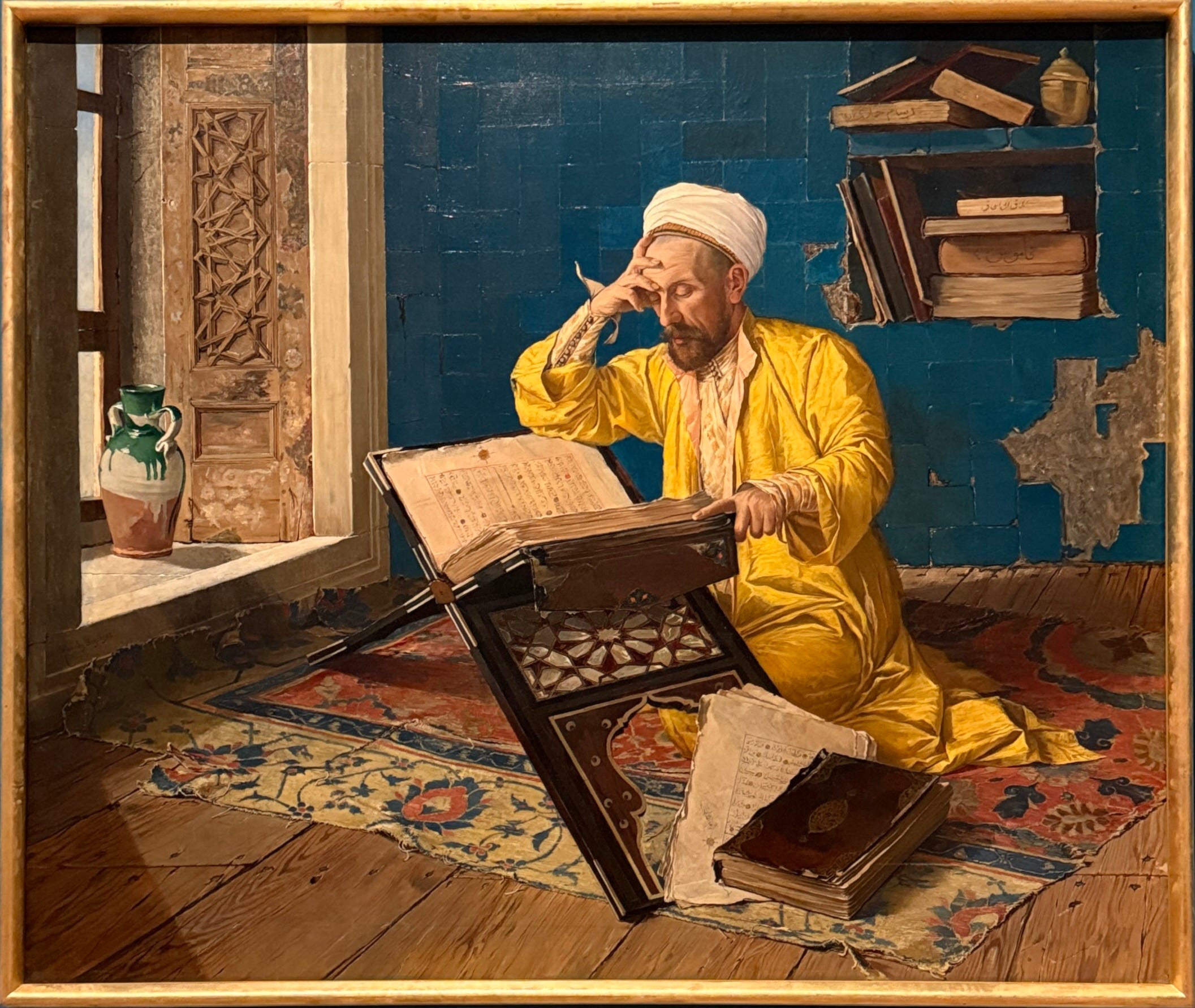
Hamdi was born in 1842 in Istanbul to Ibrahim Edhem Pasha, who had been a Greek child from Chios sold into slavery after the massacre memorialised by Delacroix. Acquired by the statesman Koca Hüsrev Pasha, who raised him as a son, Edhem was sent off to Paris to study mineral sciences. Upon his return, he became a reformer the sultan would eventually promote to Grand Vizier. In 1860, he sent his own son to Paris to study law. After nine years there, however, Hamdi returned an artist of impeccable refinement. He had studied with Gustave Boulanger and Gérôme himself, the leading masters of the French Orientalist school. Hamdi perfected the eye for detail that distinguishes the best Orientalists, and honed the skill of a first-rate académicien. His portrait (now lost), painted by Boulanger, hung in the Salon of 1865; the following year Hamdi’s own work was admitted, and in 1867 he showed three medal-winning canvases at the Exposition Universelle. He was called home to take up the responsibilities of his class in the Ottoman administration.
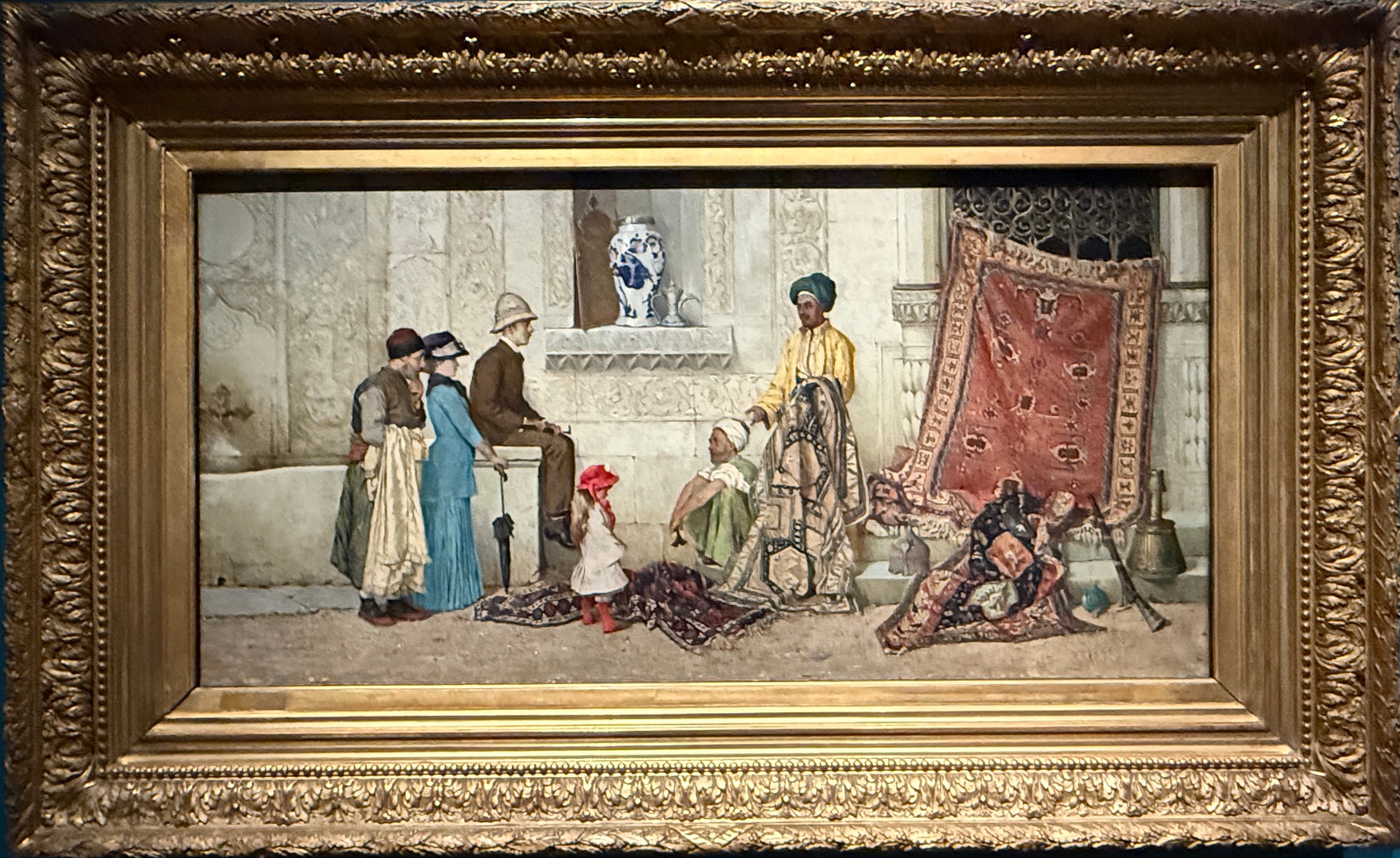
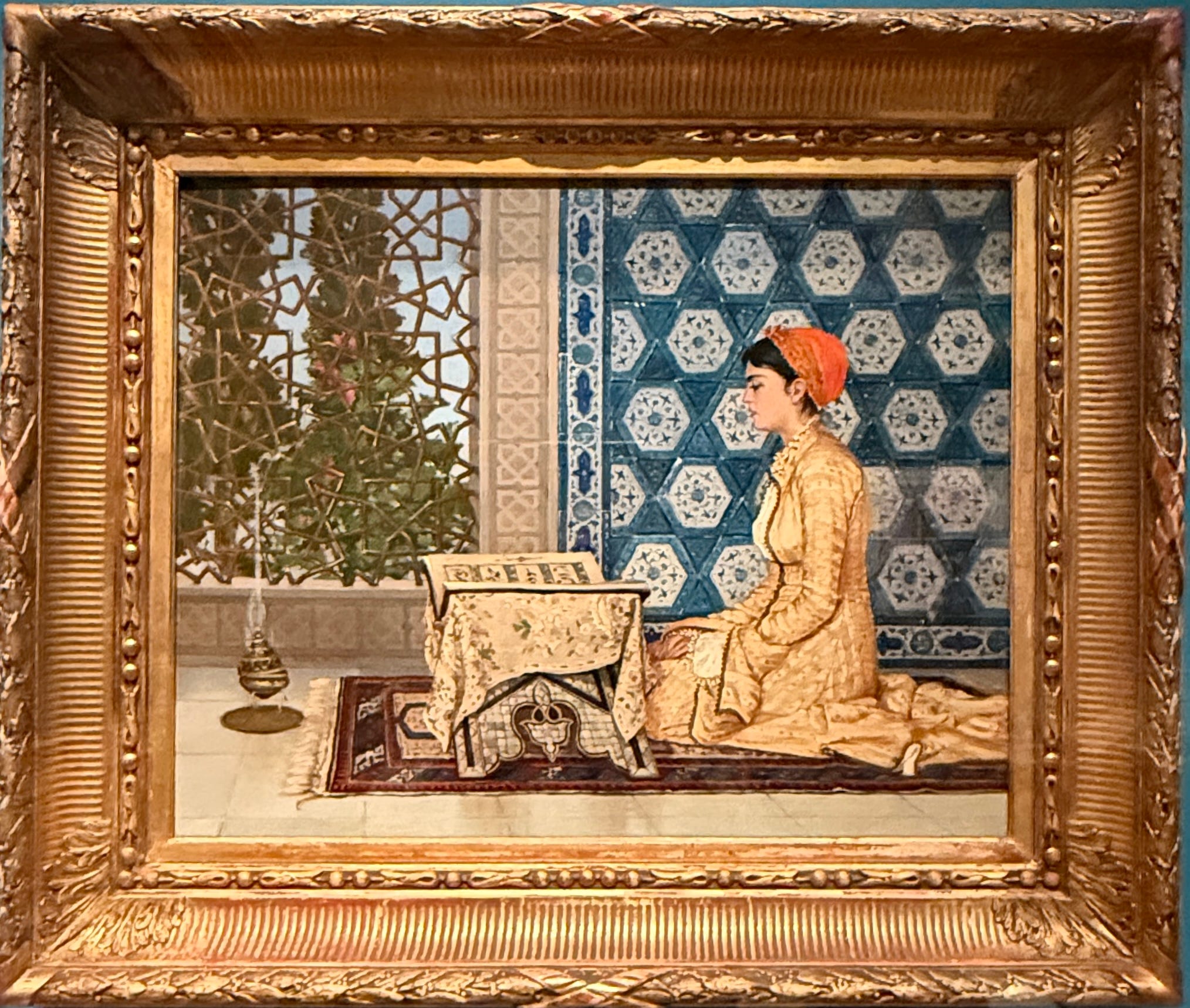
Aside from his Turkish ethnicity, what distinguishes Hamdi from his French colleagues is the presence of Europeans in his pictures, a more accurate representation of daily life in the Ottoman East, and a respectful depiction of women. Gérôme avoided including Western details that would break the spell of his exotic pseudo-reportage, known for its flesh and other titillations. Rather than lounging in harems or hammams, Hamdi painted women either socialising outdoors in white yaşmaks and colourful feraces, or indoors reading.
I remember nodding at the page as I read Nochlin’s essay—her argument had long needed to be made. But today, I find it indicative of art history’s limitations. No mention of Gérôme’s devotion to his subject, which he treated with a lifetime of intense concentration. He spent his career romanticising—perhaps in a suspect way to us—a world not his own that colonised his consciousness. Nochlin’s analysis doesn’t broach why so much as how. And she doesn’t mention Hamdi because the Ottoman Orientalist, though never forgotten in Turkey, only appeared in Western scholarship recently.
If we pull back and look at the subject broadly, it predates the immediate Orientalist cohort and has insinuated itself more profoundly into Western culture than Nochlin acknowledges. One way to look at Gérôme is as the apotheosis of a long-gestating European fascination. If Islamic aesthetics has a strong specialist literature, its seduction of Western sensibilities has yet to receive its due in mainstream art history.
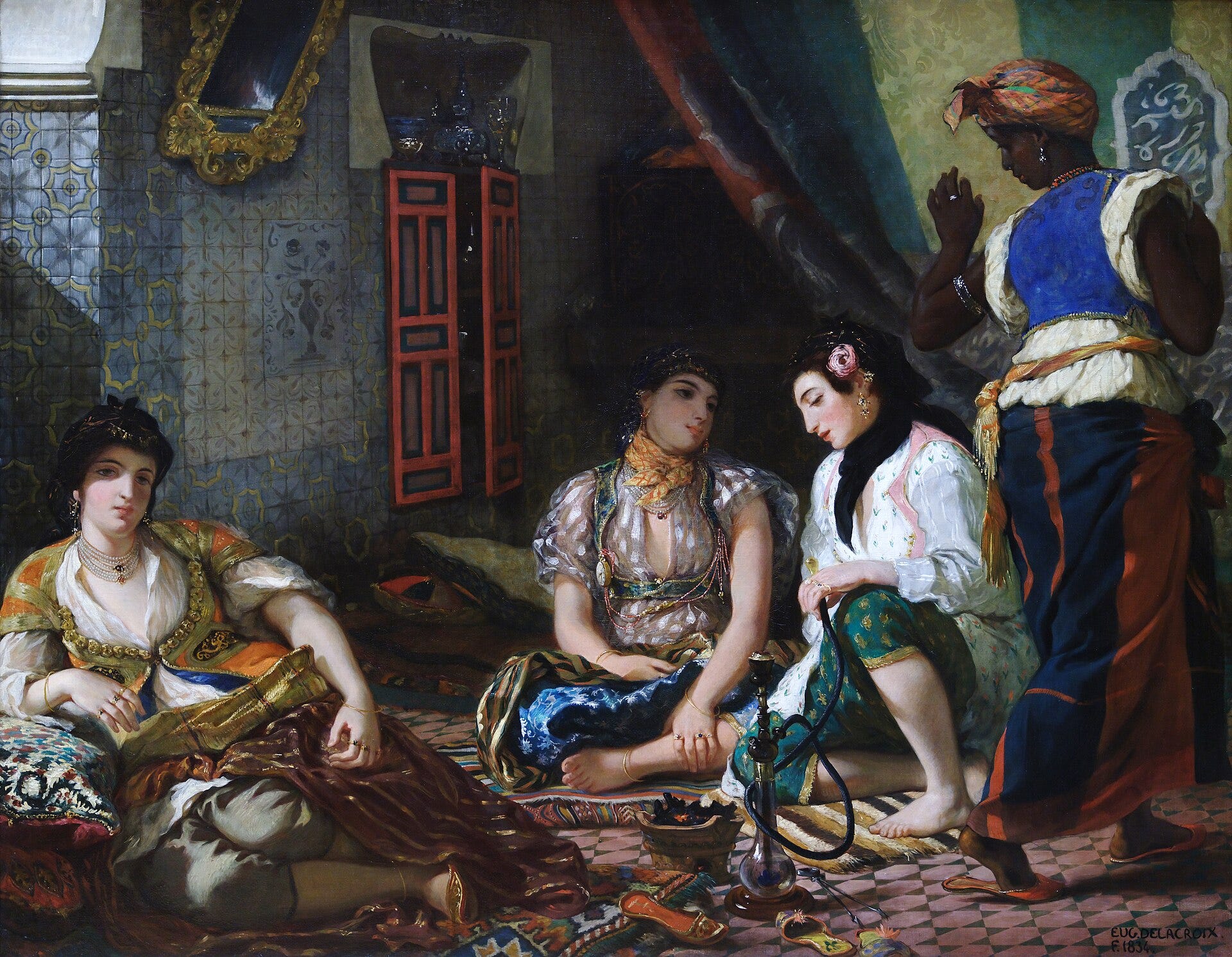
Delacroix belonged to the generation before Gérôme’s. We categorise him as an exemplar of Romanticism, but he was also an important Orientalist. Unlike Gérôme, Delacroix’s stature in the master narrative is unimpeachable because of his pioneering formalism as an advocate of colour over drawing. Orientalism itself, then, is not the capital offence. Before Delacroix there was Jean-Étienne Liotard, an artist who lived and died in the eighteenth century and who was known in Paris as “le peintre turc” for his appearance, altered by his years in Constantinople.
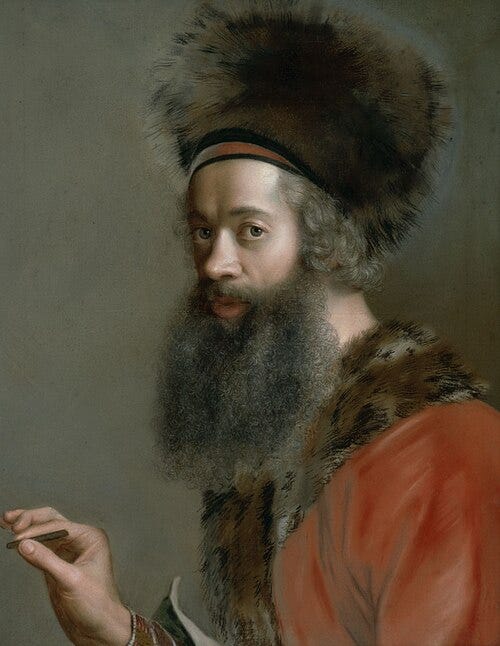
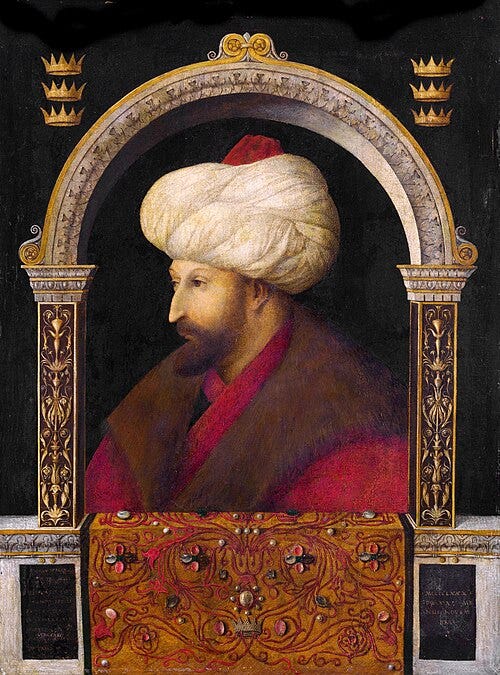
To be sure, Liotard, Delacroix, and the others up to and beyond Gérôme’s generation were outsiders looking in. Henri Matisse travelled to Algeria and especially to Morocco where he was inspired to paint bright, schematic pictures of lounging North Africans. Looking much further back, Quranic embroidery sometimes decorated medieval Catholic chasubles. The famous carpets in Lorenzo Lotto’s sixteenth-century paintings were Anatolian, while the carpets traditionally used in Catholic ceremonies—notably when popes lie in state—are Persian. The influence of Islamic forms pervades Western art. In 1479, Gentile Bellini, the Venetian Republic’s leading civic painter, was sent to the court of Mehmed II as a peace offering from the Doge. The Sultan had requested a painter, so Bellini joined the diplomatic delegation after Venice sued for peace following a long costly war. Known as Mehmed the Conqueror, this was the sultan who turned the Ottoman state into a major imperial power when he took Constantinople. He owes his most enduring likeness to a Venetian painter who would later include eastern motifs in his cosmopolitan panoramas.
In Gérôme’s day, there was the enormously influential Owen Jones—architect, decorator, colourist, and historian of ornament, one of the most influential British design theorists of the nineteenth century. His books are still in print. From his studies of the Alhambra, Jones held that Islamic design principles have a universal significance that might cure Western stylistic corruption with the aesthetic hygiene, so to speak, of pure geometry.
The obvious Saidian objection is that none of this exonerates anything—that desire is a mode of power, that to find the East charismatic, absorbable, useful as raw material for your own renewal is precisely the indictable operation. Gérôme’s harem fantasy is desire; the connoisseur’s delight in an Anatolian “Lotto carpet” is desire. Naming the appetite does not absolve it.
The objection is sound, and I accept much of the desire-domination argument, but it proves less than it claims. Desire is a distinct mode of power; it’s too pat to subsume it as a feature of domination when things work just as easily the other way. Owen Jones is the hard case here: an Englishman at the height of British imperial confidence who looked at Moorish geometry and concluded that the West should be corrected by it. That is not the posture of a man asserting supremacy. Hamdi turned the coloniser’s own apparatus back on itself; he tells us a fuller, subtler, more plausible story than his French teachers did, and with the same means. Bellini’s Mehmed is the conqueror’s portrait painted by the supplicant’s emissary, desire running uphill, from the weaker power toward the stronger. Desire and domination often travel together, but not necessarily. What the power-narrative cannot account for is the direction of the traffic: forms moving from the conquered into the conqueror who is changed by them. That much is not victimisation, but the capture of imperial attention, a part of the story art history has not told well but is well placed to try again.
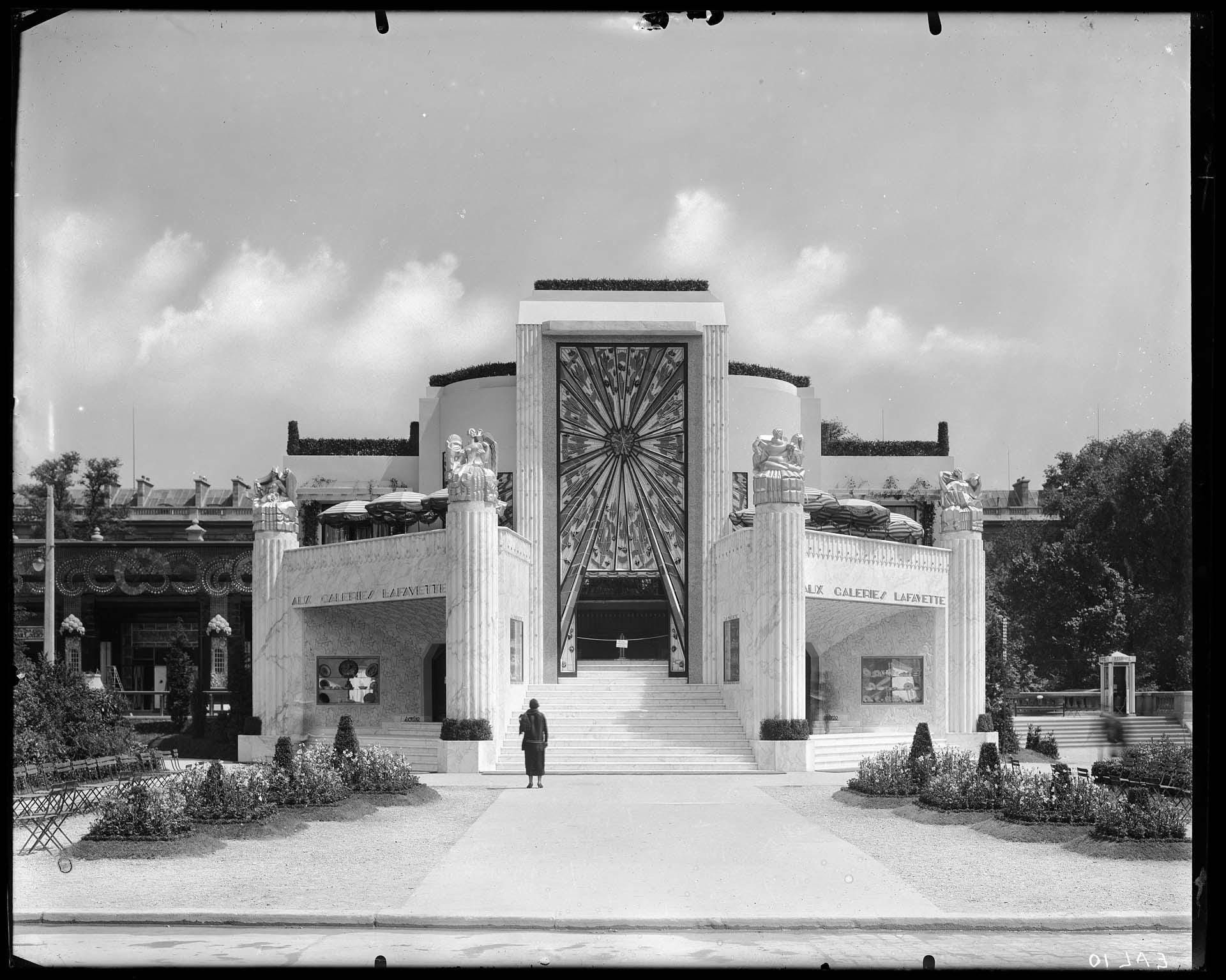
In its various guises—Neo-Moorish, Neo-Mamluk, Neo-Ottoman, Indo-Saracenic—Orientalist imitation lasted well into the twentieth century, especially in architecture: synagogues, mansions, theatres, public buildings. Given the centrality of geometry in Islamic aesthetics, the legacy would eventually inform Art Deco, and from there geometric abstraction; the radiating star-polygons of Cairo and Granada are not far from the zigzags and sunbursts on Paris façades circa 1925. We can trace a similar, though more recent infiltration of the Western canon by the forms of Sub-Saharan Africa, Oceania, and Indigenous North America. And why not point out how much Western modernist architecture owes—the open plan, the screen, the modular bay, the fidelity to materials—much less to its own inheritance than to the building forms of Japan. Aesthetics has always been promiscuous, with or without the army.
The cruelty, waste, ignorance, and unsustainability of centralised imperialism, Western or otherwise, are thoroughly documented and broadly condemned. But imperialist motivation tends to be elided behind its methods and violations. Empires want not only what others possess, but what they have made, and to have made it themselves. The history of Western decorative arts makes my argument for me; for example, the Met exhibition includes exceptional Orientalist recreations of enameled glass. Conquest comes wrapped in admiration, imitation, and finally assimilation—the conqueror conquered by what he set out to subdue. The phenomenon is hardly peculiar to the West. Arab rule in Iran and Spain, Ottoman expansion into Europe and the Levant, Mongol dominion in China, and Mughal control of India: each installed and absorbed aesthetic forms as readily as it moved armies and administrators. The charisma of material culture goes missing in the worthy campaign to denounce foreign domination, a narrative so fixated on power that it forgets the oldest power of all: the pull of beauty.
You could argue that Orientalism is cultural appropriation consistent with Western imperialism and the colonial taste for the exotic. But that discounts the dynamic and transformative agency of non-Western forms. It also misunderstands the autonomy of aesthetics and how it works. In a sense, the notion of cultural appropriation as an offence is itself a manifestation of the colonial mentality in search of redemption. It treats the movement and assimilation of forms as an instance of victimisation, and uses their presence in Western culture as evidence of a crime. But that conveniently ignores the artistic genius of the conquered and the power of their beautiful things. It isn’t helpful to conflate military history with the migration of forms.
If we want to understand ourselves, our history and motivations, art history has potentially a lot more to offer than its teleology. Indeed, historians in general need to look more carefully at objects, because the things we make ultimately make us.
Excellent article, Marc, insightful in unexpected ways - as always. Makes me want to read more on the subject.
Fascinating essay! (Even the drenched and chafing bits.) I've always been interested in Orientalism in history and architecture, but had never known its origins and evolution in terms of visual artists. And Osman Hamdi Bey is a revelation -- a welcome antidote to all those haute porn Gerome canvases. Many thanks, Marc.