
Raphael
Il Divino at The Met

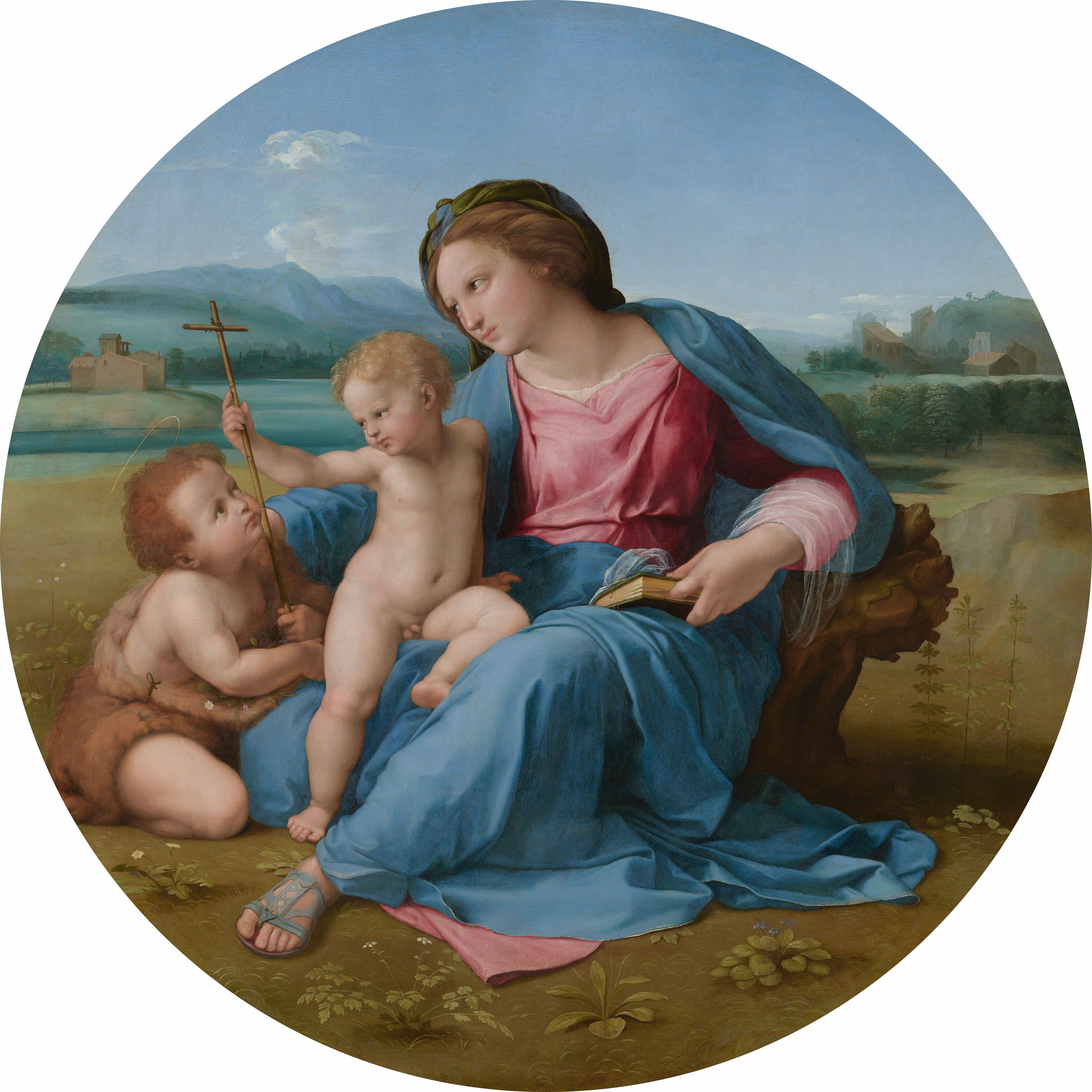
At school, the profs would use warm language when discussing Raphael. They called him divine without irony, or with a touch of it, but he was divine in any case. Looking at an easel painting or an altarpiece (projected on a screen in the dark) my sensibility found it hard to square that word with what I perceived. I saw a sweetness that pursed my lips and an idealisation that often failed by the standards it invoked. If pressed, I would admit to two or three “magical” pictures, but without much enthusiasm. Maybe it was the impediment of taste, but I often found something to dislike.
Latin hyperbole plays a role here. To call someone il divino, the epithet that Giorgio Vasari canonised, has a lightness in Italian, a joy expressed while smiling. But in English, the language in which I studied art, divine has a different tonality, a touch of gravity, a whiff of incense. I was confused by the word because of an unevenness I sensed in Raphael’s heads that did not amount to divinity. Few of his pictures entirely silenced my technical objections—anatomical fudging, formulaic colour. I kept my mouth shut because budding art historians learn early about the futility of resisting a canon built by generations of authorities. You might as well attempt to move a mountain.
Raphael forms the High Renaissance trinity with Leonardo and Michelangelo. Nobody cares that I think heads don’t do what The Alba Madonna’s does. They’ll only tell me that I miss the point of style and refer me to his master Perugino where perhaps I’ll understand what style means for painting. If I persist, they’ll call me a tourist.
Decades later, after all that quiet opposition, I found myself in the Vatican standing before The School of Athens and I finally understood. This is where Raphael is divine: painting history on wet plaster. My body constricted. We had carefully studied the fresco in class, all those decades before, so I was prepared for the encounter but I had yet to feel the sensation of the work’s presence. When I did, it eclipsed the old resistance. Art history teaches, indirectly, that the thing itself operates in another phenomenological dimension than its representations. Every time I see something in the flesh that had been made familiar by photographs and words, I learn the lesson again. Representation is used too liberally when figurative art and photographs of it share the same term.
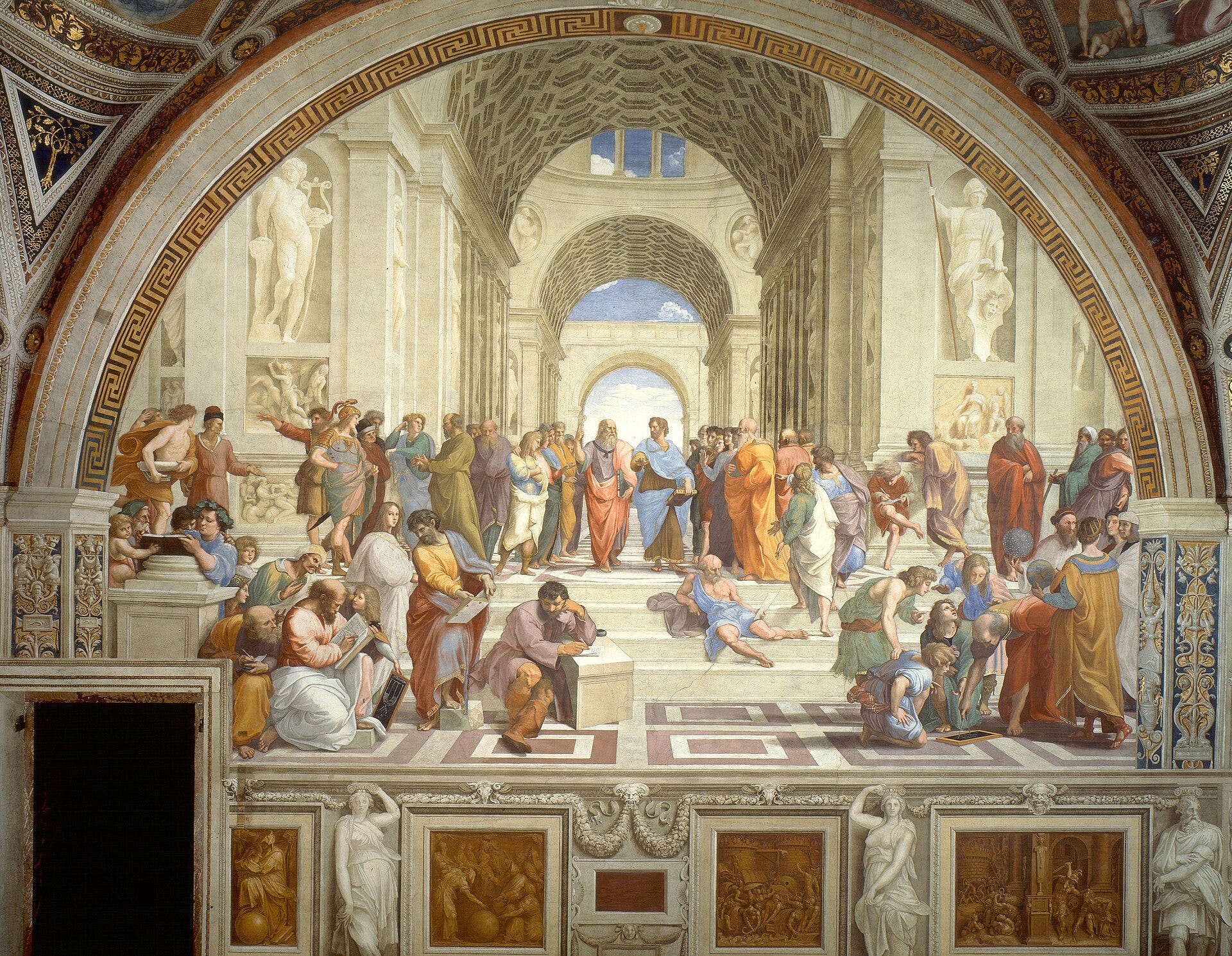
The School of Athens, painted on a wall in the Vatican’s Stanza della Segnatura (the Room of the Signature), is a singular thing in the world, an enchanted surface. Its subject is the pantheon of ancient Greek thinkers, but mimesis is inadequate for this theatre of philosophy—where Leonardo is Plato, Bramante is Euclid and Michelangelo the irascible Heraclitus—a tableau of specific performers enlisted to portray men of forgotten physiognomies. The power of the painter’s performance doesn’t fully come through in plates or slides—the physicality of colour and line, the reciprocity of illusory volumes, the relation of fictive space to real space, the patina of centuries. Works of visual art and theatrical performances have this in common: if you weren’t there you didn’t see it.
But The School of Athens doesn’t elevate the easel paintings reflexively; too many still fall short of divine in my anachronistic estimation. Though they can be idiosyncratic and often arresting, they have too much personality to be inevitable. There were other painters of this quality in Italy at the time who weren’t called divine. With few exceptions, Raphael’s easel pictures strike me as minor cousins of a royal family.
Between Raphael’s panel pictures and his frescoes there’s a categorical difference; you would almost think that they were produced by different hands. In fact, they were. His divinity, it turns out, is not in ‘painting history in wet plaster’ either. If a good deal of the easel paintings are in his hand, though not every inch of them, the ratio is inverse in the frescoes, and all of the posthumous murals were executed by his many assistants, working from the master’s drawings—Giulio Romano, Gianfrancesco Penni, Perino del Vaga, Polidoro da Caravaggio, Giovanni da Udine, Raffaellino del Colle are the most prominent. The old popes—first Julius II, and after him Leo X—who hired Raphael on the strength of his sweetest Madonnas and the advice of their architect Bramante—had deadlines and expiring lifespans. Julius, who also put Michelangelo to work in the Sistine Chapel, commissioned not just a painter but his bottega, a well-staffed workshop that Raphael led like a busy contractor. His broad frescoes that cover Vatican walls and ceilings were necessarily teamwork.
Given the scale of such projects, painters of the classical tradition were closer to what couturiers are today: leaders of specialised teams executing their designs. Iris van Herpen doesn’t construct all her gowns any more than Christian Dior, or Yves Saint-Laurent did, though they knew how. Architecture offers yet another model of creative detachment—an artist’s conception executed by draftsmen, carpenters, masons, tilers, and glaziers. Scholars ascribe large passages of The School of Athens to Raphael’s hand, but he didn’t paint most of it, and his direct execution decreased from wall to wall; the ambitious, multi-room commission was completed without him after his death. Still, they were his pictures, based on concepts he articulated in drawings, but even the concepts had multiple authors.
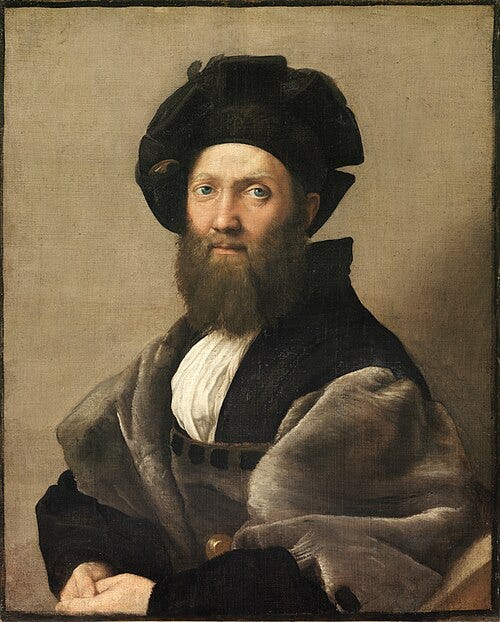
Raphael did not concieve alone. The room where we see The School of Athens is an ensemble of four painted walls and an allegorical ceiling depicting theology, philosophy, poetry, and justice—together they constitute the signal expression of Neo-Platonic thought in Renaissance art. Though the room is in Rome, Neo-Platonism is a Florentine synthesis of Platonic and Christian philosophies that had been a century in gestation. It was unlikely to have been part of Raphael’s education in his father Giovanni Santi’s studio in Urbino. The programme was almost certainly conveyed to him through the commissioning pope’s intellectual circle, particularly Tommaso Inghirami, Prefect of the Vatican Library, a celebrated humanist scholar, and—not incidentally—a director of classical theatre. Raphael also moved in the orbit of Pietro Bembo, humanist and literary theorist who would eventually become a cardinal. And there was Baldassare Castiglione, author of The Book of the Courtier and coiner of sprezzatura—the doctrine of effortless grace that gives a name to what Raphael achieved in his four Vatican rooms: the appearance of inevitability in large stagings of interacting figures. Along with Julius and Leo, Raphael also painted Inghirami and Castiglione from life. The latter portrait’s uncanniness makes it stand out in the global catalogue of likeness.
Art history supports a cottage industry of sleuths searching for traces of divine facture, connoisseurs trained through long experience to identify a hand. The modern cult of artistic personality begins with Vasari, whose Lives of the Most Excellent Painters, Sculptors, and Architects, published in 1550, established a template for individual creative genius that subsequent centuries would only elaborate. The German Idealists provided the philosophical framework; the connoisseurs of the nineteenth century gave it a quasi-scientific method. But the cult of the solitary creator was always a distortion—applied to Raphael by his own contemporaries well before Vasari, and hardened into orthodoxy through repetition. Marcel Duchamp is not given enough credit for clearing the mists away from authorship. His readymades neatly separate making from conceiving by elevating the intentional act of choosing—though they stop short of the fuller Renaissance lesson, in which even conception was distributed—culture was the deepest author.
What was divine was not so much Raphael but the brilliant milieu that converged in him. The Neo-Platonic programme came from Inghirami; the compositional ambition from Leonardo and Michelangelo; the dolcezza (sweetness) from Perugino; the desire for such rooms came from the popes, and the philosophical coherence from the humanist circle whose orbit he entered in Rome. He received all of this and returned it as image. The Romantics, who required solitary creators, misread this as personal divinity. But even conception, in Raphael’s case, was collective. The Stanze were not an individual’s vision but a culture’s self-portrait, executed through the moment’s exacting translator. The clearest image of what Renaissance culture thought about itself remains Plato pointing upward and Aristotle pointing outward, both holding their books of learning. But who chose the books? And who posed the philosophers this way: Raphael or his discursive milieu?
The Metropolitan Museum of Art’s Raphael: Sublime Poetry, organised by Carmen C. Bambach, almost works as a show about a culture, but tends more toward the old celebration of a miraculous hand. There are 142 drawings in the exhibition—a substantial selection of the between 400 to 600 extant (an exact number will likely always be controversial)—supplemented by 33 paintings, some decorative objects, and three of the original ten tapestries that were woven in Brussels from the artist’s designs for the lower walls of the Sistine Chapel. Not all works are by Raphael; other artists are helpfully included to anchor him in a broader pictorial scene. It was also helpful to install a media gallery with wall-filling projections of his four-room Vatican commission, but they are too bright to be more than indexical.
Drawing is fundamental to Renaissance art and for the centuries in its shadow. So important was it that disegno, the Italian word for drawing, expanded within Italian theory to mean the governing idea in the artist’s mind—the creative concept. The English word design is not a distant relative. The Renaissance situated disegno, and thus drawing, at the heart of classical creativity as the genitor of painting, sculpture, and architecture. We like to think that modernism resituated creativity from skill to idea, but the process was well underway by the late fifteenth century as painting claimed the intellectual prestige of the liberal arts.
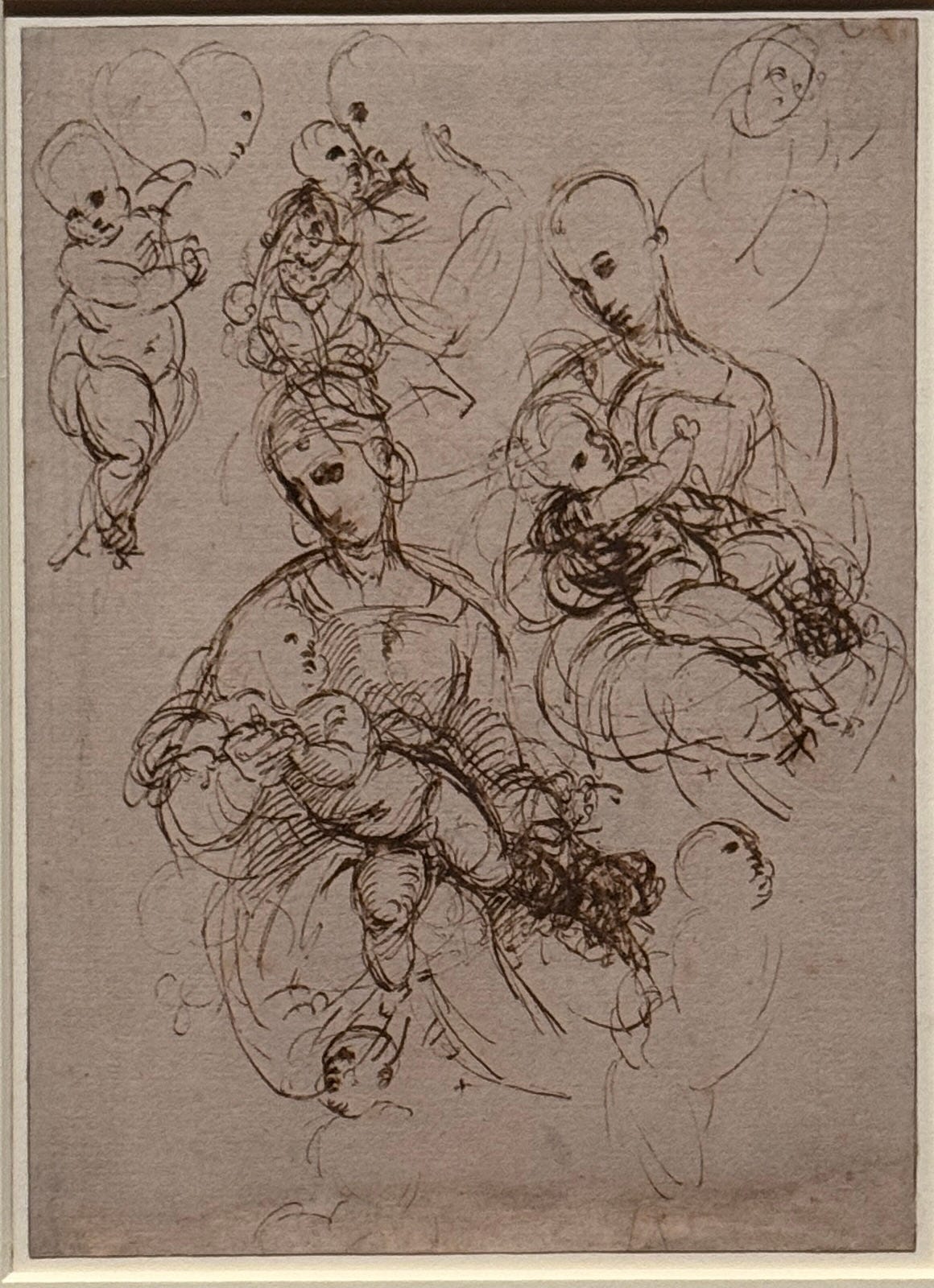
There is a stirring moment in the exhibition after Raphael goes to Florence and encounters the work of his contemporaries Michelangelo and Leonardo, especially the dynamic sketches of the latter. Unlike the finished preparatory drawings that he had learned from Perugino, Leonardo’s were energetic and messy like the fits and starts of a writer’s first draft. By learning to work this way, using drawing as an extension of thinking, Raphael’s compositions acquired a new spontaneity—great paintings, sculptures, and buildings are born of drawings that preserve the freshness of invention. What you see when Raphael absorbs this method is not influence in the Romantic sense—one genius bending to another—but a culture transmitting itself through responsive hands.
Some fifteen years after his death at 37—of sexual exhaustion according to colourful Vasari—another painter was born in Raphael’s native Urbino who would inherit the legacy of dolcezza. For me, Federico Barocci achieves what the tradition had been reaching for since Perugino, a project Raphael paused to decorate the Vatican with erudition and sobriety. Barocci worked without the humanist machinery of papal Rome—no Inghirami, no Castiglione, no Neo-Platonic programme to absorb and translate. Instead, he had the Counter-Reformation’s appetite for devotional affect and the memory of a pictorial tradition encoded in drawings. His sweetness is anchored in a firmer command of anatomy and a more adventurous palette than Raphael’s panels sustained. If Raphael was the avatar of humanist Rome, Barocci was the avatar of a different cultural moment—the post-Tridentine church’s hunger for painting that moved the faithful rather than educated them. The tradition transmitted itself between them across half a century, through the survival of images rather than personal succession. This is how skill advances in time: through emulation, consolidation, and transcendence.
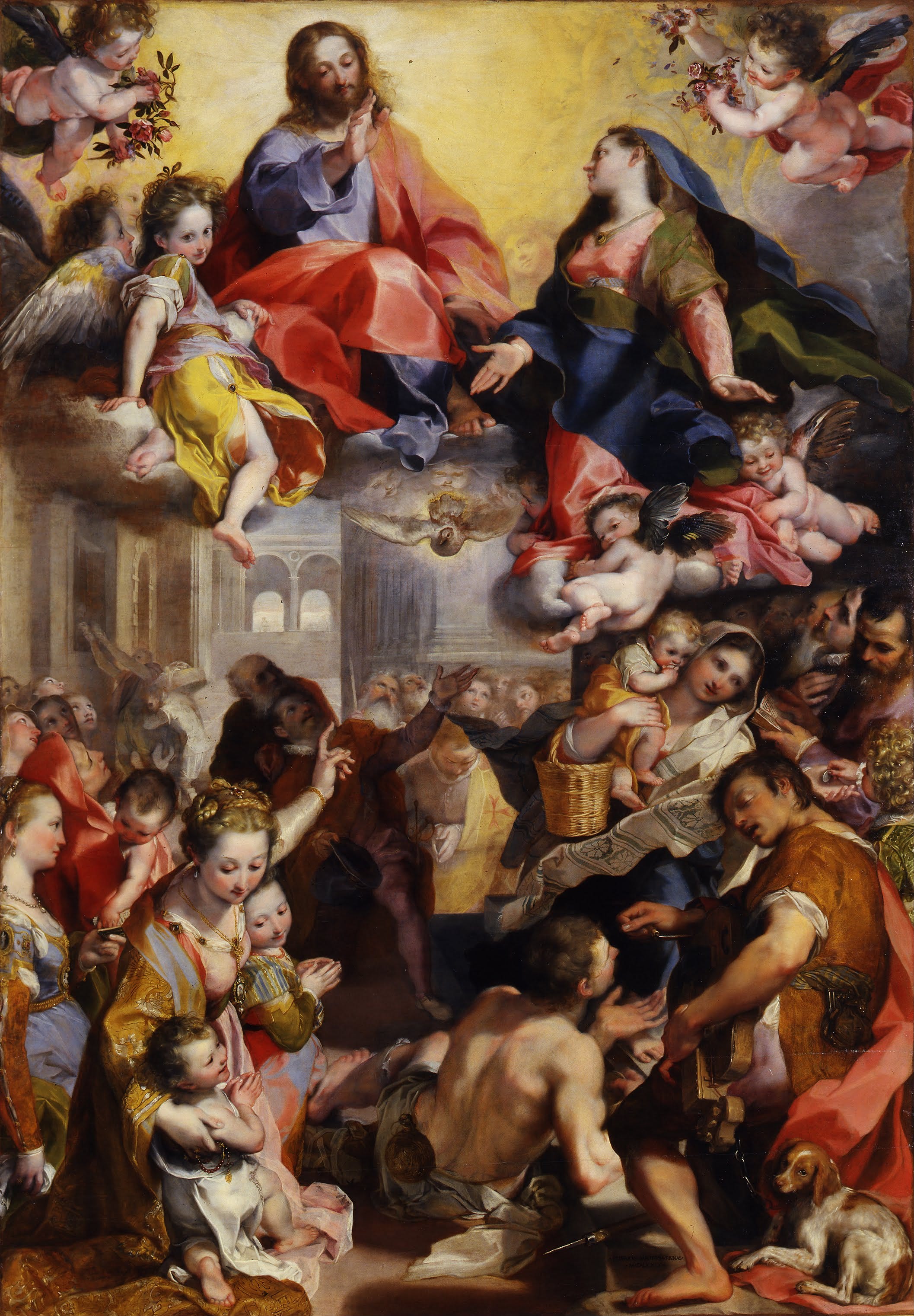
For a contemporary culture saturated with a surfeit of sensations, when so many of art’s miracles are accessible in museums and online, drawings do not enjoy the glamour they merit as the locus of creation. Either finished works in their own right or the material traces of thought as it occurred, drawings are specialist fetishes with a smaller audience. Despite Raphael’s long established “divinity” and the size of the exhibition, entrance to Sublime Poetry does not require a timed ticket. Although it was busy midweek, I had no trouble getting up close to the traces of a brilliant hand I often find awkward on panel—or rather, to the vestiges of a culture thinking through it.
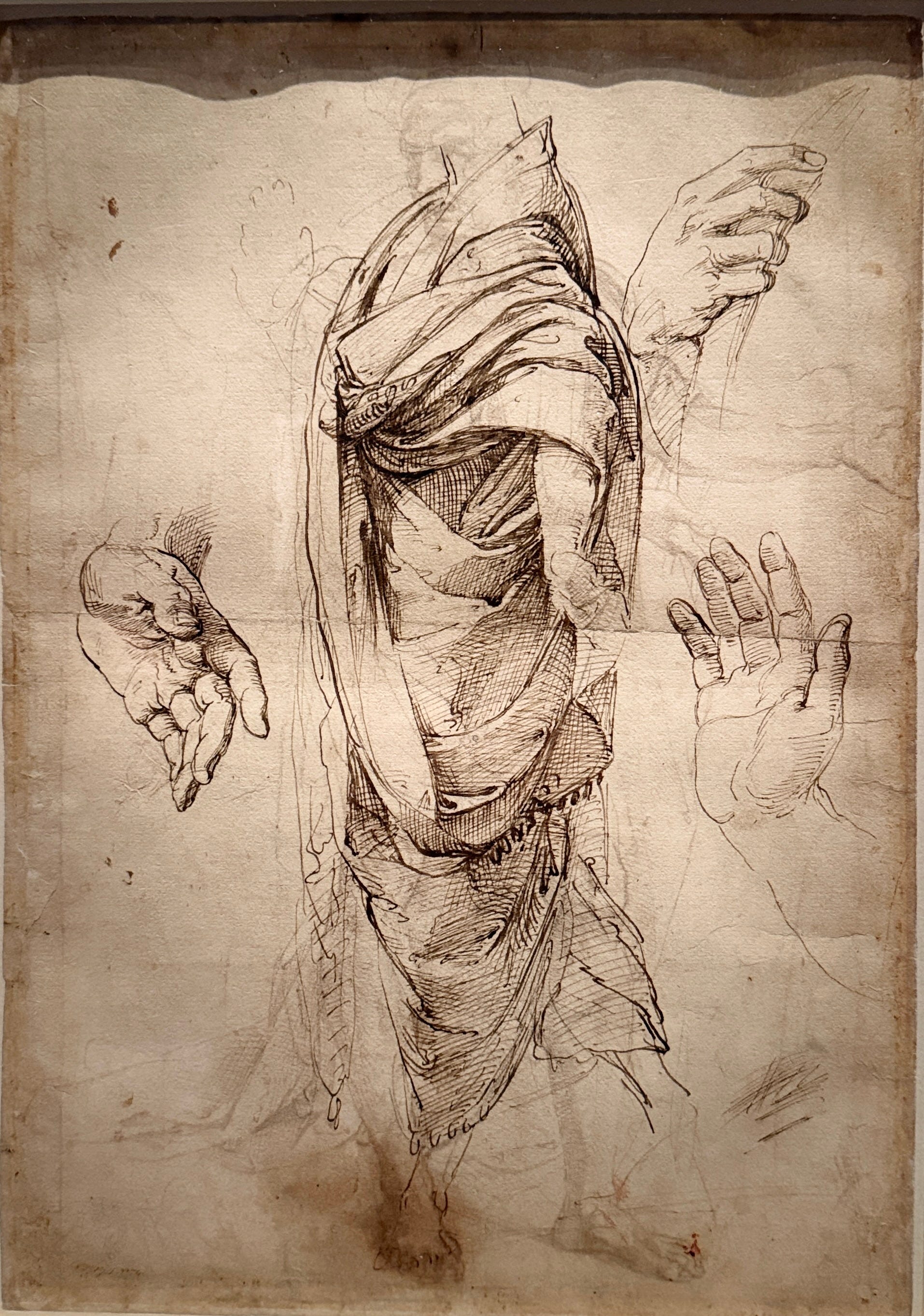
In Rome you encounter an ensemble: theology, philosophy, poetry, and justice on four walls, a coherence that no photographic documentation properly conveys. Some of the drawings now at The Met are among the earliest inklings of that coherence, relics of what a culture can produce when its best minds work in concert, and what no single mind could have conjured alone. That is what “divine” indicated before Vasari decided it was pointing at a man.
Marc, This post is divino! I love Raphael and I so appreciate all the background that you have given in this beautifully written piece.